
“I think things like art and culture are so vital to why we exist as people,” Steph Rue, an assistant professor and artist at the University of Iowa Center for the Book, told Iowa Capital Dispatch.
UNESCO is reviewing hanji, a traditional Korean paper made from mulberry bark, for inclusion on its Intangible Cultural Heritage of Humanity list. The University of Iowa remains the only U.S. institution teaching the craft at the master’s degree level.
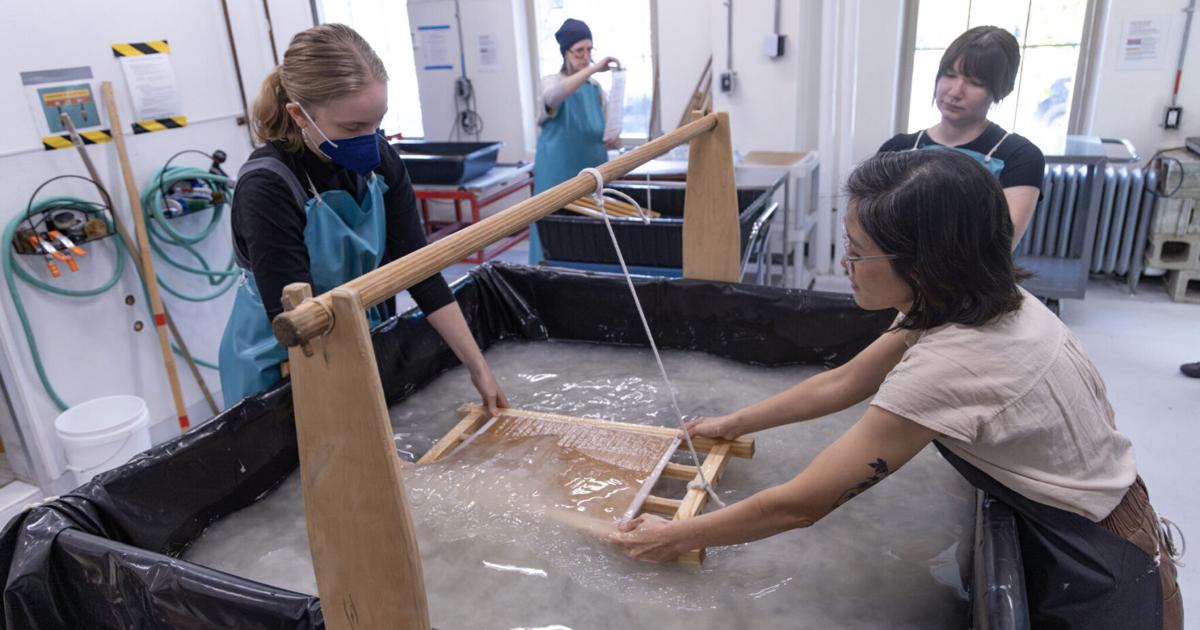
Rue earned her MFA from the Center for the Book in 2015 on a Fulbright scholarship before traveling to Korea to study hanji production. The process weaves fibers by dipping a bamboo screen side-to-side into a slurry of inner mulberry bark, creating sheets used for art, household objects, waterproof coatings, and textiles. Rue co-founded Hanji Edition with printmaker Lars Kim to produce art books and introduce the material to broader audiences.
Rue said only one person in Korea — a woman over 80 — still weaves the bamboo screens essential to production. Her husband, the recognized intangible cultural property holder for screen making, died several years ago. Conservation of dak, or paper mulberry trees, remains expensive and laborious, pushing many producers to import fibers from abroad.
“I don’t think it’s dying, I think it’s evolving, but I also feel like there could be a lot more support for some of those more vulnerable parts of the industry,” Rue told Iowa Capital Dispatch.
The Center for the Book has bucked a national decline in book arts programs. When Rue enrolled, five other U.S. universities offered MFA-granting book art programs; today only two remain. Rue credited the center’s survival to sustained support from the university and Iowa City.
Steph Rue earned her MFA from the University of Iowa Center for the Book in 2015 and holds a BA from Stanford University. As a 2015–2016 Fulbright Research Grant recipient to South Korea, she studied traditional Korean bookbinding, papermaking, and printing, focusing on hanji production.
That research informed her artistic practice and teaching specialization in East Asian techniques, which she has taught at Mills College, Penland School of Craft, and the San Francisco Center for the Book.
“Making things by hand, understanding where we come from and what our traditions are… I think that’s what makes us human, and that’s what makes it worth living,” she told Iowa Capital Dispatch.
Related reading
Aya Healthcare Lists Two Travel Cyto Tech Jobs in Oklahoma City
Aya Healthcare has posted two travel Cyto Tech job openings in Oklahoma City, Oklahoma, with a start date...

No. 2 Virginia 83, Xavier 71: Lewis (21), Gertrude (17) Lead Cavaliers Past Musketeers in Battle 4 Atlantis
No. 2 Virginia pulled away from Xavier for an 83-71 win Friday in the Battle 4 Atlantis Signature...

Maryland Seeks First Home Win Over Penn State Since 1961
Maryland has not beaten Penn State at home since 1961, a 65-year drought the Terrapins will try to...

No. 20 Florida Favored Over FSU With Bowl Bid at Stake
Florida (7-4, 5-4 SEC) is a 6.5-point favorite over FSU (5-6, 3-5 ACC) at Doak Campbell Stadium. Kickoff...