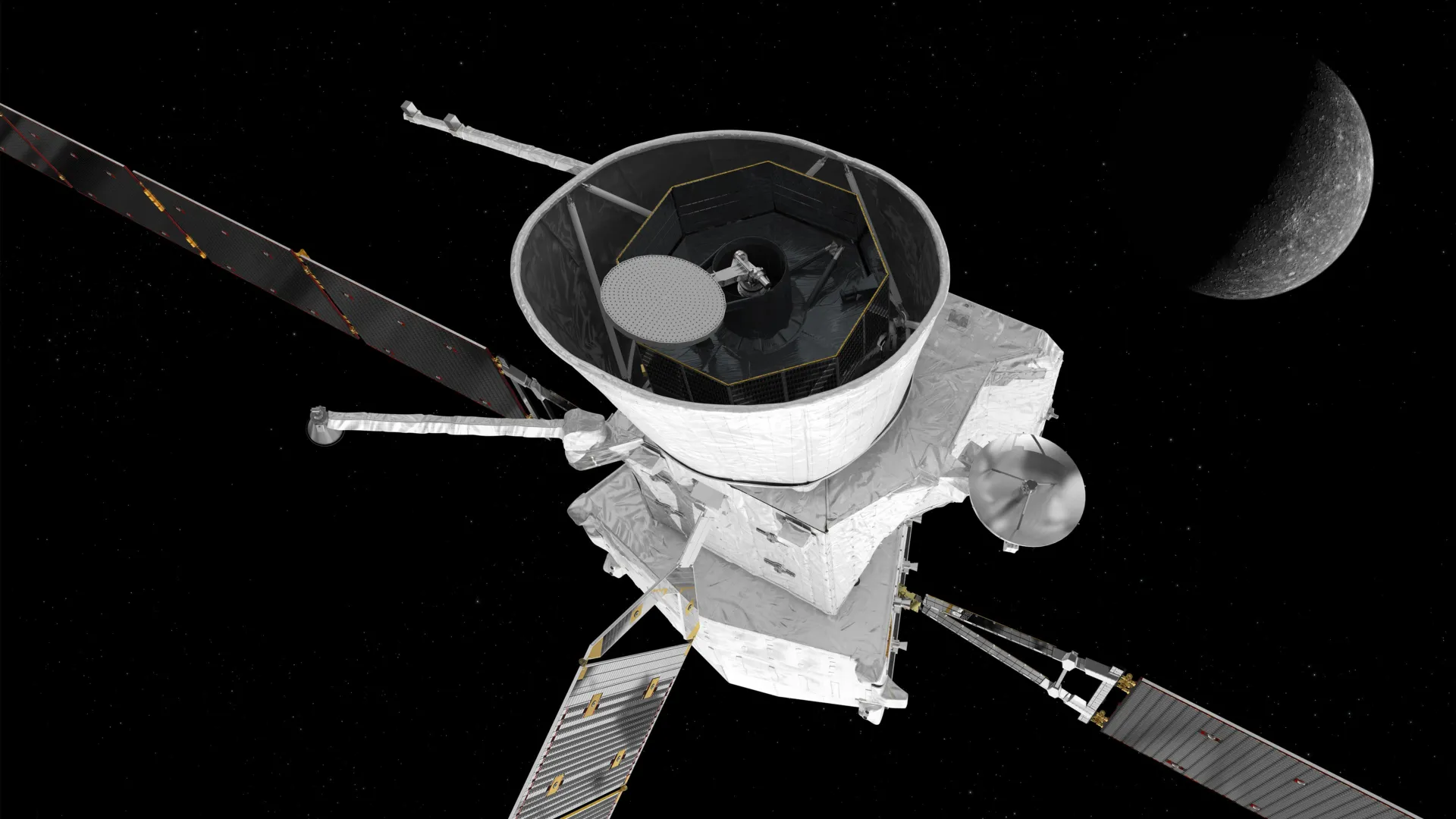
BepiColombo slipped into orbit around Mercury on November 21 after an eight-year, 10-billion-kilometer journey, becoming only the second spacecraft to circle the solar system’s innermost planet.
The European Space Agency confirmed orbital capture on November 23, but the arrival did not go as planned. A scheduled 37-minute thruster burn ended early, leaving the Mercury Planetary Orbiter in a 75-hour orbit instead of the intended 58-hour path.
Its highest point sits about 10,000 kilometers farther from the surface than designed. Engineers determined the partial burn still achieved roughly 77 percent of the required velocity change — enough for capture, but not for the science orbit.
“We've heard back from Bepi,” ESA posted on X after the tense communications blackout during the maneuver. Flight controllers in Darmstadt waited four hours before confirming the spacecraft was in a stable, if unexpected, orbit.
Thruster glitch reshapes mission
The premature cutoff stemmed from a timing mismatch between the spacecraft’s guidance software and its thruster controls — a problem that only appeared after the Mercury Transfer Module separated on September 3. “Since we separated from MTM in September, we are basically flying a new spacecraft,” ESA operations manager Ignacio Tanco told CNN. Commands now take about 20 minutes round-trip, forcing engineers to plan sequences days in advance.
Mission controllers considered attempting a second insertion burn but concluded the fuel cost would jeopardize the science phase. Primary science operations are still targeted for April 2027, though the altered orbit means additional maneuvers will be needed to lower the spacecraft into its final science trajectory.

MIXS telescope passes first test in deep space
Before orbital insertion, the UK-built Mercury Imaging X-ray Spectrometer (MIXS) captured its first astronomical X-ray images — observations of the Crab Nebula, 6,500 light-years away — during a September calibration campaign. The instrument, which uses novel micro-pore optics to achieve a one-meter focal length and a mass of just 11 kilograms, had been shielded inside the spacecraft stack for the entire cruise.
“We have waited a long time to make measurements with MIXS and it is fantastic to see it operating brilliantly in space. This is testament to our engineering and technical team, and our international partners who we have worked with over many years to build this incredible instrument. 80% of the technology on MIXS is new!” said Professor Emma Bunce, Principal Investigator (PI) for MIXS and Director of the Institute for Space at the University of Leicester.
The calibration also served as a health check after eight years in space.
Mercury’s origin clues drive mission goals
Planetary scientist Carolyn Ernst from the Johns Hopkins University Applied Physics Laboratory told Scientific American that the leading theory suggests Mercury’s material came from either a volatile asteroid or comet impact.
Prof Emma Bunce from Leicester University told BBC that Mercury is an under-loved planet in the inner Solar System, which makes it compelling, and explained that one explanation for its huge metal core is that the mantle was stripped away in a large collision early in its history.
David Rothery, a planetary geoscientist at the Open University in England, told Sky & Telescope that scientists do not understand what’s causing the volcanism observed on Mercury.

Sean Solomon of Columbia University, former lead for MESSENGER, told Scientific American that BepiColombo’s orbit should reveal whether features seen in the north are also found in the south, including by looking for signs of ice in shadowed craters.
Geraint Jones, ESA’s BepiColombo project scientist, emphasized the importance of the new scientific phase following years of preparation and navigation operations, according to ColombiaOne. The team will contrast relatively smooth areas with heavily cratered terrain to see if the fracture pattern backs the newest contraction estimates.
Two orbiters, one puzzling planet
BepiColombo carries two science orbiters: Mercury Planetary Orbiter (MPO) and JAXA’s Mercury Magnetospheric Orbiter (Mio). They are scheduled to separate in early December, after which Mio will deploy its 15-meter wire antennas and 5-meter magnetometer booms over roughly a month.
The pair will then settle into complementary orbits — MPO close to the surface for high-resolution mapping, Mio farther out to sample the magnetosphere — providing the first comparable coverage of both northern and southern hemispheres.
Previous missions left major gaps. NASA’s MESSENGER (2011–2015) followed an elongated orbit that favored the north; Mariner 10 only flew by in the 1970s.

BepiColombo’s dual-spacecraft design aims to close those gaps and tackle Mercury’s deepest mysteries: a core that extends 85 percent of the way to the surface (versus 55 percent for Earth), possible ice in permanently shadowed polar craters, and a surface that appears to be shrinking — a study published in September 2026 estimated the planet’s diameter has decreased by up to 23 kilometers since formation.
The BepiColombo mission, a joint endeavor of the European Space Agency (ESA) and the Japan Aerospace Exploration Agency (JAXA), became the second mission to orbit Mercury in November 2026.
It comprises two orbiters: the Mercury Planetary Orbiter (MPO), built and operated by ESA, and Mio (Mercury Magnetospheric Orbiter), built and operated by JAXA. Launched in October 2018, the spacecraft performed a comprehensive study of Mercury, including characterization of its magnetic field, magnetosphere, interior, and surface structure.
Its scientific goals include investigating the origin and evolution of a planet close to its parent star, Mercury’s form, interior, geology, composition, and craters, as well as the structure and dynamics of its magnetosphere and exosphere.
Commissioning continues through March 2027. The science phase is slated to begin April 6, 2027 — more than eight years after the October 2018 launch. Engineers will use the coming months to optimize MIXS and other instruments, adjust the orbit with additional burns, and prepare Mio for its magnetospheric survey.
Keep reading

Supreme Court Suspends Temple Trustees, Orders CRPF Security and Deepam Lighting at Thirupparankundram
The Supreme Court on Friday ordered the Karthigai Deepam to be lit on the deepathoon stone pillar atop...

Scammers Steal Photos of Dying Daughter to Fake Fundraiser
Scammers stole photos of a two-year-old girl fighting for her life in a hospital to create a fake...

Trump Pressures Intel Board Into 10% Equity Stake for CHIPS Grants
President Donald Trump pressured Intel's board into handing the U.S.

Berau Fire Volunteers Face Safety Risks as Occupational Health Is Overlooked
Volunteer fire groups in Berau face safety risks as occupational health and safety is overlooked in forest fire...