In the high-altitude forests of Costa Rica and the vast, rugged steppes of Asia, two University of Montana researchers are working to uncover the survival secrets of the world’s most elusive small cats.
As of November 17, 2026, Ph.D. student Amaia Autor and postdoctoral researcher Ehsan Moqanaki are bridging critical gaps in wildlife biology, focusing on species that have long been overshadowed by their larger, more famous relatives.
The stakes for these small felines are high. While lions and tigers often dominate global conservation efforts, smaller cats frequently suffer from a lack of scientific data, leaving researchers struggling to determine their population health or the specific threats they face. For many of these animals, the primary challenge is simply understanding where they exist and what barriers prevent them from thriving in their natural habitats.
Amaia Autor’s work in Costa Rica centers on the oncilla, a tiny cat often called the tigrillo. During her fieldwork in the Cordillera de Talamanca, Autor faced months of silence before finally capturing a small black cat with white feet, whom she nicknamed “calcetines.” Because so little is known about the species, she even had to modify a standard GPS collar by hand to ensure a proper fit.
“One thing that surprised me a lot was that their territories were a lot bigger than I expected, said Amaia Autor, a Ph.D. student in the University of Montana’s Wildlife Biology Program.”
Her data suggests that even small cats require significant space, with home ranges reaching nearly eight square miles. This discovery is vital for conservation planning, as it highlights how infrastructure—specifically the Pan-American Highway—fragments the landscape. While these cats often approach the road, they cross it only rarely, suggesting that targeted wildlife crossings could be essential for maintaining healthy, connected populations.
The Grumpy Face of the Asian Steppe
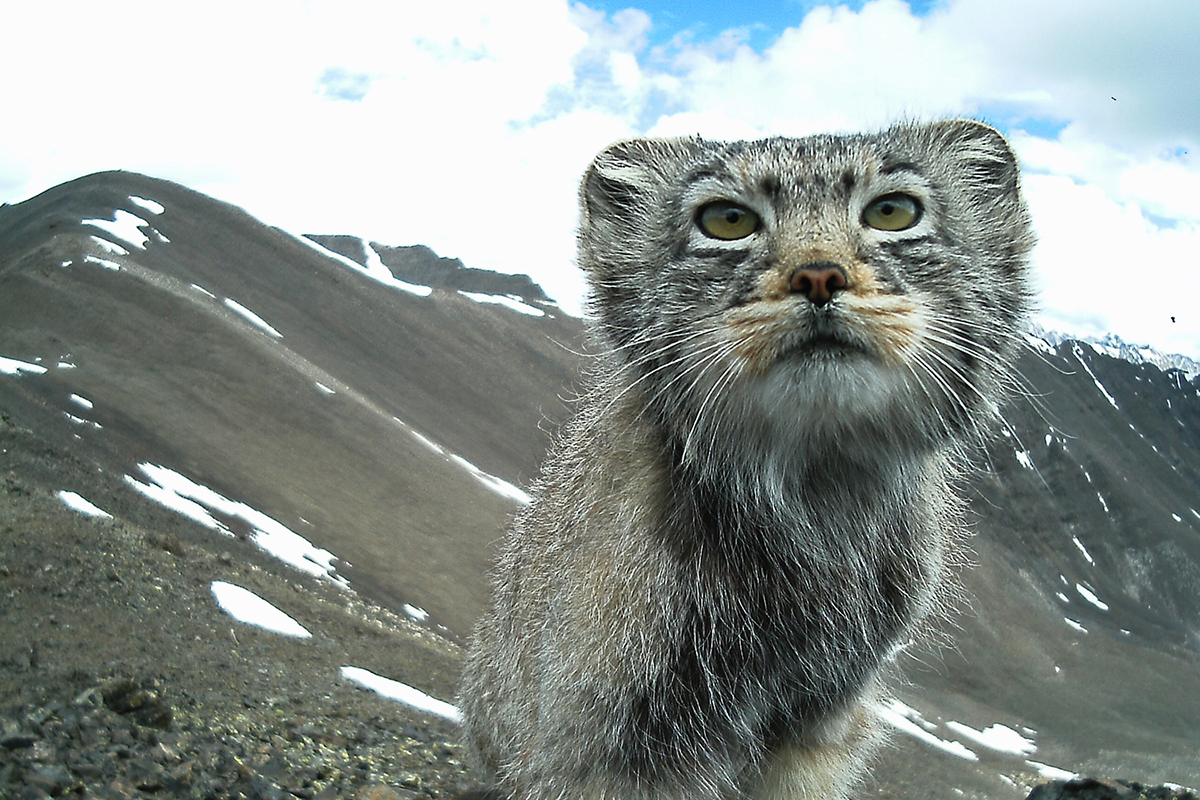
Half a world away, Ehsan Moqanaki is investigating the manul, or Pallas’s cat, a species known for its distinct, flattened face and grumpy expression. These cats inhabit high-elevation grasslands from the Caspian Sea to Siberia, yet their population status remains murky. Unlike the oncilla, which faces habitat fragmentation from roads, the manul is grappling with a shift in human land use.
As climate change alters grazing conditions in the lowlands, herders and their livestock are increasingly moving into higher-elevation steppe regions. This shift brings domestic dogs and human activity into direct competition with the manul. According to Moqanaki, these free-ranging dogs represent one of the most significant threats to the species.
“They are vulnerable to human modification of the landscape, said Ehsan Moqanaki, a postdoctoral researcher in the University of Montana’s Wildlife Biology program.”
The challenge for conservationists is that current population estimates often rely on broad, regional data. While the manul as a whole is not classified as threatened due to large populations in China and Mongolia, smaller, isolated groups may be on the brink of collapse.
Moqanaki’s team is now using a network of wildlife cameras—typically reserved for monitoring snow leopards—to identify previously unknown pockets of manul activity and provide data for more precise conservation protections.
Data Gaps and Future Protections
Autor and Moqanaki's work shows a fundamental problem in modern conservation: we cannot protect what we have not yet measured. For the oncilla, the recent scientific reclassification of the tilcayo as a separate species shows how much about feline biodiversity is still unknown. For the manul, the lack of quantified impacts from threats like changing snowpack and pest control measures makes it difficult to design effective policy.
Both researchers are now working to turn these individual field observations into actionable guidelines. Moqanaki has already published a book of standards for monitoring manuls, aiming to standardize how scientists track these cats across borders. By combining genetic data from scat, community interviews, and camera-trap footage, they are building a more comprehensive picture of species that were, until recently, largely invisible to science.
The question of how these small cats will adapt to an increasingly human-modified landscape remains open. While Autor continues to analyze the movement patterns of the oncilla in Central America and Moqanaki works to update the conservation status of manul populations across Asia, the success of their efforts will depend on whether this data can be translated into meaningful habitat restoration and policy changes.
For now, the researchers remain focused on the immediate task of filling the map, one GPS coordinate at a time.

Campbell University Meets Oklahoma at Lloyd Noble Center Wednesday Night
Campbell University travels to the Lloyd Noble Center on Wednesday night to face the University of Oklahoma in...

Rhoades Says Penn State Needs High-Level Basketball Hosting IU Indianapolis
Penn State demands more as they host IU Indianapolis Wednesday. The Nittany Lions, sitting at 4-1, are building...

Springfield Farmers Market Offers Thanksgiving Items November 21
Springfield Farmers Market offers Thanksgiving items Saturday, Nov. 21. The season of giving and sharing centers on the...

Lions Consider Former Boise State Star Hassanein for Hutchinson Replacement
The Detroit Lions are adjusting to a sudden, high-stakes change in their defensive front following a bittersweet weekend...