
“This is a consensus decision,” acting Army Secretary Adam Telle posted on social media Monday.
The U.S. Army detonated 68 barrels of degraded lead azide at the Iowa Army Ammunition Plant near Middletown at approximately 9 a.m. CST on Wednesday, following a federal appeals court ruling that lifted a temporary pause on the operation.
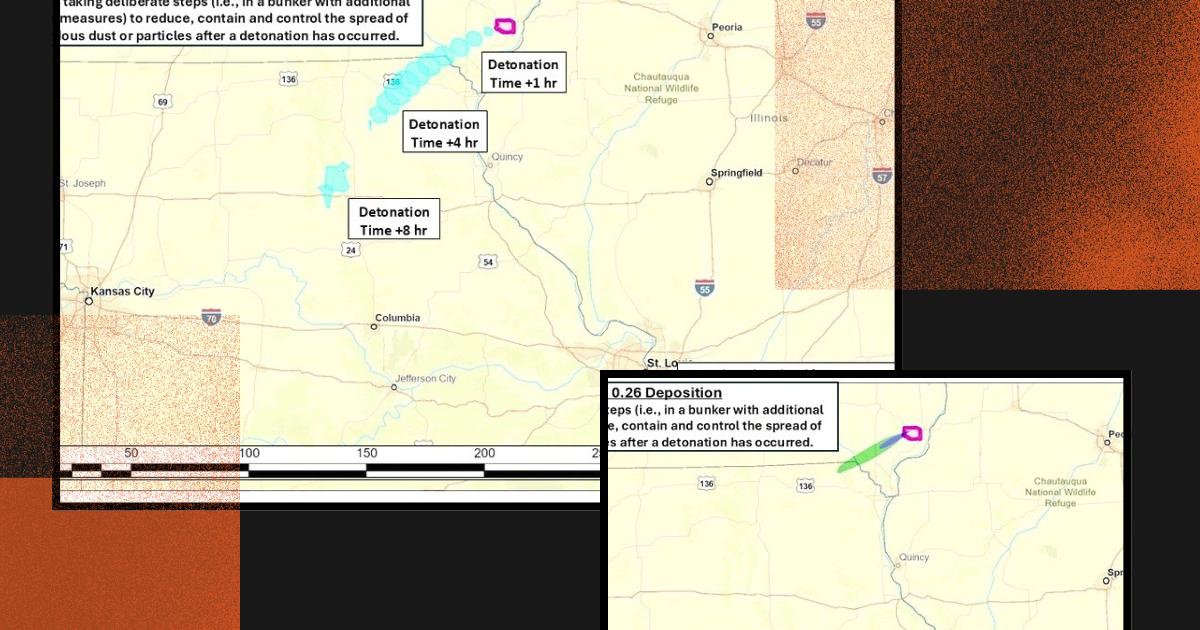
The controlled blast dispersed a plume of lead particles southwest toward northern Missouri, according to dispersion models released by the Army and monitored by the University of Iowa and NASA.
My office is continuing to monitor the planned detonation at the Iowa Army Ammunition Plant on Wednesday and I remain in contact with officials at the White House and the Army. Protecting the health and safety of people in surrounding communities must come first, and every…
Emergency timeline and court fight
Plant staff discovered crystallized lead azide during a routine inspection on March 11, 2026, creating what the Army called an “unacceptable risk of accidental detonation,” according to its public safety advisory. The material, used in munitions detonators, had been stored at the plant since 2009 after being consolidated from bases nationwide, Task & Purpose reported.
Environmental groups sued to stop the initial Nov. 20 detonation date, prompting a federal court to pause the Army’s emergency EPA permit. The Justice Department argued the permit was unnecessary given the immediate threat. A three-judge panel of the 8th U.S. Circuit Court of Appeals lifted the pause late Sunday, AP News reported, allowing the rescheduled Wednesday blast.
Plume maps and health thresholds
Army dispersion models showed lead dust traveling southwest over an eight-hour window. Surface deposition maps outlined two scenarios: a lighter coating of 5 micrograms per square foot and a heavier concentration of 100 micrograms per square foot near the site — both thresholds the EPA uses to trigger professional cleanup inside homes and daycares, Iowa Public Radio reported.
“The lead is going to fall out relatively rapidly from the plume,” Matt Taraldsen, a supervisory meteorologist at the Minnesota Pollution Control Agency, told MPR News. “Areas immediately downwind are going to get quite a bit of lead dust.”
Evacuations and agricultural impact
Approximately 400 Middletown residents evacuated due to shockwave risks, and the town library closed for the weekend, posting on Facebook that “no amount of lead exposure is safe,” Futurism reported. The Iowa Department of Agriculture estimated 350 farms lay in the plume’s path.
Secretary Mike Naig said the state is working with the USDA to test forage and livestock to ensure “Iowans are fully compensated” for losses. Hamilton said that the maps shared by the Army represent “some of the worst case scenarios” of the lead dispersion.
Contractor history and missed alternatives
American Ordnance, a Day & Zimmermann subsidiary, has operated the plant since 2008. The EPA fined the company and the Army $39,311 in December 2024 for hazardous-waste violations in 2023, and OSHA cited American Ordnance in October 2024 for a serious violation involving TNT exposure monitoring, Military.com reported.
Emails reviewed by The Washington Post show American Ordnance sought a chemical neutralization proposal from MuniRem Environmental in September 2025 — six months before the Army said it discovered the hazard. The Army later rejected the method, saying an expert panel found it carried too great a risk of triggering a spontaneous explosion.
“Every viable option that we received, it was considered,” Col. Aaron Teller, commander of the 71st Explosive Ordnance Disposal Group, said at a press conference covered by Task & Purpose. “Experts were never able to find a viable alternative.” Telle said the Army wanted to “prevent” a detonation because of the risk associated with it, but experts “were never able to find a viable alternative.”
USDA is on the ground in Iowa, working with state agriculture officials to support farmers and ranchers who may be affected by the U. S. Army’s planned detonation in Middletown, slated for 9:00 AM CT. Under Secretary Richard Fordyce is coordinating with Iowa and Missouri… pic.twitter.com/BccLlFmcDE
Precedent and next steps
The Army’s last major lead azide disposal, in 1977, involved nearly 7,000 pounds with “zero mitigation” measures; 25% of lead particles entered the atmosphere, Teller said. “We believe we can significantly reduce that last 25% with the mitigation strategy that we have in place,” he said about the Iowa plan. The service believes current mitigation can “significantly reduce that last 25%.”
“Once we do it, then it becomes considered a viable option for other situations in other places,” Peter Thorne, a University of Iowa professor, told Iowa Public Radio. “So, we expose Iowans this time, but how many more times will we think of doing this and think it’s okay now?”
Thorne announced Tuesday a “thorough examination” of all U.S. weapons storage facilities to “ensure that something like this never happens again,” Task & Purpose reported. “We will be examining every single storage facility across the U.S.”
To farmers and livestock producers in southeast Iowa and northeast Missouri: USDA is on the ground to help ahead of the U. S. Army’s planned detonation in Middletown, Iowa. Under @SecRollins’ leadership, USDA is coordinating with @IAGovernor, @MikeNaigIA and Missouri agriculture…
University of Iowa and EPA teams are conducting air and soil sampling this week; results are expected within a week, Iowa Public Radio reported.
Keeping Missourians safe also means keeping Missourians informed with facts. Tomorrow's federal operation at the Iowa Army Ammunition Plant is taking place to reduce the risk of an uncontrolled, spontaneous explosion. The federal multi-agency team planning the detonation is…
Worth a look

COP31 Collapses Without Agreement as EU, Pacific Reject Fossil-Fuel Omission
COP31 collapsed in Antalya, Türkiye, on Sunday without a cover decision, the first such breakdown since Copenhagen in...

A Senior U.S. Lawmaker Warned European Allies Not to “Backslide” on Defense Spending
A senior U.S. lawmaker warned European allies not to “backslide” on defense spending as EU leaders prepare to...

Ireland to Pilot Electronic Tagging for Up to 150 Inmates to Ease Overcrowding
Up to 50 ankle tags will monitor 90–150 people over one year. Prisons hold 700 inmates above capacity;...

Study Links Air Pollution Metals to Asthma Mechanism; CaSR Block May Help
Researchers have identified a biological mechanism linking metal particles in air pollution to asthma attacks and chronic bronchitis,...