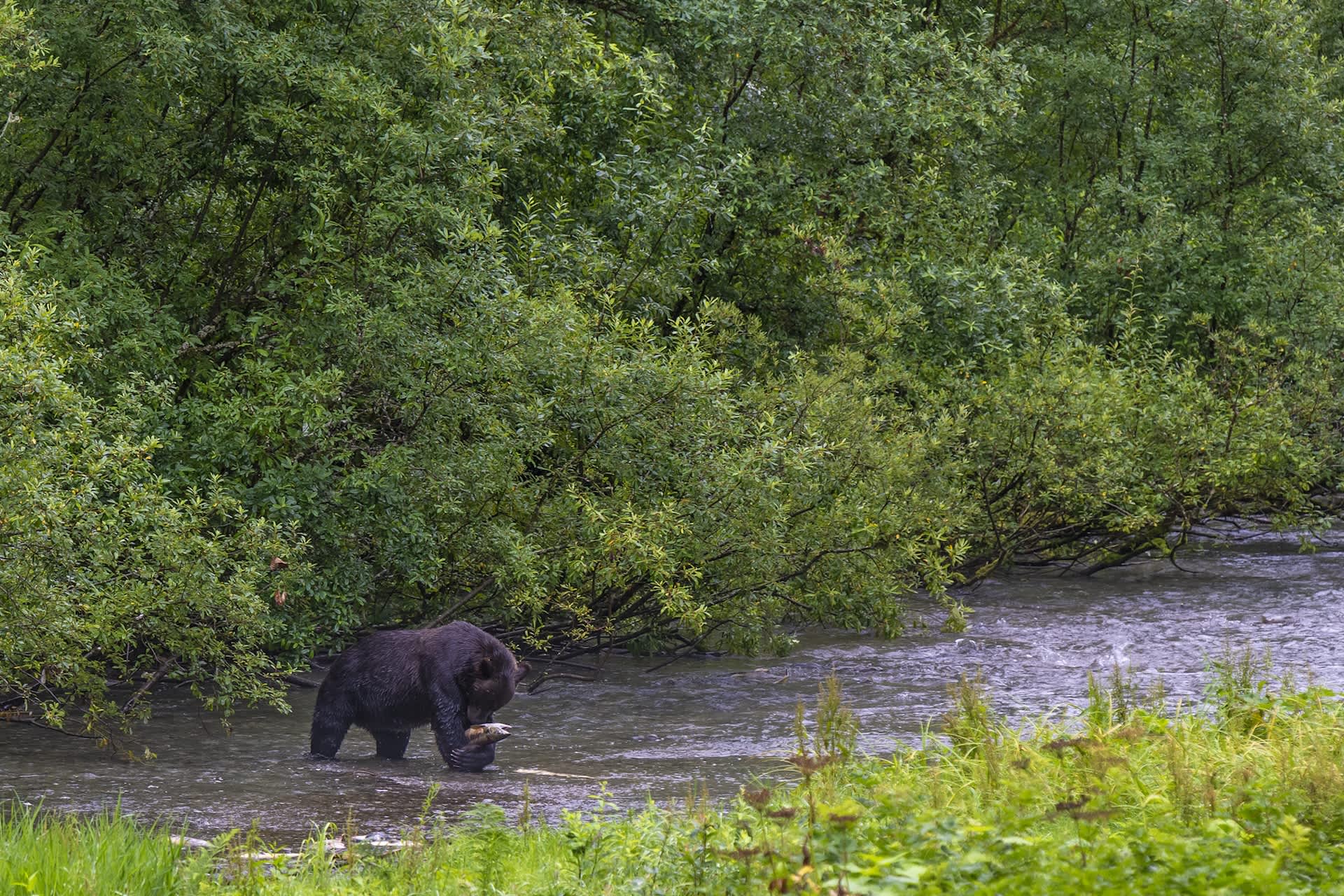
The U.S. Forest Service ordered staff to exclude known bear dens from logging plans for a Tongass National Forest timber sale, More Than Just Parks reported.
Acting Forest Supervisor Janelle Crocker rejected additional buffers or seasonal restrictions for two dens found in old-growth trees slated for clearcutting on Prince of Wales Island. “Do not include bear dens or timing restrictions in the unit cards,” Crocker wrote in a July 16 email to staff, according to internal records obtained by More Than Just Parks. The October logging plan for Unit 346 omitted the den documented there.
Wildlife surveyors discovered a spacious bear den beneath an old-growth spruce in Unit 346 on June 23, 2026. A second den was found inside a cedar in July. A Forest Service wildlife biologist warned that protecting individual den trees would still leave them vulnerable to being blown down, the records show.
The Twin Mountain II timber sale targets 1,738 acres of old growth and would yield an estimated 26.4 million board feet of timber, More Than Just Parks reported.

A federal court overturned the project’s logging and road-building approvals in 2020 because the Forest Service had not adequately examined site-specific consequences. After that ruling, the agency faced pressure from Washington to accelerate Twin Mountain II. An April 2026 timetable gave staff only 11 calendar days after public comments closed to prepare responses, finish the environmental review, and ready the draft decision, More Than Just Parks reported.
Crocker cited unfinished tribal work and a publication deadline as reasons to leave out a Cultural Tree Plan associated with the Central Council of Alaska’s Tlingit & Haida Indian Tribes. The agency missed that deadline anyway. A Government Accountability Office report published in June 2026 found a roughly 20% decline in Forest Service staffing during 2025, straining its ability to meet increased timber targets, according to More Than Just Parks.
The final logging decision remains unsigned. More Than Just Parks identified an objection deadline of 11:59 p.m. Alaska time on Nov. 30, 2026, and directed readers to its Twin Mountain II action page for instructions on submitting objections directly to the Forest Service. The outlet urged people citing discoveries made after public comments closed, like the bear dens, to identify that evidence and explain why they could not have raised it earlier.
The Forest Service says the sale would support regional timber businesses and employment. Its environmental review identifies a smaller alternative that would meet the project’s purpose while reducing the affected old-growth acreage by roughly 600 acres, according to More Than Just Parks. The draft decision favors the larger sale.
Prince of Wales Island anchors the ecological integrity of the Tongass, hosting extensive old-growth stands that shelter American black bears and grizzly bears (Ursus arctos terribilis) within the Karta River and South Prince of Wales Wilderness areas.
As the fourth-largest U.S. island at 2,577 square miles, Prince of Wales Island contains endemic subspecies like the Prince of Wales flying squirrel and island ermine found nowhere else, underscoring its role as a biodiversity reservoir within the national forest.
“Twin Mountain II is the second large-scale, destructive old-growth timber project proposed this year by the Forest Service within the Tongass,” Earthjustice attorney Kate Glover told More Than Just Parks. “We oppose both projects as we also prepare to fight a possible management shift away from old-growth protections to increased logging of these ancient trees.”
Related reading

Santa Clara Edges Texas Tech 75-73 in Paradise Jam Championship
Texas Tech fell to Santa Clara 75-73 in the Paradise Jam championship game Saturday in St. Thomas. The...
Detroit Catholic Central Overwhelms Romeo 47-7 to Repeat as MHSAA Division 1 Champion
Detroit Catholic Central overwhelmed Romeo 47-7 to repeat as MHSAA Division 1 state champion on Saturday at Ford...
USA TODAY Network Writers Pick 2026 AHSAA Football, Flag Football Champions Before Playoffs
USA TODAY Network writers Jaeden Day, Maxwell Donaldson and Amelia Hurley published their 2026 AHSAA football championship picks...

American Eagle Jet Slides Off Wet Taxiway at Provo Airport; No Injuries
An American Eagle jet bound for Dallas‑Fort Worth was scheduled to leave Provo at 7:05 a.m. Saturday; instead...