
U.S. stock futures were little changed Tuesday night after a technology-led selloff pulled the S&P 500 and Nasdaq Composite lower during the regular session, according to CNBC World.
S&P 500 futures and Nasdaq-100 futures advanced 0.06% and 0.2%, respectively, paring earlier losses that had seen Dow futures down 0.33%, S&P 500 futures down 0.65% and Nasdaq-100 futures down 1.17% at 9:51 p.m. EST.
The Nasdaq Composite shed 356 points, or 1.48%, to close at 23,733.54, while the S&P 500 declined 0.5% to 7,201.09. The Dow Jones Industrial Average rose 0.85%, or more than 400 points, to 50,018.70, outperforming as it has less exposure to technology shares.
The retreat in tech equities followed a sharp rally Monday. Nvidia shares gave back gains tied to Jensen Huang’s return, and Anthropic fell below its IPO price. The iShares Semiconductor ETF (SOXX) plunged more than 8% and the VanEck Semiconductor ETF (SMH) lost more than 7% at the close, Stocktwits reported.
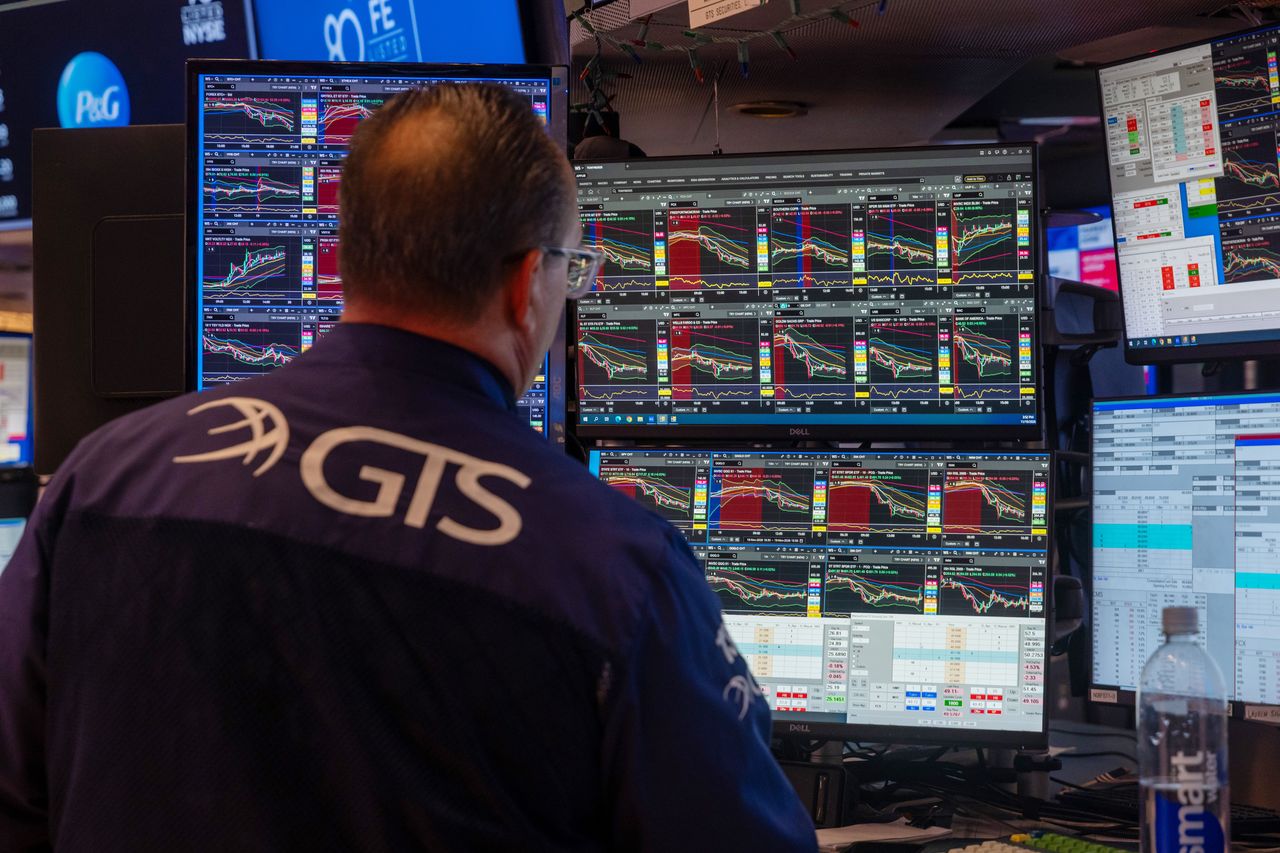
Traders are now focused on the October Personal Consumption Expenditures (PCE) price index, the Federal Reserve’s preferred inflation gauge, due Wednesday at 8:30 a.m. ET. Forecasters polled by Dow Jones expect the headline reading to rise 0.3% for the month and 3.8% year-over-year, with core PCE seen increasing 0.3% month-over-month, CNBC World said.
The report arrives ahead of the Fed’s December policy meeting. Data from the CME FedWatch tool show a 96.4% probability of a 25-basis-point rate hike and a 3.6% chance of a 50-basis-point increase, Stocktwits reported.
Market commentators offered divergent views on the outlook. Ed Yardeni, president of Yardeni Research, called the post-Huang reversal a potential “one-day wonder” and argued the Fed should hike by 50 basis points. James E. Thorne, chief market strategist at Wellington Altus, said Huang’s reinstatement and falling energy prices have brought stability and advocated for rate cuts in 2027, Stocktwits reported.
Mohamed El-Erian, chief economic advisor at Allianz, warned on X that the market is providing “warning signals, especially with respect to technicals,” extending well beyond Nvidia. “The key question now is whether bad technicals risk becoming back fundamentals,” he said. Jurrien Timmer, director of global macro at Fidelity Investments, noted the S&P 500 is down 12.3% from its Oct. 6 intraday high, calling it a garden-variety correction, Stocktwits reported.
The Kobeissi Letter posted on X that inflation remains America’s biggest concern, with 40% of U.S. consumers expecting their financial situation to deteriorate over the next 12 months, the second-highest reading on record, Stocktwits reported.
Related reading
South Carolina Court Upholds Mastercard Tax Assessment on In-State Card Transactions
South Carolina's Court of Appeals ruled on October 21, 2026, that Mastercard International owes corporate income tax on...

6 Hospitalized, 1 Critical, 16 Displaced in Allentown Fire Days Before Thanksgiving
A fire on the 600 block of West Turner Street displaced 16 people and sent six to hospitals...

Idaho Governor Grants State Employees Extra Paid Day Off After Thanksgiving
Idaho Gov. Brad Little announced Monday that eligible executive branch state employees will receive an additional paid day...

Trump Approves Major Disaster Declaration for Florida Flooding; Brevard Among Counties Eligible for FEMA Aid
The declaration covers severe storms and flooding that began Oct. 31 and continuing, FEMA said. Individual assistance —...