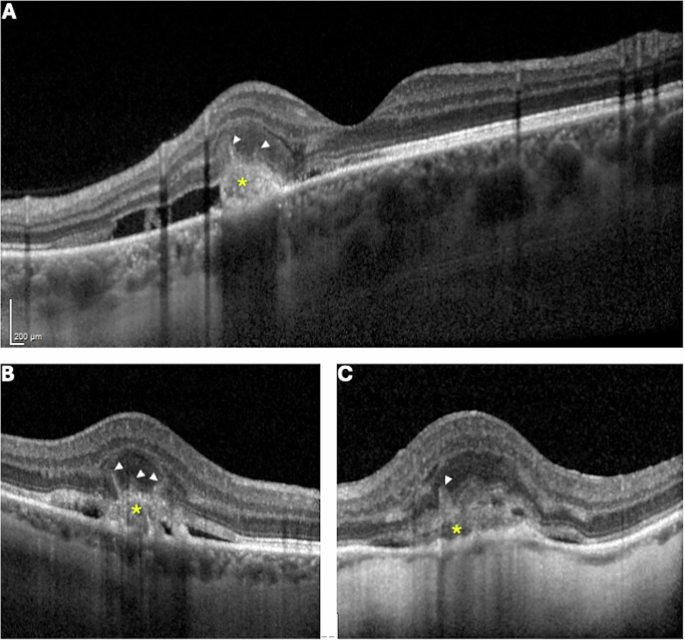
A distinctive optical coherence tomography pattern — the “pitchfork sign” — helps distinguish inflammatory choroidal neovascularization from other forms, researchers report in Nature.
The sign, first described by Hoang and Freund in 2013, appears as a bifurcated hyperreflective structure at the neovascular complex on OCT. Falavarjani and colleagues reappraised it using en face OCT in 2019, while Zicarelli et al. correlated OCT features with age, gender and underlying disease in 2021. Recent comparative work now maps the sign across inflammatory and non-inflammatory etiologies, including punctate inner choroidopathy, tuberculosis, syphilis and choroidal osteoma.
“The pitchfork sign: a distinctive optical coherence tomography finding in inflammatory choroidal neovascularization,” Hoang and Freund wrote in Retina.
Comparative imaging across etiologies
Studies since 2019 have documented the sign in tuberculosis-associated CNV, acute syphilitic posterior placoid chorioretinitis, and CNV secondary to choroidal osteoma with focal choroidal excavation. Ramtohul, Comet and Denis reported it in tuberculosis in 2019. Christakopoulos and Munch described it in syphilis the same year. Rajabian, Arrigo, Grazioli, Sperti, Bandello and Battaglia Parodi identified it in choroidal osteoma in 2021.
Gao, Ma, Zhang, Shang and Duan compared spectral-domain OCT biomarkers across multifocal choroiditis, myopic CNV and idiopathic CNV in 2021. Bottazzi, Barlocci, Sacconi, Battista, Servillo, Beretta and colleagues compared one-year outcomes of choroidal neovascularization secondary to punctate inner choroidopathy versus myopia in a 2025 study.
Researchers proposed new signs and standardized reporting for neovascular AMD
Giuffrè, Marchese, Fogliato, Miserocchi, Modorati, Sacconi and colleagues proposed the “sponge sign” as another novel feature of inflammatory CNV in 2021. Spaide, Jaffe, Sarraf, Freund, Sadda, Staurenghi and others standardized reporting for neovascular AMD in 2020.
Researchers report the pitchfork sign findings in Nature, the British weekly international scientific journal publishing peer-reviewed research across the natural sciences, including biology and interdisciplinary fields. Nature operates editorial offices in London, the United States, continental Europe, and Asia under Springer Nature and maintains an acceptance rate below 8% for submitted papers, reflecting rigorous editorial standards focused on technical readability.
For ophthalmology research, Nature’s peer-review process involves evaluation by expert referees who assess methodological rigor, novelty, and clinical relevance before acceptance. The journal’s multidisciplinary scope and high impact factor of 50.5 (2022 Journal Citation Reports) ensure that accepted studies on optical coherence tomography biomarkers reach a broad scientific audience across biology, physics, and clinical medicine.
Gelormini, Parisi, Vallino, Ricardi, Marolo, Borrelli and colleagues documented a pitchfork sign following pars plana vitrectomy for idiopathic epiretinal membrane in 2024.
Related reading

Prabowo May Visit Baku in 2027 for 35th Anniversary of Diplomatic Ties, Envoy Says
Indonesian President Prabowo Subianto may visit Baku in 2027 for the Organisation of Islamic Cooperation summit, Indonesia’s ambassador...

ESA’s Hera Arrives at Didymos to Assess DART Impact Damage
Hera is a sort of Inspector Columbo going back to the crash scene to investigate what is the...

Dublin City Council to Ban Lorries Without Blind-Spot Cameras by End of Next Year
Dublin City Council will ban large articulated lorries from the city centre next year unless they are fitted...

One in Three 16-24s in Britain Never Had Sex, Natsal-4 in Lancet Finds
One in three 16- to 24-year-olds in Britain have never had sex, a proportion that has nearly doubled...