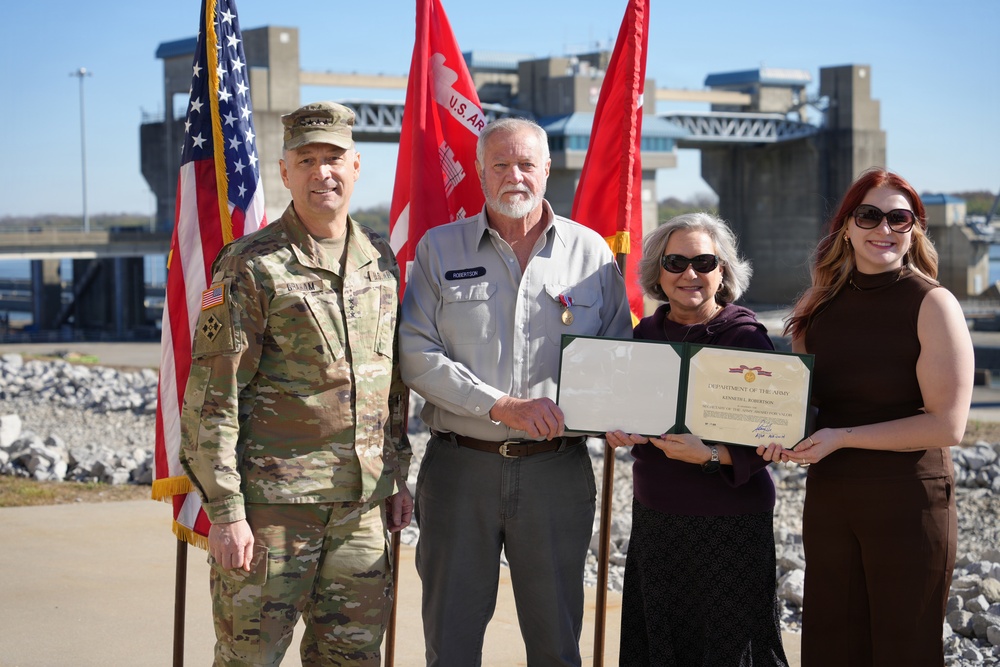
“Ken, your courage and judgment gave seven people the chance to reach safety,” Lt. Gen. William H. “Butch” Graham Jr. told the gathering at Olmsted Locks and Dam on Monday.
With those words, the Chief of Engineers pinned the Secretary of the Army Award for Valor on Kenneth Robertson, a boat pilot at the Ohio River facility, for a rescue that played out in the current of the river last July.
The honor is one of the highest the Department of the Army can bestow on a civilian employee, reserved for acts of extraordinary heroism where the recipient’s own life is at risk, army.mil reported.
The citation reads like a thriller script: a powerless towboat drifting toward an open dam gate, seven crew members trapped aboard, and Robertson steering his own vessel into the suction to pin the drifting boat against the guide wall until everyone escaped. Only then did the current seize his pilothouse, drag it beneath the gate, and capsize it. He surfaced from the flooded cabin. All seven teammates survived.
The mission and the moment
Olmsted Locks and Dam sits on the Ohio River. The Louisville District crew there works largely out of public view, maintaining the flow of grain, coal, and manufactured goods that underpin regional economies.
“Like generations of river crews before them, they work behind the scenes to keep commerce moving,” Waylon Humphrey, Louisville District Operations Division chief, said at the ceremony. “Our nation’s security and economic prosperity depend on that daily work.”
On a July 2025 shift, the routine shattered. Robertson, at the helm of a district work boat, did not wait for orders. He positioned his craft between the disabled tow and the gate, using his hull as a brake against the guide wall.
The maneuver bought the seven crew members time to evacuate. The current then overpowered his vessel, sweeping it under the gate and flipping it. Robertson escaped the submerged pilothouse and was recovered downstream.
Valor in civilian service
The Secretary of the Army Award for Valor represents one of the highest levels of recognition the Department of the Army can bestow upon a civilian employee.
Graham, the 56th Chief of Engineers, framed the distinction in his remarks: “We are recognizing a teammate who acted without hesitation when others needed him. And we are recognizing a team that understood, in that moment, that the most important mission was getting everyone home safely.”
“Mission accomplishment and taking care of people are never separate responsibilities.”
— Lt. Gen. William H. “Butch” Graham Jr., Chief of Engineers and Commanding General, USACE
Humphrey echoed the sentiment, tying the individual act to the culture of the lock crew. “When his teammates called for help, Kenny steered toward danger, showing the courage and selflessness that define this crew,” he said. “It’s a privilege to serve alongside people who are as committed to one another as they are to the mission.”
The award citation, read aloud as Graham pinned the medal, formally credits Robertson with saving seven lives and notes that his actions “reflect distinct credit upon himself, the Louisville District, the Great Lakes and Ohio River Division, the United States Army Corps of Engineers, and the United States Army,” DVIDS reported.
Olmsted Locks and Dam sits on the Ohio River at river mile 964.4, about 17 miles upstream from where the Ohio meets the Mississippi at Olmsted, Illinois. It replaced the aging and frequently congested Locks and Dams 52 and 53, where transit could take 15 to 20 hours; the new complex cuts passage to under one hour.
The project became fully operational on August 30, 2018, after a 30-year effort that grew from a $775 million authorization in 1988 to a final cost exceeding $3 billion, making it the largest and most expensive inland waterway project in U.S. history.
The ceremony at Olmsted on Monday brought the district’s leadership and workforce together to witness a rare moment: a river pilot honored not for moving cargo, but for refusing to let the river take his crew.
Related reading
Stanford Hosts Sacramento State Thursday Night After Comeback Win
Stanford heads into Thursday night's home date with Sacramento State carrying a 4-1 record and a hard-earned belief...

Apache Junction Father Killed, Wife and Two Daughters on Ventilators After Head-On Crash on US 191 Near Safford
A head-on collision on U.S. 191 near Safford over the weekend killed Aaron Johnston and left his wife...

The Family Initiative Names Melissa Briggs Next CEO for January 2027 Transition
The Family Initiative named Melissa Briggs its next president and chief executive officer Thursday, setting up a January...
No. 4 Virginia Plays Loyola Maryland Friday for 7-0 Start
No. 4 Virginia takes a 6-0 record into John Paul Jones Arena on Friday night for a 7...