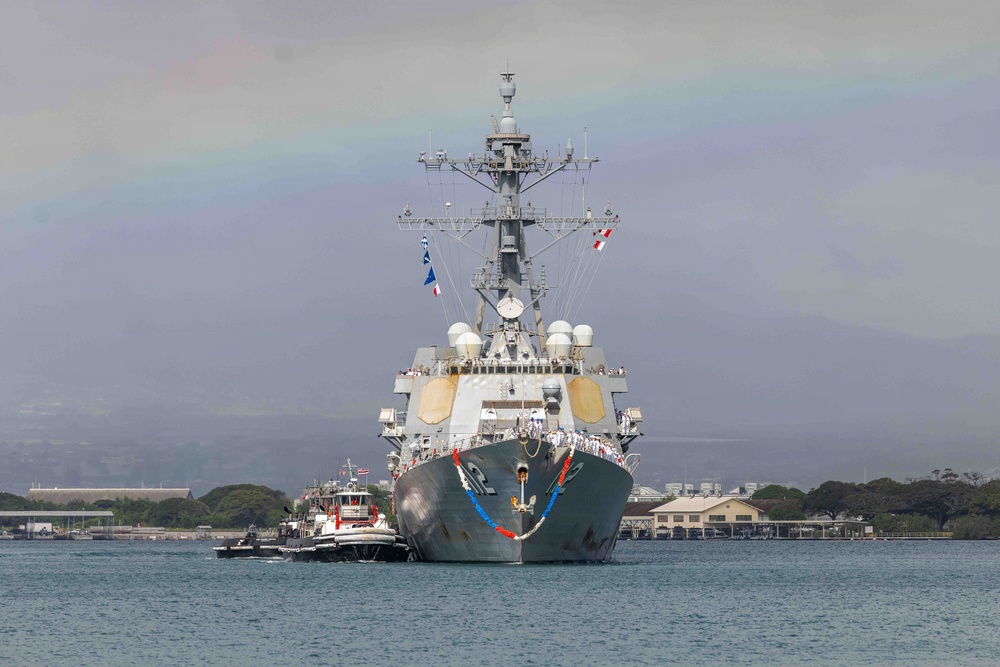
The USS Michael Murphy returned to Joint Base Pearl Harbor-Hickam on Nov. 12, 2026, following an 11-month deployment defined by sustained combat operations.
The Arleigh Burke-class guided-missile destroyer, DDG 112, arrived home after operating across the U.S. 3rd, 7th, and 5th Fleet areas of operations, DVIDS reported. The ship’s return marks the conclusion of a high-intensity period that saw the vessel serving on the front lines of Operation Epic Fury.
After departing Pearl Harbor on Dec. 1, 2025, the ship entered the U.S. Central Command area of responsibility in late January 2026. During this window, the crew engaged in dozens of Tomahawk land-attack cruise missile strikes and successfully defended the vessel against hostile missile and drone attacks.
“The Sailors of Michael Murphy demonstrated unmatched grit, professionalism, and warfighting excellence during this deployment,” said Cmdr. David Nicolas, commanding officer of Michael Murphy.
“Whether defeating incoming air and surface threats or leading operations through contested choke points, this crew never hesitated,” Nicolas told DVIDS. “They answered every call of our nation, defended our allies, and lived up to the heroic namesake. I could not be prouder of this crew.”
The Crew Earned Honors for Enforcing a Naval Blockade
The intensity of the mission earned the crew the Presidential Unit Citation (PUC) and the Combat Action Ribbon (CAR). These honors recognize the ship’s role in enforcing the first naval blockade in 60 years, a strategic maneuver conducted in the North Arabian Sea, the Gulf of Oman, and the Strait of Hormuz.
Serving as the Surface Action Group Commander for Task Force 50 (TF-50), the Michael Murphy coordinated the defense of 14 different vessels. This coalition included U.S. Coast Guard Fast Response Cutters, Littoral Combat Ships, destroyers, and logistics fleet oilers.

The ship’s operational data highlights the sheer scale of the deployment’s logistical and physical demands:
| Metric | Deployment Total |
|---|---|
| Distance steamed | More than 97,000 nautical miles |
| Replenishments-at-sea | 43 |
| Combat in-port refuelings | 8 |
| F-76 marine diesel fuel transferred | Over 8 million gallons |
| JP-5 jet fuel transferred | 2 million gallons |
Beyond the fuel transfers, the crew managed the receipt of 1,100 pallets of food, stores, repair parts, and mail while operating under combat conditions.
Securing the Strait of Hormuz
The vessel’s presence in contested waters was a primary factor in maintaining regional stability. The Michael Murphy completed 12 contested transits of the Strait of Hormuz, a critical maritime choke point, while facing threats from surface, air, and mine attacks. During these transits, the destroyer escorted four merchant tankers to safety.
The ship’s air detachment, consisting of Helicopter Maritime Strike Squadron (HSM) 71 Detachment 2, was central to these defensive and offensive capabilities. The detachment flew 330 sorties and logged over 900 mishap-free flight hours, which included 273.4 hours of direct combat flight time.
While operating within the U.S. 7th Fleet, the destroyer also conducted anti-submarine and surface operations in the Philippine and South China Seas. These actions were intended to provide deterrence to adversaries and ensure the security of regional allies.
As an integral component of the U.S. 3rd Fleet, the ship’s movements contributed to the broader mission of advancing freedom of navigation and the rule of law across the Pacific and Middle Eastern theaters.
The Michael Murphy operated as part of Carrier Strike Group 3 (CSG) 3 under Destroyer Squadron (DESRON) 21, alongside the aircraft carrier USS Abraham Lincoln (CVN 72) and the destroyers USS Spruance (DDG 111) and USS Frank E. Petersen Jr. (DDG 121).
The ship’s service continued under TF-50 leadership throughout the deployment, maintaining coordination with the staffs and aircraft of CSG-10 and CSG-5.

How Maine Carpenters Can Lower Insurance Costs
Maine carpenters can lower their insurance expenses by utilizing bundling, safety improvements, and continuous coverage, according to Insureon....

Professional Mermaid Attacked by Fake Rideshare Driver in New Orleans
A professional mermaid and former Muay Thai boxer suffered facial fractures and a concussion after an assailant posing...

HAKC Maintains Waiting List for Family Self-Sufficiency Program
Families seeking to transition from housing assistance to economic independence in Kansas City are on a formal waiting...

Iowa Traffic Fatalities 15% Below Five-Year Average, Radio Iowa
Iowa traffic fatalities are running slightly higher than last year's record lows, according to data released during a...