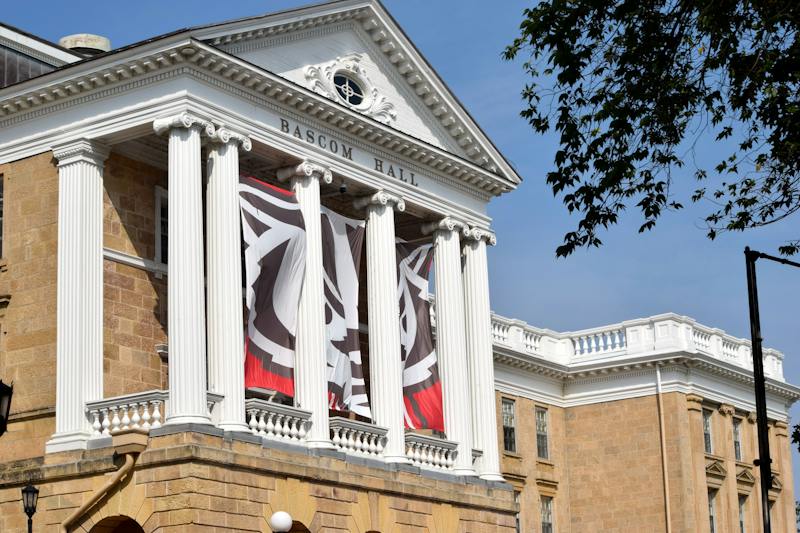
UW-Madison improved its national free-speech ranking from 101st to 61st this fall, but the Foundation for Individual Rights and Expression still gave the campus a D for student comfort expressing ideas and an F for political tolerance, The Daily Cardinal reported.
Seventy-two percent of students surveyed said shouting down a speaker is acceptable at least in rare cases. FIRE data analyst Chapin Lenthall-Cleary said at institutions where more students approve of shout-downs, conservative students tend to self-censor more, and that campuses with more liberal leanings generally show greater support for shout-downs while being less tolerant of speakers who raise politically controversial topics.
The grades behind the ranking
FIRE’s annual College Free Speech Rankings, released in September, grade colleges on an A-to-F scale using student polling, campus policies, and speech-related controversies. UW-Madison’s overall score rose from an F to a D. The breakdown: disruptive conduct earned a C+, openness a C, administrative support a D-, self-censorship a D, and political tolerance remained an F.
University spokesperson John Lucas said leaders have taken significant steps since the start of the 2024-25 academic year to address free expression, though he acknowledged the exact relationship between those actions and the ranking increase is unclear.
Shouting down speakers: civil disobedience or disruption?
“I think it’s good to have events where dialogue is welcome. What’s not good is where that dialogue is being used to intimidate or devalue specific groups of people,” said Adam Donahue, a member of Students for Justice in Palestine.
“We’re willing to entertain the dialogue. It’s just that the dialogue needs to be respectful and also, we’re not going to humor certain viewpoints that are clearly racist or bigoted in certain ways.”
Howard Schweber, an emeritus professor of political science and law school faculty affiliate, drew a sharper line. He said students generally should not be able to shout down speakers without consequences, but acknowledged exceptions.
“A student who wants to shout down a speaker and is willing to accept the disciplinary sanction that follows is engaging in civil disobedience, which is appropriate if the issue is grave enough that lesser measures will not do,” Schweber told The Daily Cardinal in an email.
He added that university authorities usually have an obligation to let speakers finish, but may remove a speaker if the speech constitutes face-to-face insults, incitement to imminent lawless action, or a risk to public safety.
Policy restricts protests near building entrances
Lucas said the Expressive Activity Policy states that infringing on others’ free speech rights is not allowed, and shouting down a speaker could result in consequences under UWS 17 or the Student Organization Code of Conduct.
Donahue linked the campus’s high self-censorship scores to the Expressive Activity Policy implemented in 2024, which replaced UW-6011. He said the rules are clear on paper but enforced unevenly.
The policy bans protests, chants, and amplified sound within 25 feet of building entrances, caps noise at 85 decibels, and prohibits activities that obstruct passage. Schweber called the 25-foot rule and noise limits sensible, but warned that vague or overly broad regulations invite self-censorship.
“Rules have to be drawn narrowly to avoid that self-censorship,” Schweber said. “The problem of excessive discretion arises when a rule is written so broadly that in practice the officer can use it to bar or not bar anyone based on his or her immediate judgment.”
He compared the UW rule to a recent lawsuit against Indiana University’s policy, which restricted both the place and time of expressive activities, including quiet ones. While UW’s rule covers a smaller physical area, Schweber said that distinction may not matter legally.
Donahue, speaking as a protest organizer, said compliance can be impractical. “How are we supposed to check [the 25-feet rule]? Do we need to get a tape to measure the length?” he asked. “Oftentimes, protests are planned by less than ten people with a crowd of more than a hundred… even if the rules are specific, they are unrealistic.”
Donahue disputes safety justification for restrictions
Lucas said the policy’s stated goal is to ensure academic activities and campus management proceed smoothly and safely, while supporting free expression and a welcoming community.
Donahue disputed the safety rationale. “I’d say that while safety can sometimes be compromised by particularly disruptive activities like a riot for example, this almost never applies in the context of protests,” he said. “I think there is a slight tension between protest and speech and safety, but the tension is much, much less pronounced than the university administration makes it seem… protests are not endangering students.”
Related reading

UAH Hosts 500 Students for Adventures in Engineering
The club hosted 500 North Alabama high school juniors and seniors at the University of Alabama in Huntsville...

European Tech Startups Target $81 Billion This Year, Second-Highest Since 2015
European tech startups are on track for their second-strongest funding year since 2015, with Atomico projecting $81 billion...

Thunder Basin Coal Plans Six-Mile Wyoming Highway 450 Relocation to Expand Black Thunder Mine
Thunder Basin Coal Company wants to shift six miles of Wyoming Highway 450 east of Reno Junction so...
Auburn vs. West Virginia: Tigers Favored in Players Era 8 Matchup
West Virginia and Auburn meet Tuesday night in the Players Era 8 at Michelob ULTRA Arena in Paradise,...