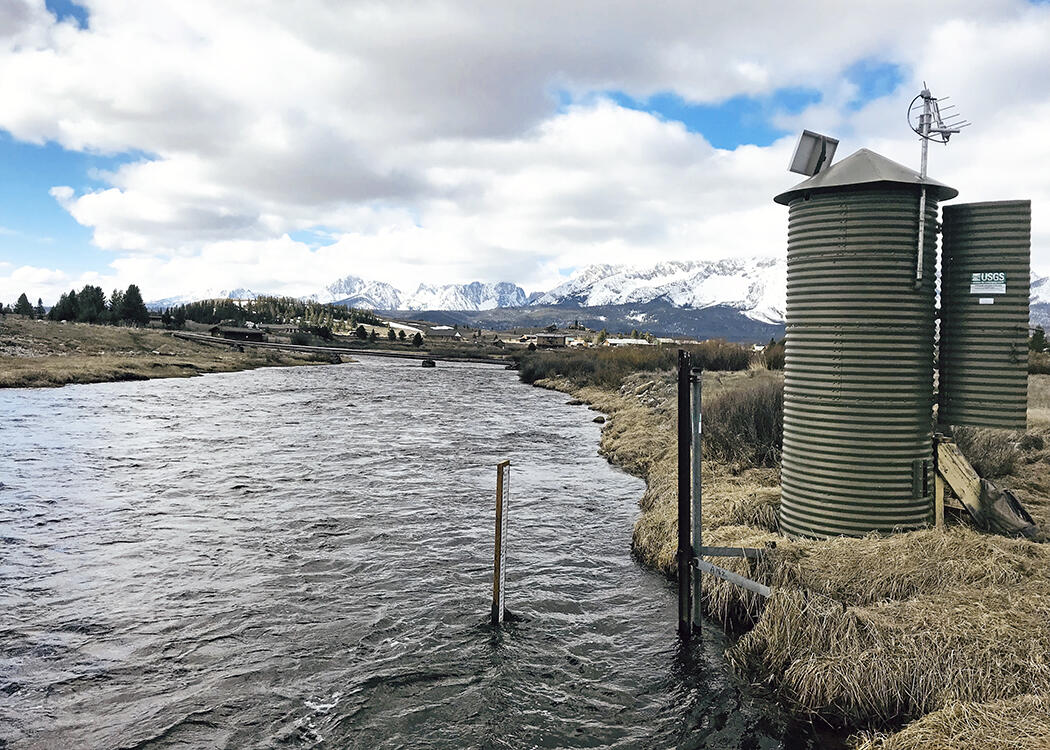
Warming slows the renewal of deep bedrock water that feeds mountain streams even as shallow pathways turn over faster, a modeling study of an Idaho headwater catchment shows.
Researchers Xiong and Chen combined nine seismic-refraction surveys with a three-dimensional hydrologic model of the Treeline catchment in the Dry Creek Experimental Watershed southwest of Boise, The Watchers reported. The catchment spans roughly 0.02 square kilometers at 1,610 meters elevation, where about half of annual precipitation falls as snow.
Seismic P-wave velocities of 1.2 kilometers per second and 3.5 kilometers per second delineated weathered regolith, fractured bedrock and deeper intact rock, providing a structural framework the model could honor rather than assume. Ten hydraulic-property realizations were tested under baseline conditions and prescribed warming of +2.5°C and +4.0°C.
Annual streamflow fell in every realization at +4.0°C, declining to 121–191 millimeters from a baseline range of 146–216 millimeters. Evapotranspiration rose 3–18 percent. Regolith-derived streamflow dropped 3–27 percent, while fractured-bedrock contributions declined more sharply, by 9–32 percent.
Particle tracking revealed diverging age trends. Regolith source water became slightly younger as faster shallow pathways dominated the remaining flow. Bedrock source water aged from a mean of 2.71 years to 3.03 years — roughly four additional months — because reduced recharge left stored water making up a larger share of the deep contribution.
“When less new recharge reaches fractured bedrock, stored water makes up a greater share of the bedrock contribution and its average modeled age increases,” the study says. Lower saturation in the unsaturated fractured system also lengthened flow paths and shortened the seasonal window for deep replenishment.
The +2.5°C and +4.0°C perturbations are model experiments, not forecasts for a specific year, the researchers emphasize. Their numerical results should not be treated as a site-specific climate forecast.
The Dry Creek Experimental Watershed is a research and education laboratory operated by Boise State University since 1999, spanning foothills and mountainous terrain in Ada and Boise counties. Its mission is to provide temporally continuous and spatially distributed hydrometeorological and geographical data from point to watershed scales, including climate and streamflow records that document the decline in mountain snowpack over a 20-year period.
Boise State University has operated the Dry Creek Experimental Watershed since 1999. The study appears in Science Advances (DOI: 10.1126/sciadv.aeh0536).
- Honolulu Civil Beat Publishes Archive of Sustained Police Sexual Misconduct
- Rich Rodriguez Vows to Fix West Virginia After Embarrassing 52-28 Loss to No. 2 Utah Ends Season
- EPA Finds No Lead in Water After Iowa Ammo Plant Detonation, Experts Question ‘Zero’ Air Readings (archyde.com)
- Thousands of UK homes to receive water bill support (newsarchyuk.com)

Honolulu Civil Beat Publishes Archive of Sustained Police Sexual Misconduct
Honolulu Civil Beat has published a searchable archive documenting sustained findings of sexual harassment and assault against Honolulu...

Rich Rodriguez Vows to Fix West Virginia After Embarrassing 52-28 Loss to No. 2 Utah Ends Season
West Virginia's season ended Friday night with a 52-28 loss to No. 2 Utah at Rice-Eccles Stadium, dropping...

Alabama Wildlife Officials Estimate 70,000 Alligators; World Atlas Names 6 Top Rivers
Alabama wildlife officials estimate the state holds roughly 70,000 American alligators, and a new World Atlas ranking identifies...

Ten-Man Truro City Draw 3-3 with Dover Athletic After 3-0 Deficit
Truro City recovered from 3-0 down with 10 men to draw 3-3 with Dover Athletic at Truro Community...