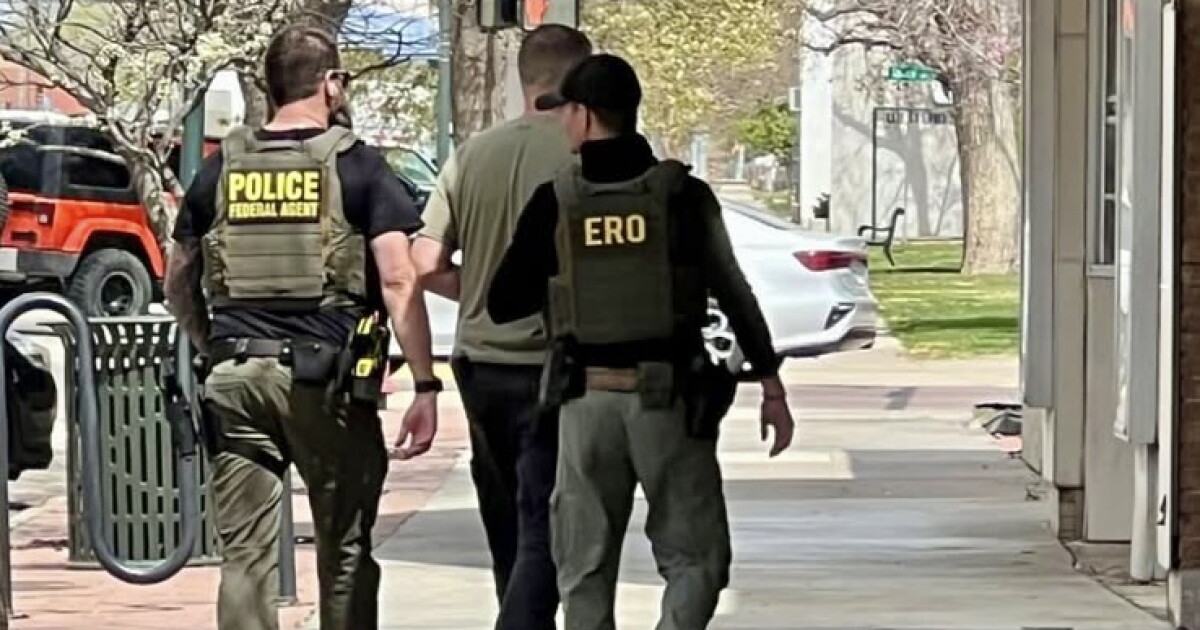
“The more attention we bring to this, the more chance that the unintended consequences will happen,” J.V. Johnston said.
Wichita city leaders declined on Tuesday to place a proposed immigration resolution on any upcoming council meeting agenda, citing concerns that opposing federal enforcement agreements could trigger federal retribution and additional immigration arrests, KMUW reported.
Mayor Lily Wu and council members Becky Tuttle and Johnston voted against placing the proposal on the agenda. Dalton Glasscock also withheld his support for a vote on the measure.
The proposal in question is the “Wichita Trust and Safety Resolution,” co-written by the American Civil Liberties Union, local immigrant community members, and council member Joseph Shepard. The measure would formally declare that Wichita will not enter into any 287(g) agreements, will not use local tax dollars to assist federal immigration enforcement, and will establish a “mattering and belonging committee” to support immigrants and refugees.
The 287(g) agreement, named for a 1996 amendment to the Immigration and Nationality Act, allows Immigration and Customs Enforcement to deputize local law enforcement officers for federal immigration duties. Forty-eight agencies across Kansas have signed these agreements, ranging from the Kansas Bureau of Investigation to the St. John Police Department. While Wichita does not currently hold a 287(g) agreement, the Sedgwick County Sheriff’s office secured one last year.
Wichita Police Chief Joe Sullivan has stated he does not plan to pursue a 287(g) agreement. However, Shepard argued that administrative assurances are insufficient.
“The commitment … while it means a lot, it is not a policy,” Shepard told KMUW. “The reality is that roles change, and that policy is a way to lock into affirmation that we see immigrants in our community, we hear them, and they belong in the city of Wichita.”
Shepard requested nearly a month ago that the resolution be scheduled for the Nov. 10 council meeting. City Manager Dennis Marstall directed Shepard to city policy requiring a majority vote from council members to add items to future agendas. Council members Maggie Ballard and Mike Hoheisel supported Shepard’s request at Tuesday’s meeting, honoring a commitment they made at an ACLU rally in September.
Other council members expressed support for immigrants broadly but rejected adding the resolution for official debate.
“What I think we’re doing is proposing a solution to a policy concern that does not currently exist within our city government,” Glasscock said.
Glasscock suggested routing immigration concerns into the city’s annual lobbying platform for state and federal delegates. Tuttle supported an immigration-focused town hall instead of an official resolution.
Tuttle shared that a close friend going through the legal immigration process with her husband made a personal appeal against the measure.
“They both begged me not to do this,” Tuttle told KMUW. “The reason they wanted to meet with me was to beg me not to support this, because they are fearful of the unintended consequences of more ICE coming to our community and him potentially being deported.”
The debate unfolds against a backdrop of recent high-profile immigration arrests and deportations in Wichita over the past month. Yessica Pena, owner of Lady Burittos, and Rob Attar, owner of La Galette French Bakery, were arrested last month, with Pena and her family subsequently deported to Mexico earlier this week.
Johnston warned that council action could increase local exposure.
“I think there are unintended consequences of this,” Johnston said. “We have a few ICE agents in town now. An unintended consequence is that the administration sends 20 or 30.”
Johnston serves as executive director of the Guadalupe Clinic, a free medical provider serving uninsured patients earning under 200% of the federal poverty line. He noted that approximately 2,600 patients—nearly two-thirds of the clinic’s total patient load—are undocumented.
“I’m not going to have it on my conscience that I did something that could — we don’t know for sure, but could — affect our patients’ health,” Johnston said. “I can’t live with myself if I [do] that.”
Shepard and community advocates who attended Tuesday’s meeting rejected the argument for silence, pointing to recent ICE raids in southwest Kansas where 104 people were arrested over three days.
“They modeled what we hear tonight: Keep your head down and be quiet,” Shepard said of those southwestern communities. “That is no way to live, by the way, and it has major consequences on the quality of life of people who live in our community.”
Keep reading
ICE Agents Arrest Minnesota Man Seeking Legal Status After Video Shows Force
Federal agents arrested a 45-year-old Minnesota man named Jose Ruelas Viorato in Robbinsdale on Wednesday, an incident captured...

Comedian and Yes, Dear Actor Anthony Clark Dies at 62
Anthony Clark, the sharp-witted stand-up comedian and actor best known for his role as Greg Warner on the...
Michigan 84, Marquette 70 – MGoBlog
Michigan men’s basketball secured an 84-70 victory over Marquette in Ann Arbor, marking a rebound following a road...

New Orleans Cyclists Build Community Through Social Riding Groups
Bicycle riders across New Orleans are increasingly using two wheels to build social connections despite narrow lanes and...