
The clock is ticking on a vision to reshape travel in the Pacific Northwest. Washington State Department of Transportation (WSDOT) has opened the first major public consultation for a Cascadia High-Speed Rail line that could one day connect Vancouver, BC, to Portland, OR. The agency is seeking input from residents and travelers as it explores the feasibility of the project.
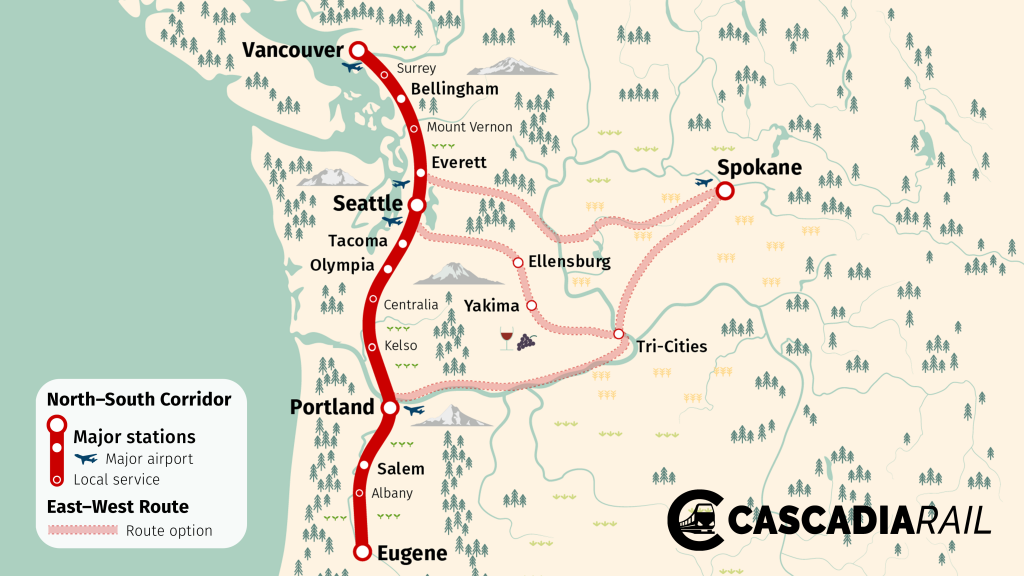
The proposed Cascadia High-Speed Rail would operate along a roughly 377-mile corridor through the Cascadia “megaregion,” encompassing Vancouver, BC, Seattle, and Portland, OR. WSDOT forecasts the region’s population will grow by 3.4 million people by 2050, leading to severe congestion on Interstate 5. In Washington, more than doubling the percentage of truck trips is expected, while 78% of I-5 in Portland is projected to operate with severe congestion by 2045. The rail is intended to provide congestion relief by offering an alternative to driving.
Creating New Travel Options Between Cities
The goal of the high-speed rail is to create new travel options between major cities. Creating other options for people to travel from point to point between those cities gives us a chance to get people off the freeway,
said Ben Tripousis, the program administrator of the Cascadia High-Speed Rail & I-5 Program. High-speed trains on this line would operate between 160 mph and 220 mph, significantly faster than the current Amtrak Cascades trains, which average about 79 mph. This could reduce a hypothetical Seattle-to-Portland trip from around three hours to just over one hour, depending on the final speed selected.
Advancing the Project with Financial Support
WSDOT is advancing the project with significant financial support. In 2024, the agency received a $49.7 million grant from the Federal Rail Administration (FRA) and a $5.5 million match from the state legislature. This funding is for completing a Service Development Plan to determine if high-speed rail is a viable transportation option for the region, as well as for the I-5 Master Plan. WSDOT is collaborating with the Ministry of Transportation and Transit in British Columbia, the Oregon Department of Transportation, Oregon Metro, and the mayor of Portland on this exploration.
Public Input Critical for Early Stages
Public input is a critical component of the early stages. So while Cascades (Amtrak) can still serve all the communities up and down the corridor for shorter point-to-point trips, the longer haul trips can be served by high-speed rail and really complement each other as the service is developed,
Tripousis said. The project aims to connect people to PDX and SEA airports. Potential users, like Joletta Lorio, who commutes from Hood River, OR, to Seattle for work, see life-changing potential. It would be huge for me just personally speaking, because missing out on that 3-plus, 3.5-hour chunk of time where I could be actively engaged in meetings, with my colleagues or working on projects,
she said. Others, like Kendall Uyeji of Shoreline, believe the project would place Washington in the company of global leaders. Keeping up with Europe and China, who already have these high-speed rails (would be huge), so if it’s possible to get it done in America, that would be amazing, especially in that corridor that people drive up all the time,
he said. Source: KOMO News
More on Cascadia High
The Cascadia High-Speed Rail would weave through a roughly 377-mile corridor through the Cascadia "megaregion," as labeled by WSDOT, connecting the metro areas of Vancouver, BC, Seattle, and Portland. https://t.co/JS99HVzFIc
The Washington State DOT has announced that the new Amtrak Airo trains will begin service on the Cascades route Sept. 30. WSDOT also announced that a development plan for the Cascadia High-Speed Rail project will be released in 2028.https://t.co/W12hen3UUW
Took it. I honestly don't see what the point of this exercise was.
Worth a look

Meet David Morales: The Youngest Providence Mayor and Former Pro Wrestler
28-Year-Old Wrestler Wins Providence Mayoral Race in Blue Wave Sweep The city of Providence, Rhode Island, woke up...
Author claims government spending plan masks true deficit size
The Ottawa Budget Trick: How Mark Carney's Three-Credit Card Spending Plan Adds $40,000 to Every Family's Tab In...
Charleston Marks 100 Years of Ashley River Memorial Bridge
A Century of Spanning History: Charleston Gears Up to Mark the Ashley River Memorial Bridge's 100th Year Next...

Path CEO: Ohio is the Capital of Physical AI, Expanding with 50+ Hires
Path Robotics Hires 50+ in Columbus, Bet on Ohio as 'Capital of Physical AI' Walk into any major...