An estimated three in four Michigan rivers and streams fail federal safety standards for fecal contamination, a rate that outpaces neighboring Indiana and Illinois and undermines billions in waterfront revitalization, NBC Chicago reported.
The finding comes from the most comprehensive testing yet by the Michigan Department of Environment, Great Lakes, and Energy, which has sampled roughly half of the state’s 76,000 miles of waterways.
Where regulators looked, they found E. coli levels exceeding limits for full-body contact in the vast majority of sites, and in more than half the waterways the bacteria counts were too high even for partial contact like paddling or wading. Molly Rippke, who leads the state’s E. coli monitoring program, said the numbers “do not look pretty.”
The pollution flows from three main sources: manure runoff from large-scale livestock operations, overflows from aging municipal sewers, and leaks from tens of thousands of failing residential septic systems. Michigan is the only state without a uniform septic code, leaving inspection and repair entirely to local discretion. Meanwhile, the livestock industry has sued to block enforcement of the state’s existing manure regulations, arguing they overreach.
“It’s just wild to me that this would be OK,” said Megan Tinsley, water policy director for the Michigan Environmental Council. “And it seems to be OK with a great many of our decision-makers.”
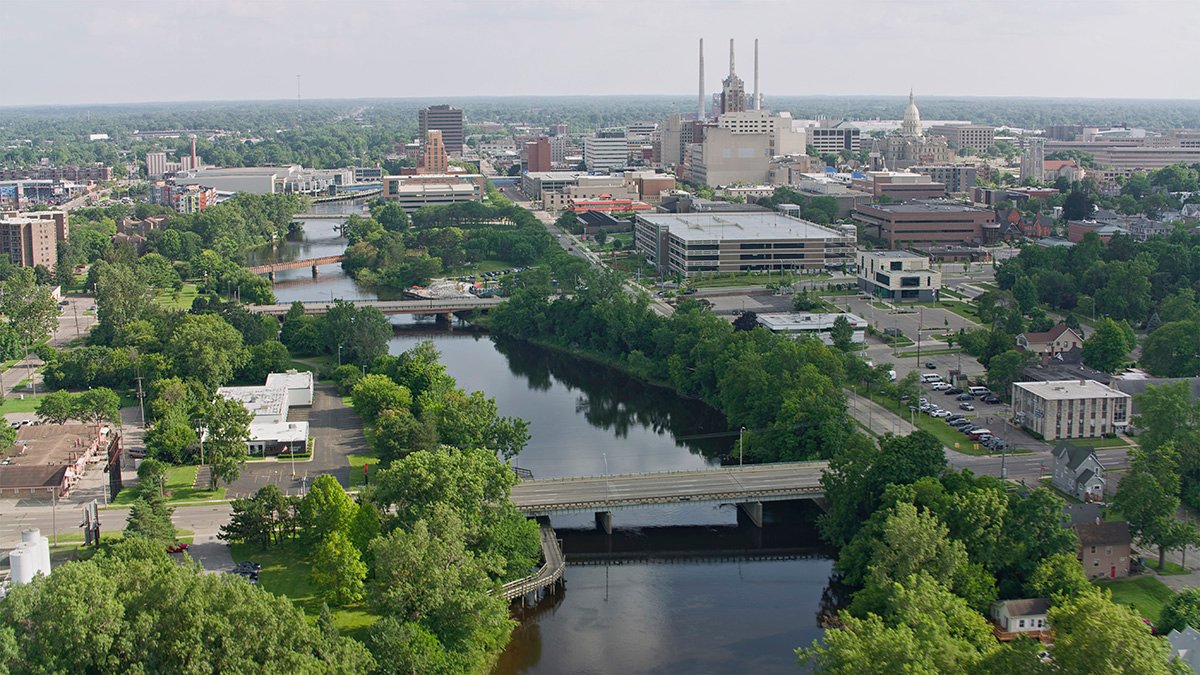
Rachel Cuschieri-Murray, executive director of the Eaton Conservation District, works on the Grand River as it winds past the Capitol in Lansing. She would not let her own children touch the water there. “You shouldn’t even put your hands in,” she told NBC Chicago. “It’s that dirty.”

The Grand is Michigan’s longest river at 252 miles, draining farmland and urban centers before emptying into Lake Michigan.
Its tributaries — along with the Rouge in metro Detroit, the Kalamazoo in the southwest, the Boardman and Pere Marquette up north, and the Tobacco and Salt rivers in the mid-section — all show chronic exceedances. The contamination does not stop at riverbanks; it feeds the Great Lakes, triggering dozens of beach advisories every summer.
Health officials warn the risk is more than aesthetic. Swallowing water tainted with fecal bacteria exposes people to E. coli, cryptosporidia, norovirus, giardia, and hepatitis. Fever, diarrhea, and vomiting are common, but some infections cause lasting organ damage.
“We’re really just beginning to break the ice on what the long-term consequences of those infections are,” said Dr. James M. Fleckenstein, a professor at Washington University School of Medicine who studies E. coli.
Michigan’s water quality standards are designed to limit illness to a handful of cases per 1,000 swimmers. The greater the exceedance, the higher the risk. Yet the state tracks no comprehensive data on recreational waterborne illness.
State figures show 12.4 million people recreate on Michigan rivers annually and 30.7 million swim at its beaches. Dr. Matthew Sims, an infectious disease researcher at Corewell Health, said his colleagues see patients with telltale exposures “all the time.”

Neighbors fare no better, but Michigan acts less
The problem is regional. Indiana reports 74% of assessed river miles exceed limits; Illinois sits at 83%. Nationally, Environment America found elevated bacteria at 69% of monitoring sites across 17 states. The state employs a single full-time staffer to monitor river E. coli. Local conservation districts, which lead voluntary cleanup efforts, receive just $40,000 a year each in operating funds.
Legislative leaders in both parties call the pollution unacceptable. Pleasant, counters that tighter rules without funding help no one. “Unfortunately, we’re broke,” he said.
Economic stakes and a stalled cleanup
The inaction threatens to erode the economic gains of river restoration. Taxpayers have spent billions dredging contaminated sediment, restoring habitat, and converting derelict factories into waterfront parks. A Michigan-based study found waterborne E. coli outbreaks cut nearby home prices by an average of $13,000 when a sale coincided with an outbreak.
“Ultimately, a polluted environment is not going to allow for economic growth and it’s not going to allow for health and wellness,” said Joan Rose, a Michigan State University microbiologist who has studied the problem for decades.
Kayakers like AJ MacArthur, who founded the Michigan River Rats paddling club in Kalamazoo, have adapted. He never swims, wears rubber boots to launch, keeps his hands away from his face, and showers immediately after leaving the water. “There are ways around it,” MacArthur said. “But it’s unfortunate that we have to even think about that.”
At the current pace, Rippke does not expect Michigan to solve its fecal pollution problem in her lifetime. The upshot, she said, is blunt: “More people are going to get sick.”

Mark Pope Addresses Need for Consistent Growth After Indiana Loss
Kentucky’s basketball program faces a reality check after falling to 4-2 on the season following a 90-76 defeat...

Atlanta Police Apprehend Male After Armed Kidnapping on Northside Dr SW
Atlanta police officers apprehended a male suspect on Friday afternoon following an armed kidnapping that originated at a...

Boise State Student Films Selected for Sun Valley Film Festival
Two short films produced by students at Boise State’s Film and Television Arts Program have earned a spot...

ECHL Issues Fines and Suspension for Trenton and Maine Players Following Third Period Incidents
Three ECHL players drew discipline from the league office following third-period infractions on November 18. The ECHL Department...