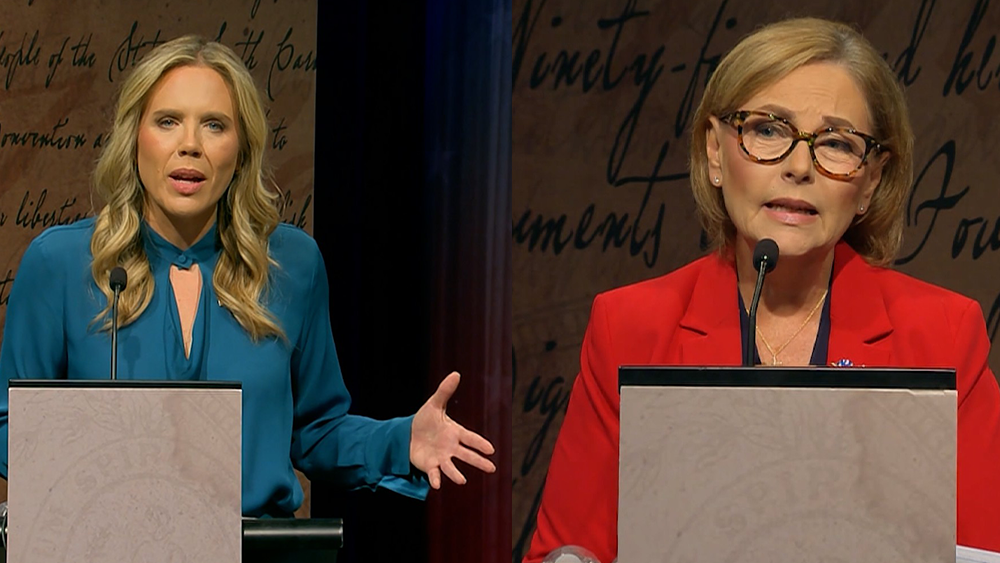
Republican Darline Graham and Democrat Annie Andrews are locked in a dead heat for South Carolina’s U.S. Senate seat, with a new poll showing both candidates tied at 48% support. The New York Times/Siena University survey, conducted between October 19 and 26, 2026, reveals a razor-thin margin in a race where only 3% of likely voters remain undecided.
This deadlock comes at a moment of high stakes for the state’s political landscape. With the candidates tied, the outcome may depend on the 30% of voters who say they are “very likely” to vote and the 38% who are “almost certain.”
The Breakdown of the Electorate
The poll, which surveyed 707 likely voters, highlights a fragmented partisan divide. Republicans currently hold the largest share of the respondent pool at 38%, followed by independents at 30% and Democrats at 27%. Another 2% identified with other parties, while 2% were undecided or declined to answer.
The fact that Graham and Andrews are tied despite Republicans making up the largest share of surveyed likely voters suggests that Andrews may be over-performing with independents or that Graham is facing headwinds within her own base.
Voter enthusiasm is high, though not universal. According to the data reported by WJCL, 22% of respondents have already cast their ballots.

Majority of Likely Voters Disapprove of Trump
While the Senate race is a stalemate, the poll reveals a starkly different picture regarding Donald Trump.
| Trump Approval Rating | Percentage of Likely Voters |
|---|---|
| Strongly Disapprove | 46% |
| Somewhat Disapprove | 9% |
| Strongly Approve | 26% |
| Somewhat Approve | 16% |
| Undecided/No Answer | 3% |
The data shows that 55% of likely voters disapprove of the president’s handling of the office, with a dominant 46% expressing “strong” disapproval. This creates a complex dynamic for Darline Graham. In many traditional GOP contests, the top of the ticket serves as a buoy for down-ballot candidates. Here, the data suggests the presidential disapproval rating might be capping Graham’s ceiling and providing the opening Annie Andrews needs to maintain parity.
The Margin of Error and the Undecided Few
In a race this tight, the technical details of the poll become as important as the percentages themselves. The New York Times/Siena University survey carries a margin of sampling error of plus or minus 4.3 percentage points. Mathematically, this means the race isn’t just tied—it is a statistical toss-up. Either candidate could realistically be leading by several points, or trailing.
The 3% of undecided voters are the only remaining “free” agents in this contest.
The human stakes here involve more than just a seat in the Senate.
With 22% of the electorate already having voted, the window for influence is closing.
Worth a look

Craig Fuller documents wildlife in Grand Teton and Yellowstone
Craig Fuller documented a wildlife tour through Jackson Hole, Grand Teton National Park, and Yellowstone National Park, reporting...

Extinction Stories: Immersive Dioramas at Milwaukee Public Museum
The emerald ash borer threatens the survival of 7.5 billion ash trees across North America, a figure that...

Cincinnati Volleyball Previews Matches Against Colorado and West Virginia
The Cincinnati volleyball team is traveling to Boulder, Colorado, to play Colorado on Thursday at 9 p.m. ET...

Washington State Suspends Pre-Election Campaign Contribution Limits
Washington state's campaign finance regulators are effectively pausing the rules on how much money can flow into political...