
Exposure to environmental chemicals and metabolic health conditions such as diabetes significantly impair male reproductive function. Research from French and Argentinian researchers indicates that pesticide exposure lowers sperm counts and alters hormone levels, while a recent study published in the journal Human Reproduction and additional scientific investigations show that diabetes combined with abnormal semen parameters triggers severe sperm apoptosis through mitochondrial pathways.
Pesticide Exposure and Hormonal Disruption in Farming Regions
Environmental factors have drawn intense scrutiny since Danish researchers reported in 1992 that sperm counts worldwide were declining. To investigate these potential drivers, scientists examined 225 men living in a productive farming region in Argentina who attended an infertility clinic between 1995 and 1998. The participants underwent physical and biological testing alongside detailed lifestyle, medical history, occupation, and pesticide exposure questionnaires.
The evaluation revealed that contact with insecticides, herbicides, and fungicides correlated directly with sperm counts falling well below the limit for male fertility. Furthermore, exposed individuals registered higher levels of two female sex hormones in their system than men who had not come into contact with pesticides. Dr Luc Multigner, of the French research institute INSERM, noted that these findings point to a toxic effect on the testicles and other sex glands, suggesting that exposure to pesticides and solvents could be contributing to falling sperm counts and rising levels of male infertility.
“The testicles are one of the most vulnerable organs to environmental, physical and chemical agents”
Dr Luc Multigner, INSERM
Diabetes Mellitus and Sperm Apoptosis Mechanisms
While environmental toxins affect reproductive health, systemic metabolic disorders create internal cellular damage. A study investigated thirty-nine men to understand how diabetes mellitus and abnormal semen parameters interact to affect male reproductive function and underlying apoptotic mechanisms. Investigators stratified participants into two phases: a validation cohort (nondiabetic vs. diabetic; fertile vs. abnormally infertile) and a four-group mechanistic study consisting of normal nondiabetic (n = 10), abnormal nondiabetic (n = 11), normal diabetic (n = 10), and abnormal diabetic (n = 8) groups.
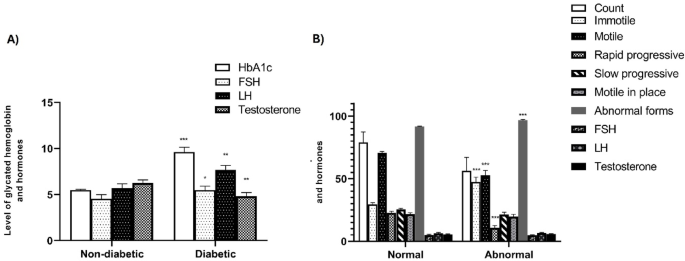
Laboratory evaluations assessed HbA1c, follicle-stimulating hormone (FSH), luteinizing hormone (LH), testosterone, semen parameters, sperm apoptosis via Annexin V/PI flow cytometry, DNA fragmentation via diphenylamine, and expression of apoptotic markers including caspase-3, cytochrome c, Bax, and Bcl-2 at gene and protein levels. Diabetic patients displayed significantly higher HbA1c (9.6 ± 2.31% vs. 5.49 ± 0.42%, p < 0.001) alongside elevated FSH and LH, and reduced testosterone. Abnormal infertile patients showed impaired motility and morphology.
The Severe Phenotype of Combined Metabolic and Fertility Abnormalities
Patients managing both diabetes and abnormal semen parameters experienced the most severe reproductive dysfunction. The abnormal diabetic group recorded the lowest rapid progressive motility at 11.3 ± 3.10% (p < 0.001 vs. control) and the highest early apoptosis at 58.9 ± 8.79% (p < 0.0001).
Protein analysis demonstrated a clear pro-apoptotic shift within this specific dual-condition cohort. Researchers observed an elevated Bax/Bcl-2 ratio of 3.64, increased cytochrome-c, and caspase-3 activation exclusively in this group (p < 0.0001), showing that diabetes and abnormal semen parameters exert enhanced combined detrimental effects on male fertility via enhanced activation of the intrinsic mitochondrial apoptotic pathway. Diabetic men with pre-existing fertility abnormalities exhibit the most severe phenotype and require prioritized clinical intervention.
| Study Cohort Group | Sample Size (n) | Key Reproductive Finding |
|---|---|---|
| Normal Nondiabetic | 10 | Baseline reference parameters |
| Abnormal Nondiabetic | 11 | Impaired motility and morphology |
| Normal Diabetic | 10 | Elevated HbA1c, hormonal shifts |
| Abnormal Diabetic | 8 | Highest early apoptosis (58.9 ± 8.79%, p < 0.0001), lowest rapid progressive motility (11.3 ± 3.10%, p < 0.001 vs. control) |
Clinical Implications for Developing Countries and Western Nations
The convergence of chemical exposure and metabolic disease underscores a growing global health crisis affecting male reproductive function. Argentina has become a major user of pesticides since the 1940s, prompting local clinicians to urge broader attention across developing nations.
Dr Alejandro Oliva, from the Hospital Italiano Garibaldi in Rosario, Argentina, highlighted the geographical scope of these reproductive concerns. Dr Alejandro Oliva stated: There has been rising concern in many Western countries about the deleterious effects of environmental chemicals on male reproduction. Attention to this issue should now be given to developing countries.
The research examining pesticide exposure is published in the journal Human Reproduction.
Related reading

Boy’s Abdominal Rash Caused by Resting Charging Laptop on Skin
A young boy presenting with a mysterious abdominal rash and suspected liver injury was ultimately diagnosed with erythema...
Local Consolidative Therapy Fails to Improve Survival in LONESTAR Trial
Adding local consolidative therapy after induction dual checkpoint blockade in metastatic non-small cell lung cancer was feasible, but...

WHO Prequalifies Multi-Dose RSVpreF Vaccine Vial to Protect Infants
The World Health Organization has prequalified a multi-dose vial of the maternal respiratory syncytial virus vaccine, RSVpreF, sold...

NIH Integrates Patient Feedback Into AI Use via Bio Genesis Mission
The National Institutes of Health is opening new avenues for patient and clinician feedback as it scales artificial...