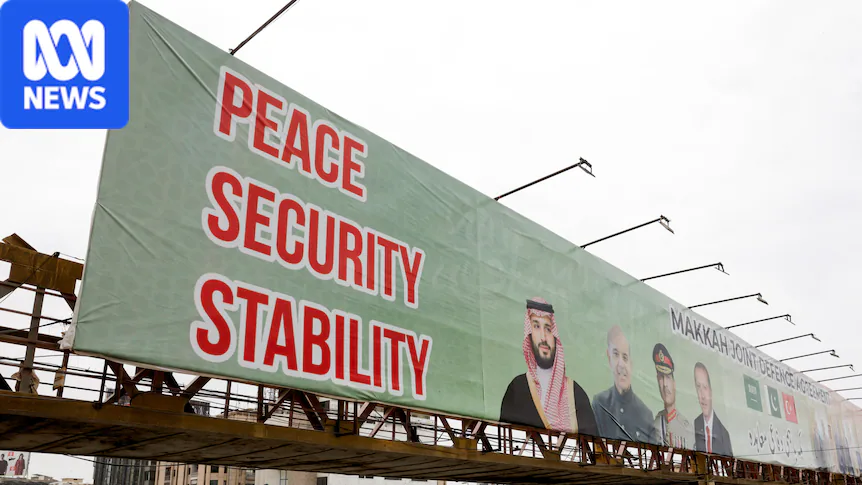
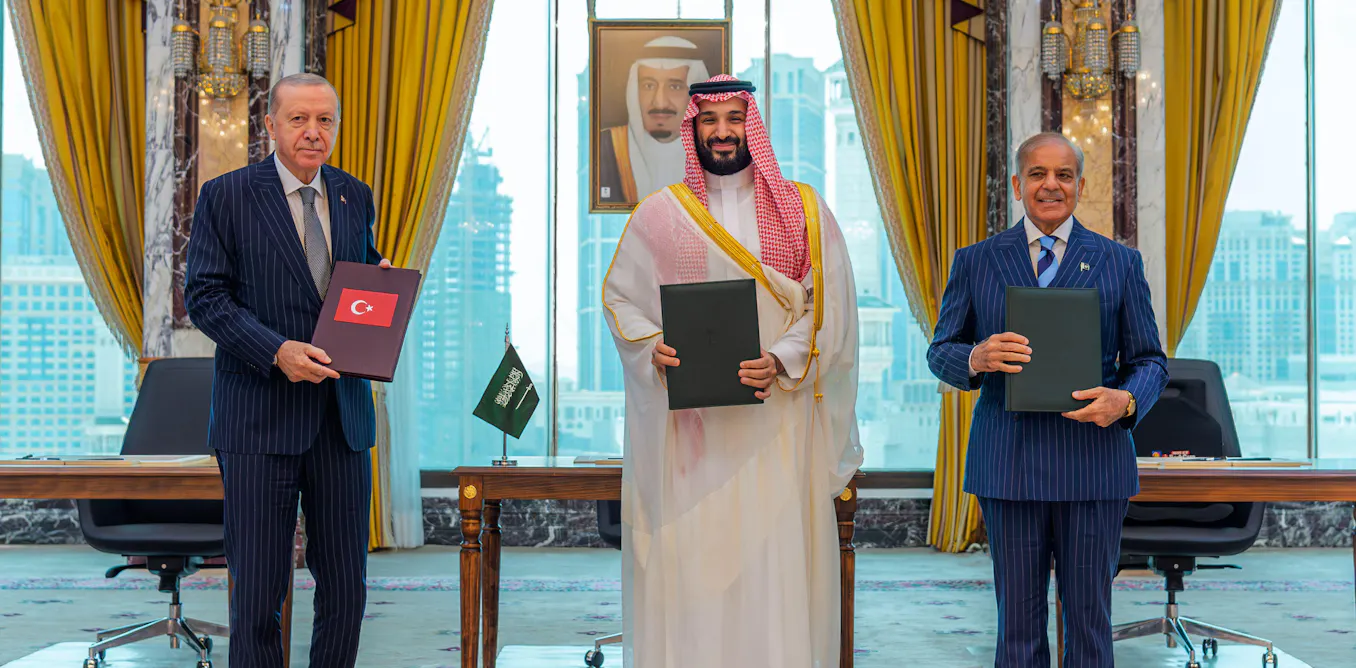
Saudi Arabia, Türkiye, and Pakistan signed the Mecca Joint Defence Agreement on August 7, establishing a mutual defense pact modeled on collective security principles. The accord, which treats an attack on any member as an attack on all, responds to regional volatility and shifting strategic calculations.
The Mecca Joint Defence Agreement: What the Pact Actually Commits To
Signed at Al-Safa Palace in Mecca, the landmark accord binds three of the Muslim world’s most powerful militaries into a formal security arrangement. The core clause stipulates that an armed attack against any one of the three states will be regarded as an attack against them all, echoing collective-defense frameworks like NATO’s Article 5.
Turkish Foreign Minister Hakan Fidan described the arrangement as technically
similar to NATO’s collective defense principle, while Pakistani Foreign Minister Ishaq Dar noted that the provision aligns with the right of individual and collective self-defense under Article 51 of the United Nations Charter. Negotiated over a period that intensified as regional conflicts escalated, the agreement aims to place military ties on a more institutional and sustainable
footing.
Under the accord, strategic political and military mechanisms are planned, involving foreign ministers, defense ministers, and chiefs of general staff or armed forces commanders. A permanent secretariat is scheduled to be established in Saudi Arabia to coordinate high-level cooperation, though the pact does not immediately outline fixed troop commitments or automatic military obligations.
Combined Military Capabilities Across Land, Air, and Sea
The three signatory nations represent a formidable military bloc spanning South Asia and the Middle East. Together, they field a combined active personnel pool led by Pakistan with 660,000 troops, followed by Türkiye at 481,000 and Saudi Arabia at 247,000.
Air power within the alliance comprises 3,415 military aircraft, including fighter jets, helicopters, transporters, and training units. Pakistan operates 1,397 aircraft, Türkiye fields 1,101, and Saudi Arabia maintains 917. On land, the nations deploy 6,046 tanks—with Pakistan leading at 2,677, Türkiye at 2,284, and Saudi Arabia at 1,085—alongside more than 179,000 armored vehicles and extensive artillery systems.
Naval assets total 344 across the combined fleets, including 33 frigates, 24 corvettes, and 22 submarines. Türkiye contributes 192 naval assets, while Pakistan operates 120 and Saudi Arabia maintains 32.
Strategic Rationale and Complementary Assets
Analysts emphasize that the pact brings together genuinely complementary capabilities. Turkiye contributes an increasingly sophisticated defence-industrial base, drones, missiles, sensors, electronic warfare, naval systems and NATO-derived military expertise,
while Pakistan contributes manpower, a large professional military establishment, operational experience, defence production and nuclear capability.

For Riyadh, the agreement diversifies security partnerships beyond traditional Western guarantees amid recurring threats to vital maritime corridors such as the Strait of Hormuz and Bab al-Mandeb. The accord builds upon an earlier strategic mutual defense agreement signed between Saudi Arabia and Pakistan in September 2025, adding Türkiye’s advanced defense-industrial base and NATO-standard capabilities to the framework.
Diplomatic Reassurance and Regional Reactions
In the days following the signing, officials from the participating nations moved to address external concerns. Pakistan’s Foreign Minister Ishaq Dar stated that the agreement was purely defensive in nature
and did not target any specific country. Turkish officials similarly emphasized that the pact was not aimed at Iran or other regional neighbors.
Despite official assurances, regional reactions varied. Jerusalem viewed the pact as an anti-Israel alignment, while commentators in international analysis pointed out that the agreement also serves as a verdict on the reliability of long-standing security guarantees from Washington, particularly following regional escalations involving Iran and missile strikes hitting Gulf energy infrastructure.
Public celebrations accompanied the announcement, with landmarks and city skylines in Islamabad and across Saudi Arabia illuminated in the colors of the Saudi, Turkish, and Pakistani flags. Prime Minister Shehbaz Sharif called the agreement a historic pact, stating he hoped it would become a shield of peace
for future generations.
Expansion Prospects and Unresolved Operational Tests
Founding members have stressed that the agreement is open to expansion.
Worth a look
South Africa Mass Shootings in Wedela and Lwandle Kill 27 People
Two separate mass shootings in South African townships over the weekend killed 27 people within hours of each...

Malaysia to End Search for 55 Missing Citizens in Nepal
Thirty-three days after glacial flash floods struck Nepal, families of 55 missing Malaysians pressed government officials in Putrajaya...

Tigst Assefa Wins Berlin Marathon Despite Injury and Cramps
Ethiopian Tigst Assefa won the Berlin Marathon on Sunday, September 27, 2026, clocking the third-fastest time in history...
Bangkok Governor Chadchart Sittipunt Declares Citywide Flood Disaster
Bangkok Governor Chadchart Sittipunt declared a citywide flood disaster across all 50 districts on Saturday after nearly 300...