
Parents who jog while pushing a stroller may face a lower risk of overuse injuries compared to those who run without one, according to research published in the journal Washington Post. The study examined running habits and injury patterns among parents with young children, challenging the assumption that the extra weight and resistance of a stroller would increase physical strain.
New Study Finds Lower Injury Rates Among Parents Who Run With Strollers
Researchers analyzed survey responses from 255 runners who had children aged zero to three years. The study compared 196 parents who regularly incorporated stroller running into their routines with 53 parents who ran without a stroller. Overall, 30 percent of the non-stroller runners reported experiencing an overuse injury during the first three years after becoming a parent, compared to 19 percent of the stroller-running group. Furthermore, parents who ran with strollers experienced a 55 percent lower injury rate for every 1,000 miles run, according to data highlighted by the Washington Post.
Biomechanics and Pacing Factors Behind the Findings
The study was led by researchers at News-Medical, who explored how pushing a pram alters running mechanics. Allison Altman-Singles, senior author of the study, an associate professor of kinesiology and of mechanical engineering at Penn State Berks, noted that stroller running changes posture and force distribution.
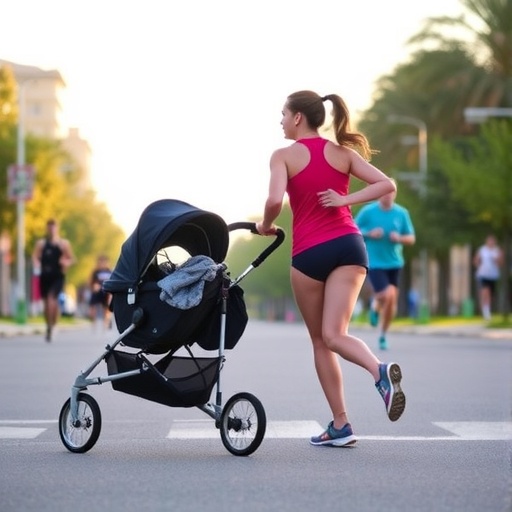
We believe this is due to the biomechanics associated with stroller running: more flexed posture, more forward lean and less vertical force,
Altman-Singles told Newsweek. The stroller runner can better distribute their vertical force through the handlebars and feet, which helps reduce the forces that cause overuse injuries.
Previous work by Altman-Singles and her colleagues indicated a 16 percent lower vertical impact force when running with a pram. The physical act of holding the handlebars allows runners to transfer some force away from their legs and into the stroller. Additionally, the added resistance makes it harder to accelerate or sprint, naturally moderating pace, encouraging shorter outings, and promoting a more consistent cadence.
Study Limitations and Common Injuries
While the findings offer reassurance for parents seeking to maintain fitness, the study’s authors noted several limitations. Because the research relied on self-reported survey data, it demonstrates an association rather than direct proof of cause and effect. The data collection methods also did not account for variables such as breastfeeding status or subsequent children born during the study period.

Among the injuries that were reported by participants in both groups, plantar fasciitis—an inflammation of the thick band of tissue along the bottom of the heel—was the most commonly reported condition. It accounted for 15 percent of all reported injuries in the stroller-running group and 16 percent among non-stroller runners. Other frequent issues included ankle pain, calf muscle injuries, and Achilles tendinitis.
Despite these risks, researchers emphasized that stroller running provides a practical way for parents to stay active. Parents with children aged six to 12 months logged 34 percent more miles than runners who did not use a stroller, demonstrating its utility during a demanding phase of life.
NASA Roman Telescope Powers Up 300-Megapixel Instrument in Space
NASA’s Nancy Grace Roman Space Telescope launched aboard a SpaceX Falcon Heavy rocket and has now successfully powered...

Perseverance Rover Finds Volcanic Rocks at Mars’ Jezero Crater Rim
NASA’s Perseverance rover found volcanic igneous rocks instead of expected sedimentary layers along the inner rim of Mars’...
SpaceX Targets First Orbital Flight for Starship on September 28, 2026
SpaceX is targeting September 28, 2026, for Starship's 14th test flight from Starbase, Texas, with a 75-minute window...
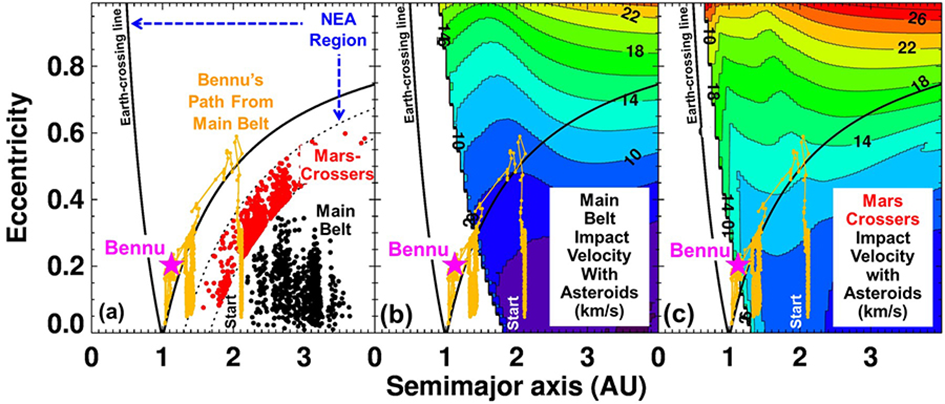
ETH Zurich Researchers Link Asteroid Bennu to Inner Solar System Transition Zone
Researchers analyzing titanium, chromium, and iron isotopes in samples returned by NASA's OSIRIS-REx mission have discovered that asteroid...