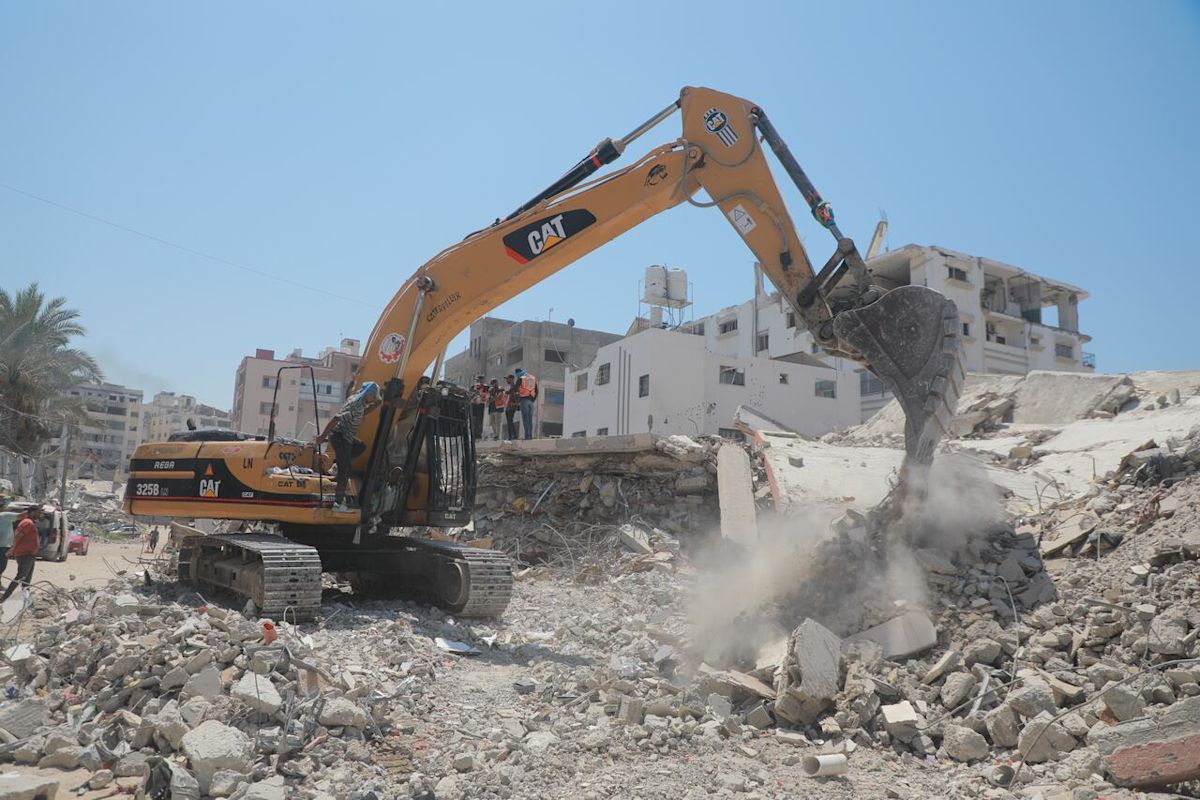
Operating two excavators in Gaza City, Samir Sabra and his son Uday struggle against soaring fuel costs and a severe lack of spare parts to recover bodies from rubble. With only about a dozen barely functioning machines left across the Strip, desperate families increasingly resort to digging by hand.
In the heart of Gaza City, members of the Al-Drimli family spend their days searching the debris of a six-storey residential building destroyed by an airstrike in November 2023. Armed with little more than shovels, buckets, a wheelbarrow, and their bare hands, the men shovel dust and broken concrete in the strong midday sun. They have already recovered the remains of their immediate loved ones and are now trying to locate a neighbor who sheltered with them when the strike hit.
A Dire Scarcity of Heavy Machinery Across Gaza
The Al-Drimli family’s exhausting physical labor reflects a broader crisis across the Palestinian territory. Because heavy equipment is scarce and largely unavailable, residents frequently turn to manual tools to search for missing people. According to estimates from the Gaza Health Ministry, between 8,000 and 10,000 bodies remain trapped under rubble nearly three years after the outbreak of the war between Israel and Hamas.
Officials and equipment operators on the ground report that only about a dozen excavators remain operational throughout the entire Gaza Strip. These aging machines are crucial for clearing blocked roads and retrieving remains, but operators say the equipment is operating on its last legs. The machinery requires constant maintenance that has become nearly impossible to secure under current conditions.
The Crushing Costs of Fuel and Maintenance for Sabra’s Fleet
Among the few remaining operators are Samir Sabra and his son Uday Sabra, who manage two excavators in the Gaza Strip. Maintaining and running the heavy machinery presents a financial barrier that is difficult to clear. Samir Sabra explained that the oil required just to run a single excavator costs at least 2,500 shekels, equivalent to about $1,175 Cdn.
Humanitarian aid groups note that ongoing restrictions on fuel, oil, and essential spare parts imposed by Israeli authorities severely hamper efforts to maintain critical infrastructure, including hospital generators, ambulances, water pumps, and water trucks. For private operators like the Sabra family, these border restrictions translate directly into immobilized equipment.
First Responders and Volunteer Crews Overwhelmed by Demand
The daily demand for excavation services far exceeds what the Sabra family’s two machines can provide. Uday Sabra works alongside members of the Palestinian Civil Defence, a volunteer organization of first responders who deploy to strike sites to search for survivors and recover bodies.
Uday noted that calls for assistance arrive every single day, leaving operators unable to keep pace. At one particular site off a main road in Gaza City, Uday spent a full week digging without finishing the recovery work. Mahmoud Basal, a spokesperson for the Palestinian Civil Defence, emphasized the sheer scale of the devastation.
Targeted Infrastructure and Diminishing Hopes for Rapid Recovery
According to Palestinian Civil Defence officials, the severe shortage of heavy machinery is the direct result of wartime targeting. Mahmoud Basal stated that heavy equipment was systematically targeted during the conflict as part of military strategy, leaving the strip starved of functional diggers.
To prevent further damage to their capabilities, the Civil Defence now hires out only a single excavator at a time. Basal noted that crews work in coordination with the International Committee of the Red Cross using one digger that runs for three days before stopping for a day of essential maintenance. Despite a ceasefire agreement reached last October that included provisions for allowing more heavy machinery and equipment into Gaza to clear rubble and roads, officials report no tangible change on the ground.
Keep reading

Downing Street Tests Public Support for UK Rejoining the EU
Downing Street is gathering evidence and testing public opinion on rejoining the EU, with senior officials consulting pollsters...
Trump Bans Canadian Alcohol Imports Under Smoot-Hawley Tariff Act
President Donald Trump implemented a trade ban on $800 million worth of Canadian alcoholic beverages on September 29,...

Pope Leo XIV Challenges Nvidia CEO Jensen Huang Over AI Safety Risks
Pope Leo XIV publicly challenged Nvidia Chief Executive Jensen Huang on September 28, 2026, rejecting claims that artificial...