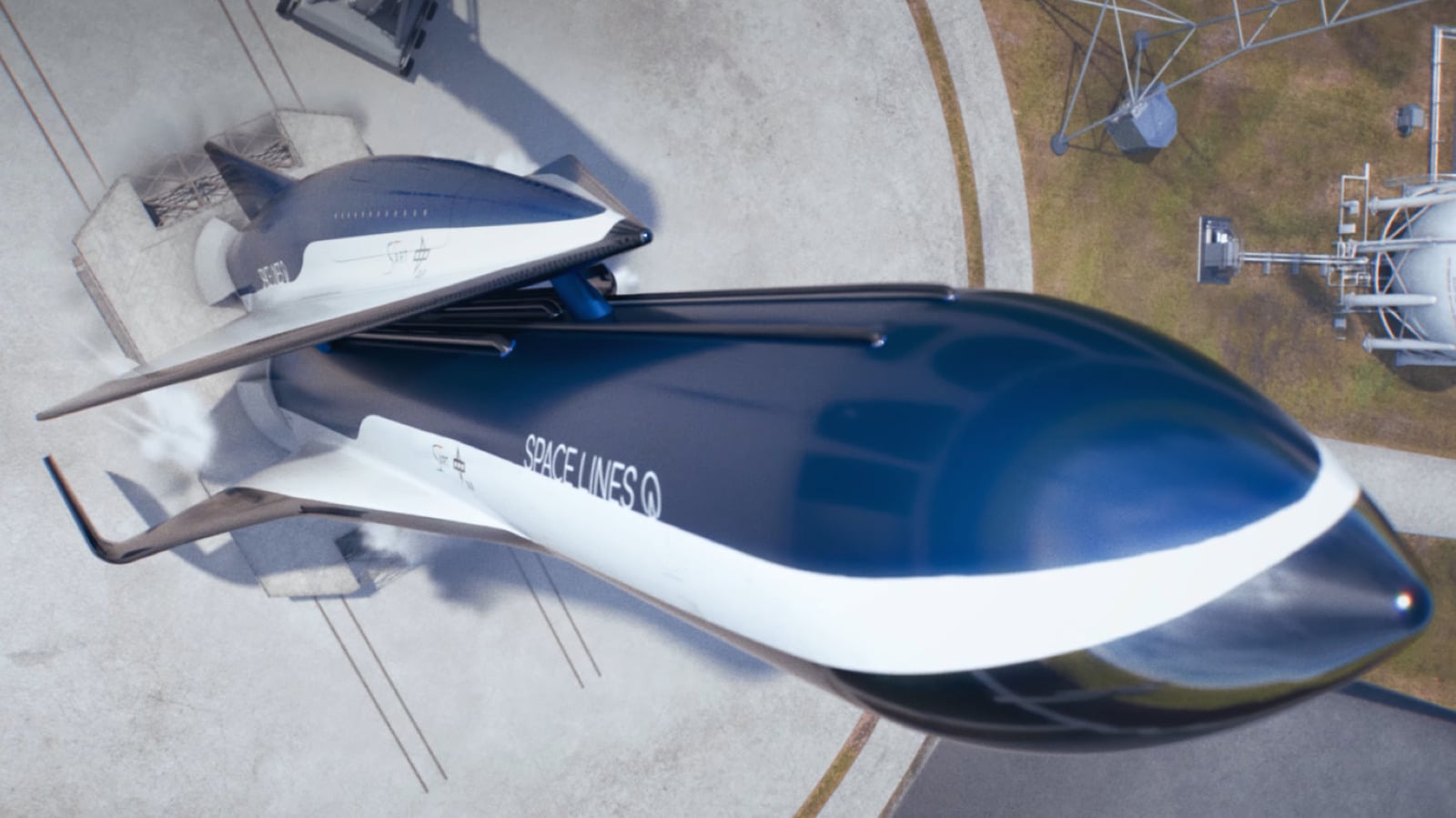
Researchers at the German Aerospace Center have proposed a winged, partially reusable rocket concept dubbed the RLV C5, designed to lift up to 74% of its mass into low Earth orbit by swapping vertical landing propellants for mid-air aircraft capture and higher-efficiency liquid hydrogen.
DLR’s Alternative Vision for European Orbital Access
Germany’s Aerospace Center (DLR) published a paper in May 2025 proposing a more efficient European version of SpaceX’s Starship rocket, with the concept called the RLV C5. The team from DLR studied SpaceX’s publicly available data and provided a unique assessment of the rocket’s ability. The analysis was built on telemetry data obtained via public broadcasts from SpaceX, which was logged by a text recognition algorithm. The aim of the study is to provide a competitive launch platform for Europe. Rather than chasing the sheer physical scale of Starship, the research team focused on structural efficiency. The RLV C5 aims to channel up to 74% of its launch mass as payload, compared to Starship which delivers 40% of its mass to orbit. If accomplished, this would represent a significant advantage over Starship.
Propulsion and Mid-Air Recovery Mechanics
The architectural divergence between the two designs centers on how each system handles booster recovery and propellant chemistry. SpaceX’s Starship separates from the Super Heavy booster, which lands back at the launch site by firing its Raptor engines. The rocket is then caught by the launch tower’s Mechazilla arms, a feat which may change everything about space travel. This landing technique costs extra fuel in order to ensure that the rocket can reduce its speed after reentry and come to a powered hover before being caught.
By contrast, the European concept revives aspects of the long-running SpaceLiner project, which has been in development since 2005. The team from Europe proposes a rocket that is similarly sized to the Starship, but has a SpaceLiner booster with built-in wings that can be used to glide it, before being caught by a subsonic aircraft mid-air. This landing technique eliminates the need to reserve fuel for landing burns, allowing more of the rocket’s mass to contribute to reaching orbit. Furthermore, the RLV C5 also proposes to use liquid hydrogen and liquid oxygen, which are more efficient than the methane and oxygen combination used by Starship.
Strategic Trade-Offs in Heavy-Lift Architecture
DLR researchers note that these divergent designs reflect fundamentally different strategic goals. Starship’s enormous capacity and rapid reuse make it ideal for lunar bases, Mars missions, and massive satellite constellations. The RLV C5, in contrast, offers Europe an intermediate step toward super-heavy lift capabilities without the extraordinary investment required for full reusability. DLR researchers emphasize that this is not a direct competition but a deliberate choice in approach. By focusing on efficiency, Europe could secure sovereign access to orbit while gradually developing the technologies for fully reusable vehicles.
Lead author Moritz Herberhold noted in the CEAS Space Journal that the design offers a practical path for Europe to independently develop partially reusable super-heavy launch capabilities,
highlighting that sometimes smarter engineering can outweigh being first. Rather than making the extraordinary financial investments required for full reusability immediately, Europe could secure sovereign orbital access through measured, incremental engineering.
Engineering Hurdles and the Pace of Development
Transforming the paper design into flight-ready hardware presents formidable challenges. While the concept from the DLR is certainly thought-provoking and innovative, building and flying a rocket of this scale is an enormous undertaking. The German researchers caution that transitioning from concept to functioning hardware is a major challenge. Those charged with the task would have to develop an entirely new rocket with its own heat-shield, rocket engines, and validated gliding performance. Starship’s thermal protection system, for instance, required complete redesigns after damage during early tests. Those three concepts were at the center of the Space Shuttle’s development hurdles, and required significant funding and time to get right.

Meanwhile, SpaceX has set a new bar for the pace of development, so much so that it treats its rocket launches like software updates, rapidly iterating and improving after every test. By the time the design can see serious investment or production, SpaceX may have improved its own design to such an extent that the European design may already be behind. Since the SpaceLiner concept has never made it into actual production in the 20 years since it was first thought up, it’s difficult to imagine the idea taking off. While the team from DLR would be able to lean on key learnings derived from SpaceX’s Starship program, developing and building a rocket of this scale would take years to complete.
Keep reading

Raja Ampat Epaulette Shark Shows Extremely High Population Densities
Researchers conducting 64 nighttime surveys across Indonesia's Raja Ampat Archipelago recorded 1,191 sightings of the Raja Ampat epaulette...

NASA Study Shows Earth Microbes Could Survive in Lunar South Pole Shadows
NASA researchers published a study in Science Advances showing that five common human-associated microbes can survive for days...

MIT Engineers Develop High-Speed Microscope for Whole-Brain Voltage Imaging
Engineers at the Massachusetts Institute of Technology have invented a high-speed microscope capable of capturing electrical activity across...

Researchers Warn Thawing Permafrost Could Trigger Climate Tipping Points
As global temperatures continue to rise, scientists warn that cumulative environmental changes could push fundamental parts of the...