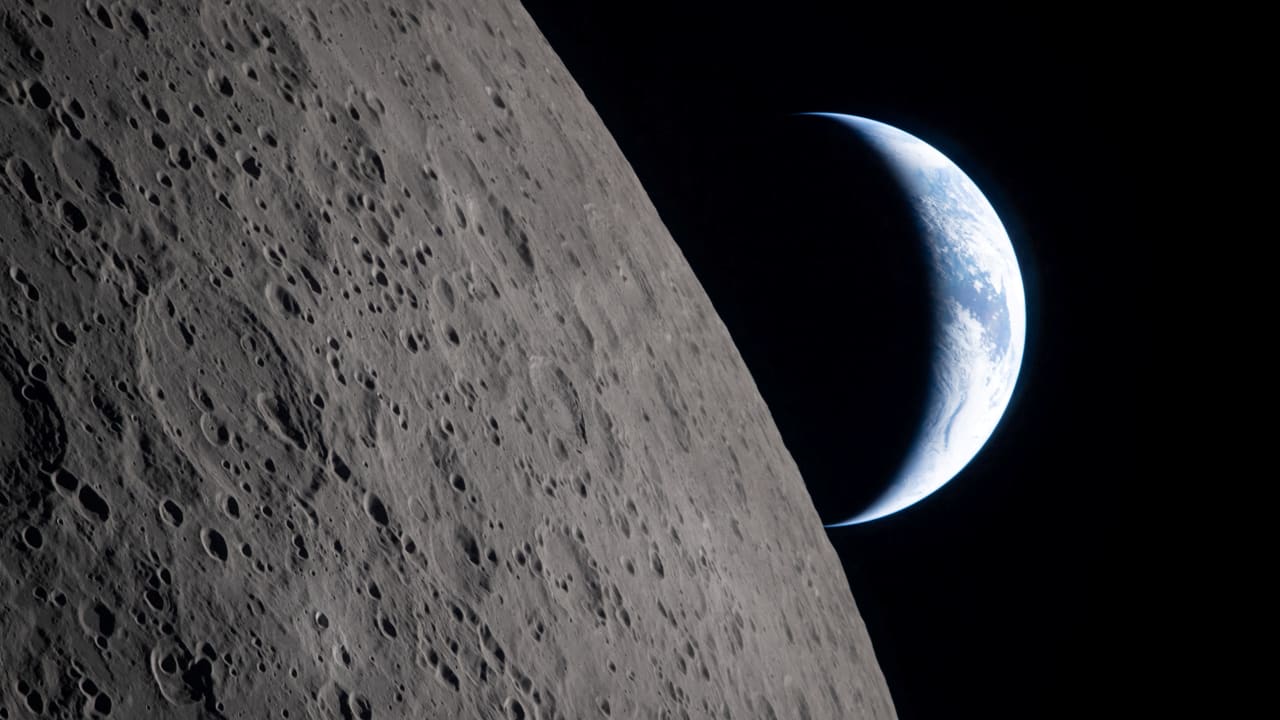
NASA researchers published a study in Science Advances showing that five common human-associated microbes can survive for days to months in shaded niches near the Moon’s South Pole. The findings raise concerns about biological contamination during upcoming crewed Artemis missions and future lunar bases.
Where Earth Microbes Can Hang On Near the Lunar South Pole
The Moon is an exceptionally hostile environment for life from Earth, marked by a complete lack of breathable air, extreme temperatures, a natural vacuum, and relentless exposure to energetic particle radiation and ultraviolet light, according to NASA-led researchers. Yet a new modeling study indicates that ordinary microorganisms hitchhiking on spacecraft, tools, or spacesuits might find temporary refuge in specific polar locations.
Planetary scientist Prabal Saxena of NASA’s Goddard Space Flight Center led the research team, which utilized illumination models based on laser-altimeter topography and temperature data from the Lunar Reconnaissance Orbiter’s Diviner instrument.
The simulations revealed that permanently shadowed regions—found inside large craters or created as micro-shadows by topography—could shield microbes from solar heat and UV radiation. In these protected niches, which can range from crater floors miles wide down to the size of a bootprint, certain organisms could remain viable for periods ranging from days to months, particularly during the autumn and winter seasons.
Fungi Prove Hardier Than Bacteria in Extreme Conditions
The two fungi tested proved significantly more resilient than the bacteria.
Aspergillus niger, a common black mold prevalent in damp indoor environments and ventilation systems, emerged as the most resilient organism tested. Astronauts have previously sampled the fungus inside the International Space Station, and experiments have demonstrated that it can survive outside the station while in orbit.
By contrast, the three bacteria species examined showed lower tolerance for ultraviolet radiation. Deinococcus radiodurans led the bacterial group, followed by Staphylococcus aureus and Bacillus subtilis, according to NASA findings.
“The bacteria we examined were less resilient to ultraviolet radiation and consequently had less survival, with Deinococcus leading the way and Staphylococcus and Bacillus bringing up the rear.”
Prabal Saxena, planetary scientist at NASA Goddard Space Flight Center
The Stakes for Artemis Science and Lunar Water Ice
The prospect of terrestrial life surviving on the lunar surface presents both scientific and practical challenges as NASA and international partners work toward returning humans to the Moon. NASA’s Artemis program aims to land astronauts near the lunar South Pole, a region attractive for its deposits of water ice inside permanently shadowed craters.

Researchers emphasized that the study focused strictly on cellular persistence rather than growth or reproduction, as the Moon still lacks an atmosphere and liquid water required for metabolism. However, buried cells could potentially remain warm and protected from radiation, and localized pockets of liquid water might theoretically support growth under specific scenarios, noted study co-author and organic geochemist Heather Graham.

“A lot of what we’re trying to do with Artemis is to understand the moon, its history, its connections to the Earth. It’s really a window onto early Earth. When we’re thinking about it that way, we want to make sure that we are looking at native materials, that we’re actually looking at a chemical signal that’s arising from the moon, that we’re not contaminating our signal through our activities.”
Heather Graham, NASA geochemist
Furthermore, understanding whether exogenous organics can survive in protosoils is vital if astronauts intend to establish permanent bases or practice agriculture on the lunar surface.
Balancing Contamination Concerns With Exobiological Research
Before crewed exploration expands toward the South Pole and eventually Mars, scientists stress the need for baseline measurements to distinguish between indigenous planetary signatures and hitchhiking terrestrial organisms. As crewed missions approach later this decade, managing biological footprints remains a critical hurdle for maintaining the integrity of planetary science.
Worth a look
Moon to Occult Jupiter Over Eastern North America on October 6
Skywatchers across much of eastern North America can watch a rare lunar occultation early Tuesday morning as a...

Saturn Reaches Closest Approach to Earth for the Year
Saturn stands roughly 784 million miles from Earth as opposition positions the ringed giant at its closest annual...

Researchers Identify Candidate Second-Generation Planet Orbiting White Dwarf
Circling its parent dead star every 4.4 days, a Jupiter-sized gas giant orbits the white dwarf HS 0209+0832...
UK Proposes Norfolk Housing Levy to Unlock Stalled Homes
Environment Secretary Angela Eagle launched a public consultation on 17 September for a Norfolk pilot scheme requiring housing...