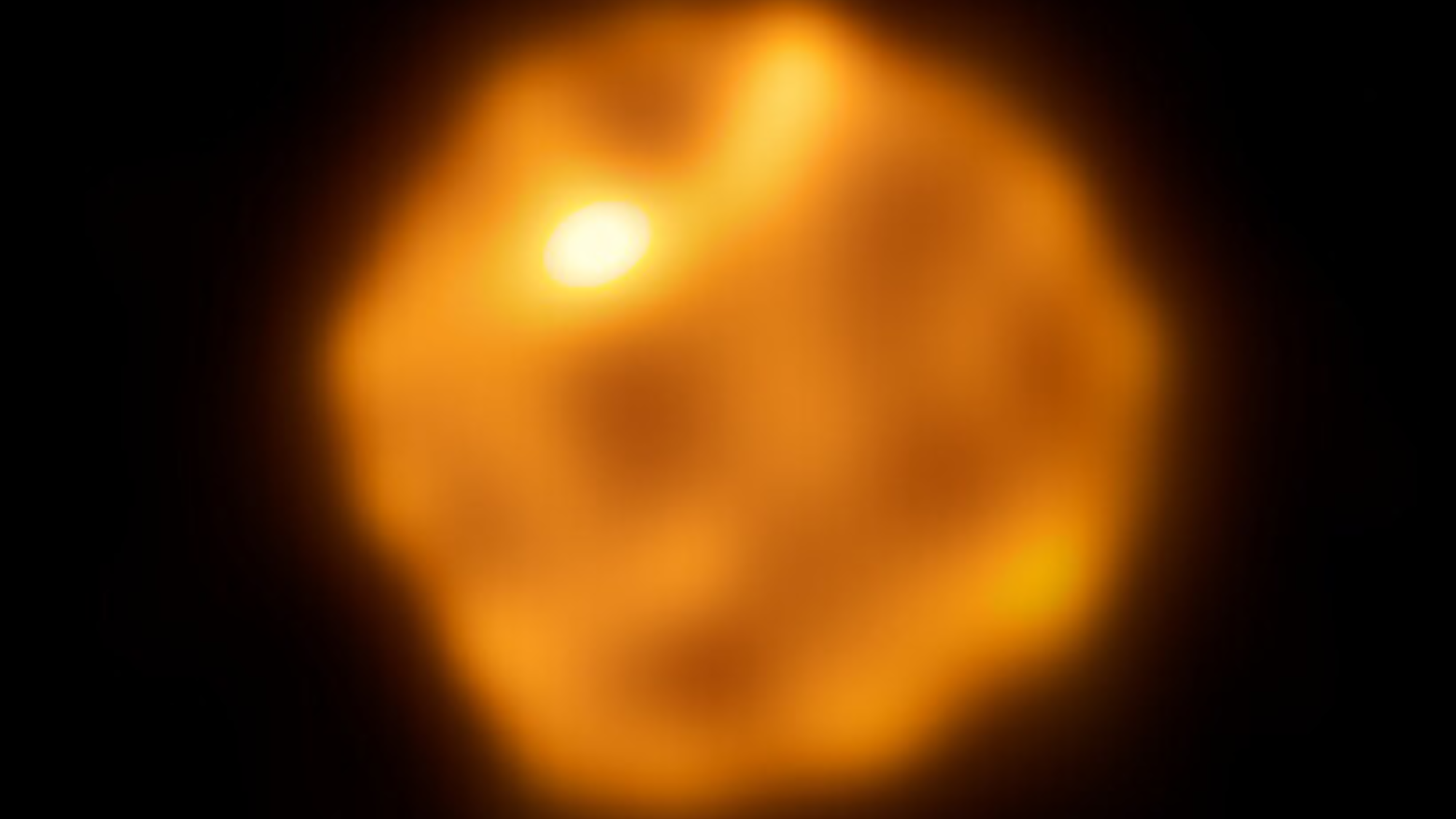
Astronomers using the Atacama Large Millimeter/submillimeter Array have captured images of Betelgeuse, revealing a corrugated surface and surprisingly persistent hotspots. Located roughly 600 light-years away, the doomed red supergiant continues to attract intense scientific scrutiny as researchers study its convective dynamics and eventual supernova fate.
Atacama Array Resolves the Red Supergiant
The doomed red supergiant star Betelgeuse has yielded new details about its turbulent atmosphere through observations gathered by the Atacama Large Millimeter/submillimeter Array (ALMA). Located roughly 600 light-years away in the constellation Orion, the massive star possesses a radius about 800 times that of the Sun and weighs in at roughly 15 to 20 times the solar mass. Because of its immense proportions, instruments can resolve atmospheric features across its disk that remain hidden on smaller or more distant stars.
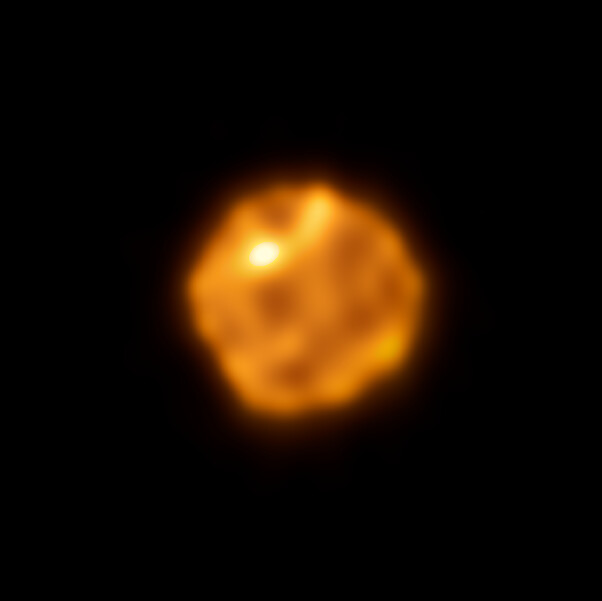
Data captured in 2023 using the array in its longest-baseline configuration achieved a resolution of approximately seven milliarcseconds. The resulting images show an irregular, corrugated outline and bright features shifting across the stellar surface. If this stellar monster replaced our Sun, its outer edge would stretch past the orbit of Jupiter. Betelgeuse is a star that has captured humanity’s awe and attention for centuries, acting as the “right shoulder” in the constellation Orion (or left shoulder, as seen from Earth) and shining as Alpha Orionis. At roughly 10 million years old, Betelgeuse is much younger than our nearly 5-billion-year-old Sun, but it is much more massive and will burn through its materials faster, resulting in a shorter lifespan. Ancient Greek astronomer Claudius Ptolemy is said to have described the star with the Greek word “hypókirrhos,” which translates to yellowish.
Convective Motions and Persistent Hotspots
The uneven surface features stem from enormous convective movements deep within the star. Hot plasma rises from the interior, generating shockwaves that erupt into the outer atmosphere to produce bright regions. ALMA measurements show an average atmospheric temperature of around 2,300 Kelvin (approximately 3,680 degrees Fahrenheit), alongside at least two significantly hotter zones positioned toward the northeast and southwest of the stellar disk.
The brightest hotspot, located toward the northeast, reaches up to about 800 Kelvin hotter than the surrounding gas. When researchers compared the 2023 data with observations collected by ALMA in 2015, they found that this prominent northeastern hotspot persisted in nearly the same location and with similar intensity over a span of more than seven years. This durability far exceeds current stellar models, which predict much shorter lifetimes for large convective structures.
Clumpy Envelopes and Companion Theories
Beyond the bright surface features, the star’s apparent radius varies by up to about six percent, while fainter emission extends several stellar radii out into the extended atmosphere. Tracing molecules including silicon monoxide and carbon monoxide reveals a chaotic and clumpy environment surrounding the aging supergiant. The orientation of these long-lived hotspots has also renewed interest in the possibility of an elusive companion star orbiting Betelgeuse, though current observations do not establish a direct connection between the phenomena.
Bill Dent, an astronomer at the European Southern Observatory (ESO), noted in a statement: Its eventual fate as a supernova makes it fascinating to know what it actually looks like now.
The Long Shadow of the Great Dimming
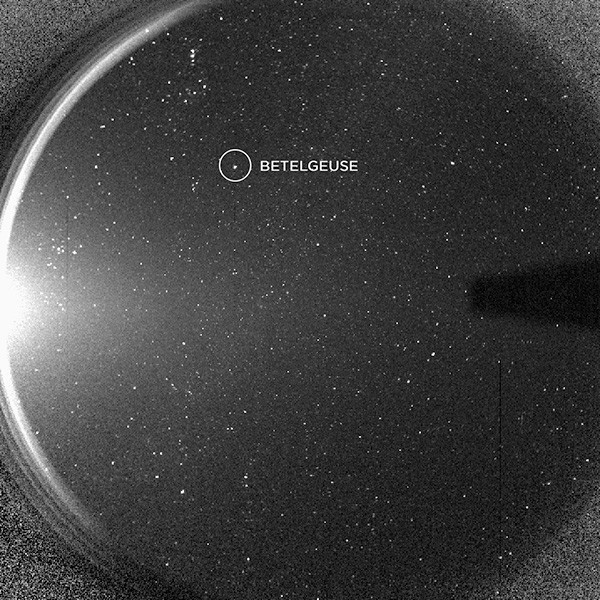
Scientific fascination with Betelgeuse intensified sharply following an anomalous event in late 2019. The star experienced the Great Dimming, dropping in brightness by about 60 percent over a matter of months. The dramatic fading prompted early speculation that the star was entering a pre-supernova phase, though it returned to its normal brightness by April 2020.
Subsequent analysis of data from observatories including the Hubble Space Telescope clarified that the star had undergone a surface mass ejection, blowing off a giant piece of its surface that cooled into a dust cloud and temporarily blocked its light. Astronomers classify Betelgeuse as a semiregular variable star with a primary 400-day cycle alongside a longer five-year cycle.
Future Monitoring and the Inevitable Supernova
While researchers are less convinced that an explosion is immediately imminent, the star remains a prime candidate for a future supernova. In the meantime, scientists plan to continue high-resolution monitoring to track how these persistent hotspots evolve in relation to mass loss, atmospheric structure, and internal convection.
Keep reading

Iron Waste and Magnetized Water Improve Sustainable Concrete Performance
Researchers examining sustainable construction alternatives report that combining industrial iron processing waste with dynamically prepared magnetized water can...

NIST Researchers Develop Scalable Superconducting Single-Photon Detectors
Researchers at the National Institute of Standards and Technology have developed a wider superconducting single-photon detector architecture using...
Menon and Adenot Replace Failed ISS Antenna During Spacewalk
On August 25, 2026, NASA astronaut Anil Menon and ESA astronaut Sophie Adenot ventured outside the International Space...
Partial Lunar Eclipse 2026 Visible in North America and the UK
North American stargazers and early-rising British observers can view a rare partial lunar eclipse in the early hours...