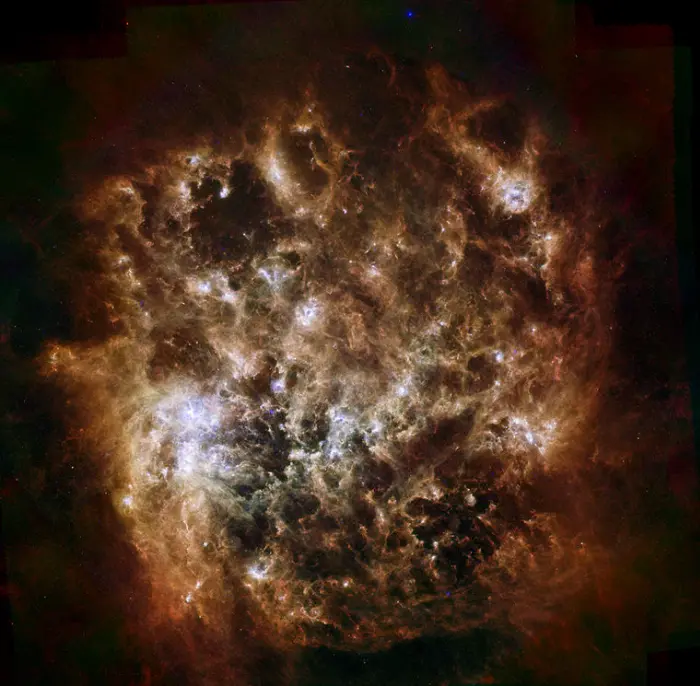
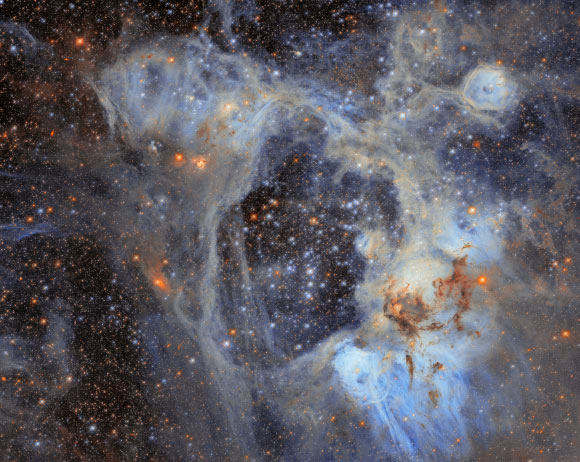
Astronomers using the NASA/ESA Hubble Space Telescope have revealed a vast cosmic superbubble within nebula N44, located 160,000 light-years away in the Large Magellanic Cloud. The central void spans roughly 210 by 140 light-years and was carved by stellar winds and explosive supernovae from a central cluster of glittering stars.
Space scientists have detailed a striking celestial feature captured by the NASA/ESA Hubble Space Telescope inside nebula N44, a highly active star birth site situated in the constellation of Dorado. The Large Magellanic Cloud itself, the Milky Way’s largest satellite galaxy, hosts this energetic environment roughly 160,000 light-years from Earth.
Anatomy of a Cosmic Superbubble in the Large Magellanic Cloud
The observed region is dominated by two primary structures: a massive central void and an outer shell composed of dense, dusty gas. According to updates from the NASA Hubble Mission Team, the central void forms a superbubble measuring approximately 210 by 140 light-years across. The cluster of glittering stars nestled at the center of this void generated the immense cavity through powerful stellar winds and explosive supernovae, which ultimately expelled much of the original gas from which the stars themselves were born.
“When the stars of N44’s central star cluster swept away this gas, the expelled gas formed a shell around the superbubble.”
NASA Hubble Mission Team
Stellar Nurseries and Historic Cataloging in N44
This sweeping evacuation of material did not simply dissipate into the void. Instead, the expelled gas compressed to form a dense boundary shell around the superbubble where new stars are actively forming. Researchers are utilizing N44 as a primary laboratory to study how stellar bodies emerge in such environments, aiming to understand the exact timeline from the collapse of cold gas clouds into dense knots to the moment nuclear fusion ignites in a newborn star.
Astronomers cataloged nearly half a million stars across the broader region using Hubble, including about 30,000 stellar objects still in their infancy before hydrogen fusion begins. The individual components of this star-forming complex carry a long history of observation, having first been cataloged by astronomer Karl Henize during the 1950s. Among these features is a smaller interstellar bubble designated as N44F, which was blown by the intense stellar winds of a single hot and massive star.
Contextualizing the Large Magellanic Cloud
The Large Magellanic Cloud spans 10 degrees of the southern sky across Dorado and Mensa and is easily visible to the unaided eye with an apparent magnitude of 0.13. As a Magellanic barred spiral galaxy classified as SB(s)m, it possesses a physical diameter of 32,200 light-years and contains approximately 20 billion stars, or upward of 30 billion depending on wide radio and infrared surveys. Its off-centre stellar bar and warped morphology point to historical tidal interactions with the Small Magellanic Cloud and the Milky Way.
Distance measurements to the galaxy have been refined over decades. While early estimates settled near 160,000 light-years using Cepheid variable stars—whose pulsating luminosity serves as a standard cosmic yardstick—subsequent analyses of late-type eclipsing binary systems by a team of astronomers established a revised distance of 163,000 light-years with a margin of error of just 2.2 percent.
Related reading
Hawaii Students Name Interacting Galaxies Nā ʻUhane Māhoe Huki Pū i ke Ola
Captured by the 8.1-meter Gemini North telescope on Maunakea, a striking pair of interacting spiral galaxies designated NGC...
Astronomers Release New Gallery of 16 Diverse Galactic Images
Astronomers have released a new gallery of 16 distant galactic images combining decades of X-ray data from NASA’s...
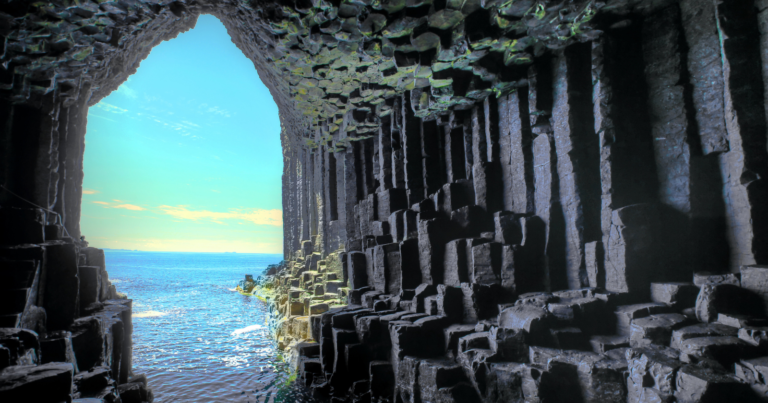
Fingal’s Cave in Scotland Inspired Mendelssohn With Its Volcanic Acoustics
Carved during the Paleocene epoch by North Atlantic volcanic activity and ocean erosion, Scotland’s Fingal’s Cave features soaring...
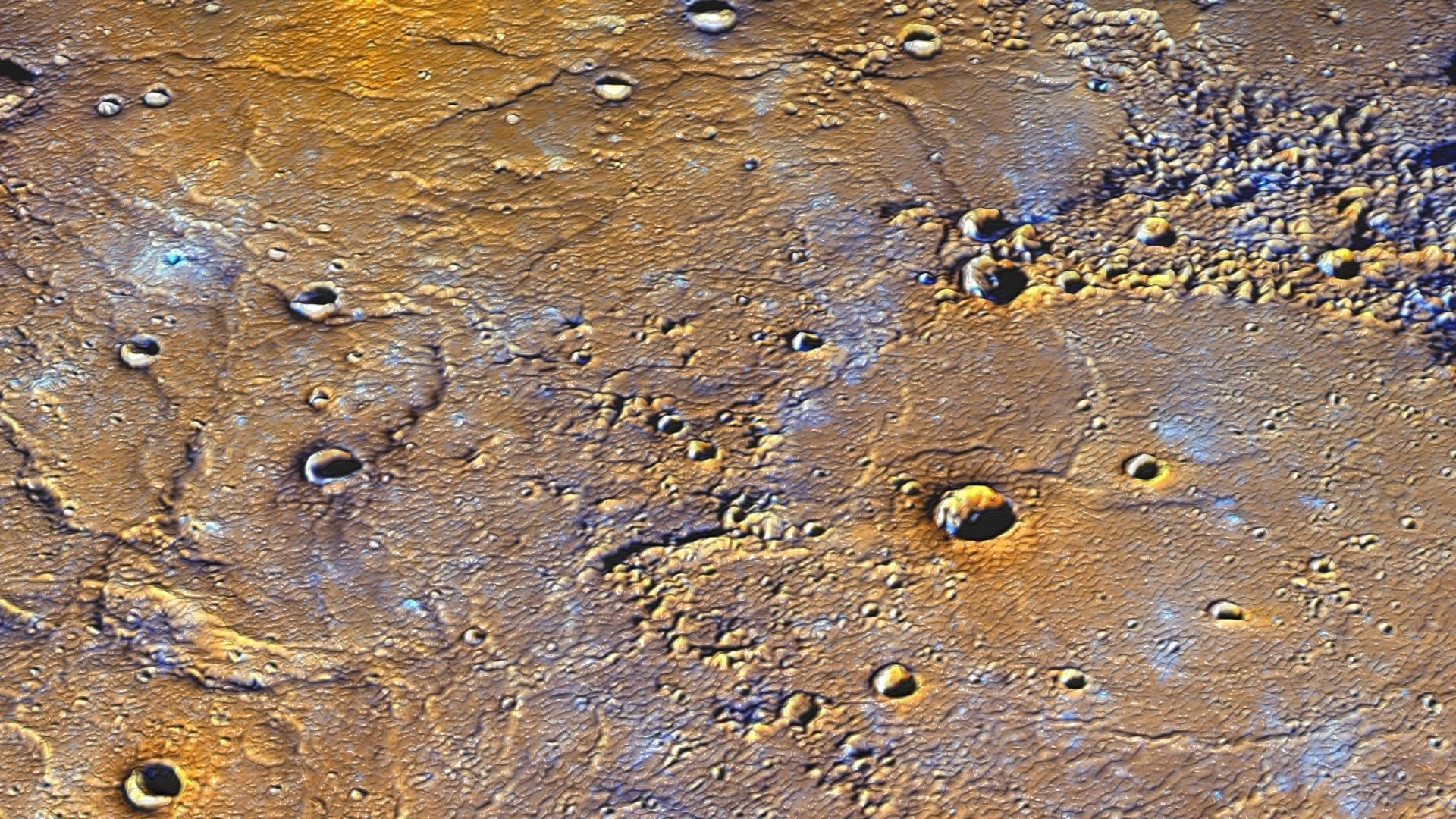
Mercury Surface Study Reveals Lower Silicon Dioxide Content Than Expected
Mercury’s surface contains roughly 37 percent silicon dioxide by mass, dropping up to 25 percent below previous estimates...