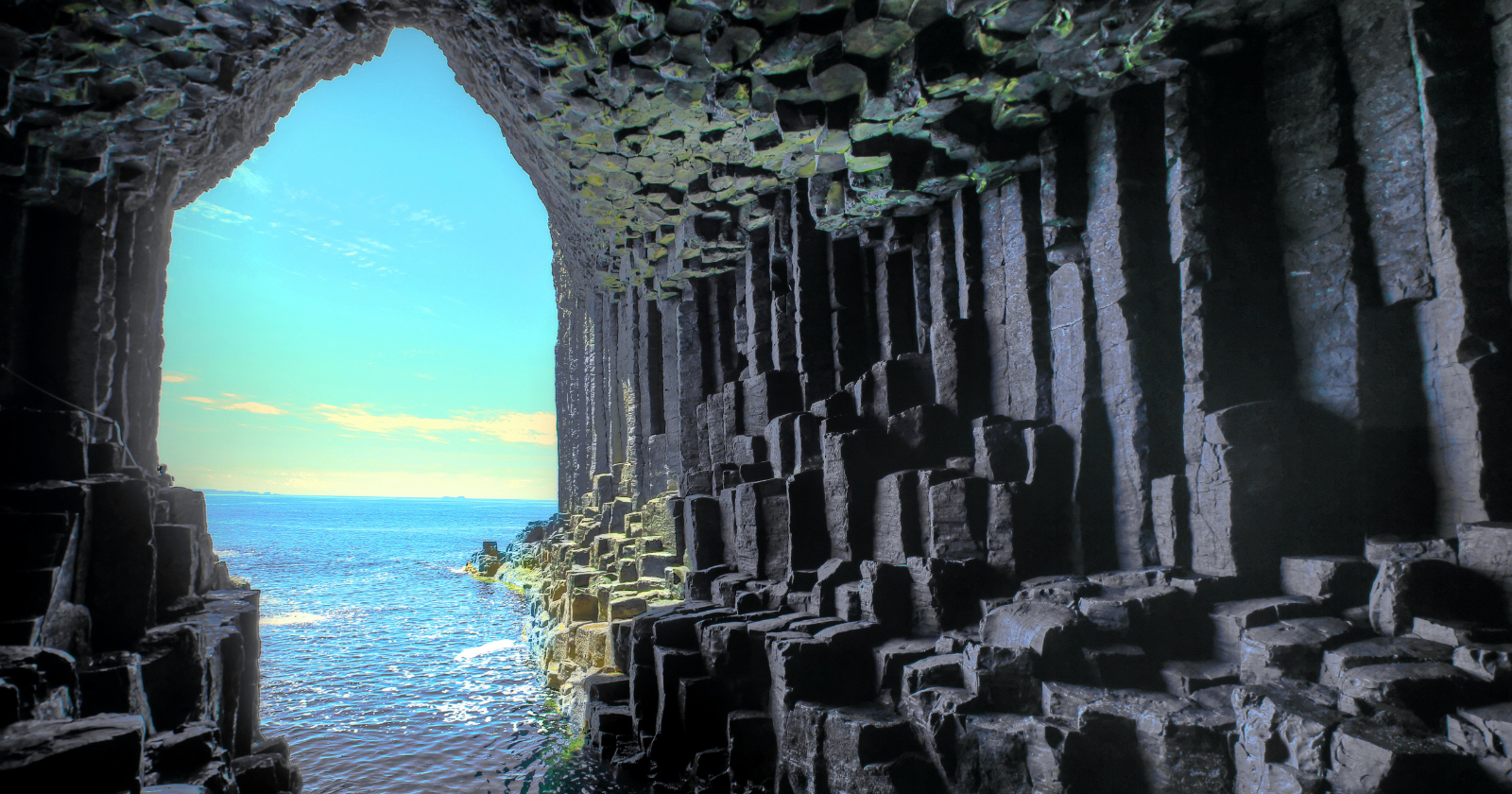
Carved during the Paleocene epoch by North Atlantic volcanic activity and ocean erosion, Scotland’s Fingal’s Cave features soaring hexagonal basalt columns and natural acoustics that inspired Felix Mendelssohn’s 1829 overture. Today, the uninhabited Inner Hebrides island of Staffa remains a popular destination accessible via seasonal sightseeing cruises from Oban and Mull.
Volcanic Origins and Geological Formation of Staffa Island
Atlantic waves carved a concert hall into 60-million-year-old volcanic
Staffa is what remains of an enormous system of lava flows belonging to the Palaeogene Mull volcanic centre, one node in a chain of North Atlantic volcanism that also produced Skye, Arran, Ardnamurchan and Rum, as the Geological Society of London records. Only the earliest flows in that sequence cracked into tidy columns. Hot rock contracts as it loses heat, tension builds, and the cheapest way to release that tension is to split. Cracks link into a rough honeycomb at the surface, then travel inward as the cooling front retreats, leaving long prisms behind. Most come out six-sided, though plenty come out five- or seven-sided instead. Fingal’s Cave extends 230 feet (70 meters) deep and 60 feet (18 m) high inside the small, uninhabited island of Staffa, located in Scotland’s Inner Hebrides, and was carved by a volcanic eruption sometime during the Paleocene epoch (66 million to 56 million years ago). Barthélemy Faujas de Saint-Fond described it in 1784 as this superb monument of nature, which in regard to its form bears so strong a resemblance to a work of art, though art can certainly claim no share in it.

Lucas Goehring, L. Mahadevan and Stephen Morris tested that cooling mechanism with cornstarch, of all things. Their paper in the Proceedings of the National Academy of Sciences found that starch dried in a laboratory cracks into columns about a hundred times smaller than basalt ones, yet geometrically similar to the fracture patterns at the Giant’s Causeway in Northern Ireland, a geological formation composed of more than 40,000 interlocking basalt pillars. Both sets of measurements collapse onto a single scaling curve, which points to one dynamical law running the show in a kitchen cupboard and in a lava flow alike, though the researchers were blunt that centuries of study had never produced a comprehensive physical account of how these patterns get their scale. Staffa carries at least nineteen sea caves, and the National Trust for Scotland, which owns the island as a national nature reserve, sets out the method: heavy ocean swells find the crevices between columns and snap off great pieces of basalt, then pick the broken blocks back up and hammer the cliffs with them, as every joint in the rock was a pre-cut line of weakness that the Atlantic just followed.
Fingal's Cave: Scotland's 'cave of melody' where eerie echoes
Cultural Discovery, Literary Visitors, and Musical Inspiration
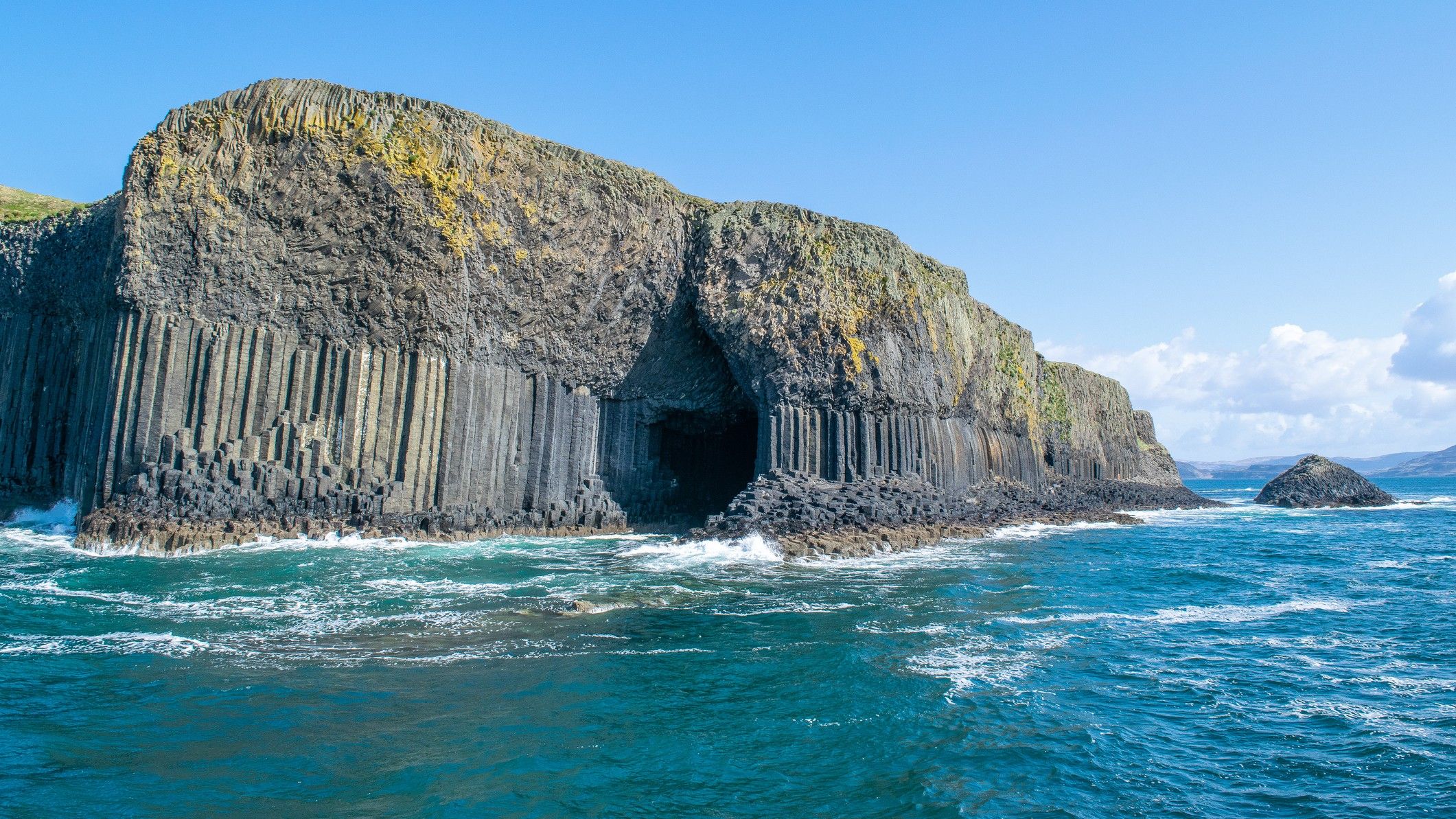
Vikings accidentally hitting Staffa island named it staffi-oy, coming from the Old Norse word for pillar or stave, because the appearance of the rocks was very similar to the appearance of their homes built out of wooden staves. Joseph Banks was not looking for a cave when he arrived fresh off Captain Cook’s first voyage. The cave gets its name from an Irish myth about a warrior called Fionn Mac Cumhaill, whose full name was shortened to Fingal, meaning white stranger,
who according to legend built the Giant’s Causeway across the sea to Scotland to fight a rival called Benandonner, with Fingal’s Cave remaining as Fionn’s path over the ocean on the Scottish side. The 18th-century Scottish writer James Macpherson popularized the name Fingal’s Cave with a book titled Fingal, an Ancient Epic Poem in Six Books
that was published in 1762.
Guide to Staffa Island & Fingal's Cave Tour from
Felix Mendelssohn was inspired by the natural acoustics and eerie echoes inside Fingal’s Cave, according to the National Trust for Scotland, and a nod to these unique sounds is also found in the cave’s Gaelic name, “Uamh-Binn,” meaning “cave of melody” or “musical cave.” Mendelssohn’s overture established Fingal’s Cave as a tourist destination, and other famous visitors include the authors Jules Verne and Robert Louis Stevenson, the poets John Keats and Lord Alfred Tennyson, and Queen Victoria.
Current Access, Tour Details, and Island Wildlife
The cave can still be visited today through organized sightseeing cruises.
Keep reading

Researchers Study Link Between Early Brain Development and Conditions Like Autism
Researchers using non-invasive tools like EEG and fMRI are probing infant brain development to pinpoint when consciousness emerges.

Artemis II Commander Recalls Moment He Feared Being Lost in Space
Artemis II Commander Reid Wiseman recalled a terrifying moment during his ten days in space earlier this year...

Researchers Recreate Planetary Turbulence in Laboratory Experiment
Scientists have successfully recreated an extreme, long-theorized form of planetary and stellar turbulence in a desktop-sized laboratory setting...

Iapetus Moon Visible Near Saturn on Thursday, October 22
Shining at 11th magnitude on October 22, Saturn’s two-toned moon Iapetus is currently passing south of the ringed...