
Researchers have recalibrated argon-argon dating using historical records from the 79 C.E. eruption of Mount Vesuvius, achieving 0.7 percent precision and 0.4 percent accuracy. Published in Science Advances, the findings provide a reliable geological benchmark to date ancient volcanic events and synchronize radioactive clocks across Earth’s history.
Nearly two thousand years after ash and pumice from Mount Vesuvius buried Pompeii and Herculaneum, the ancient catastrophe recorded by Pliny the Younger is transforming modern geochronology. To evaluate and fine-tune argon-argon dating—among the most adaptable radioactive clocks employed for measuring deep time—a joint group of researchers from the University of California, Berkeley, the Berkeley Geochronology Center, and Italy’s University of Padua utilized the historical disaster. Paul Renne, a Berkeley professor in residence of earth and planetary science along with his role as director of the independent Berkeley Geochronology Center, spearheaded the investigation alongside team members like Bill Cassata, Jack Carter, and Andy Tholt.
How Pliny’s Ancient Account Serves as a Natural Standard
Most geological dating methods rely on a chain of laboratory inferences, where small errors in one technique can compound across measurements. Vesuvius offers a rare exception. Because Pliny the Younger documented the first-century explosion with extraordinary detail, scientists rely on written history rather than radiometric estimation to know when the mountain blew. According to the sources, Pliny’s letters play an important role because they provide an eyewitness description of the disaster and identify August 24 as the day it began, while other Roman historical records place the disaster in 79 C.E.
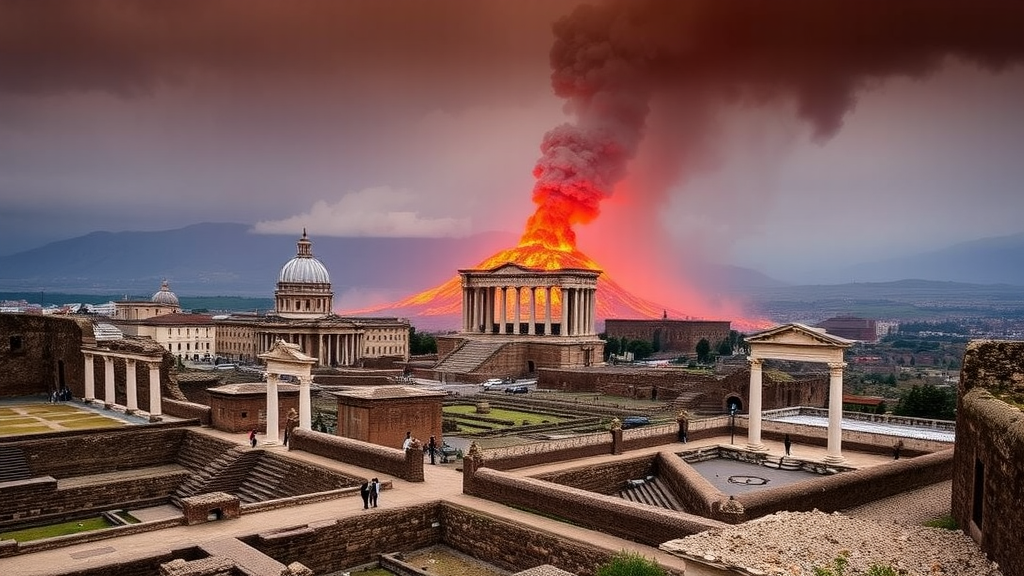
That historical record gives researchers an independent benchmark to test and refine laboratory techniques. While some historians and archaeologists have debated whether the eruption occurred on the traditional August 24, 79 C.E. date or later in the autumn—pointing to food remains, clothing, graffiti, and a disputed coin found at Pompeii—graduate student Caroline Hasler led a review of the historical evidence, allowing for a generous two-month uncertainty window. Before the research group selected August 24 as their baseline, Hasler examined that documentation and determined there is no persuasive cause to dismiss the conventional August 24 date advocated by Pliny and Roman historian Cassius Dio.
Laboratory Advances and the Oplontis Pumice Samples
The experiment centered on sanidine, a potassium-rich volcanic mineral found in pumice collected from Oplontis, another Roman settlement buried by the same eruption. Co-author Andrea Marzoli of the University of Padua had collected these potassium-rich samples back in 1998 from the lowest strata of the volcanic deposits.
Those shelved samples sat unanalyzed for nearly three decades before researchers retrieved them to improve upon an earlier 1997 analysis. Modern multicollector mass spectrometers, updated neutron irradiation techniques, and carefully shielded sample wells allowed the team to process 153 incremental heating measurements from roughly 700 milligrams of mineral across eight uncontaminated irradiation wells.
“It was really just a combination of better samples, instrumental advantage and a more concerted effort. All of those things came together.”
Paul Renne, Berkeley professor in residence of earth and planetary science and director of the Berkeley Geochronology Center, via Berkeley and ZME Science
The resulting measurements produced an age of 1,938 ±13 years before the samples were analyzed in 2025 (or 1,938 ±10 years from the incremental heating before statistical scatter expanded the uncertainty to ±13 years). When compared against the historical age derived from Pliny’s writings, which pointed to an actual age of 1,946 years, the estimate achieved a precision of 0.7 percent and an accuracy of 0.4 percent.

Calibrating Deep Time and Mitigating Modern Volcanic Threats
Argon-argon dating tracks the slow, steady decay of potassium-40 into trapped argon-40. Because younger volcanic rocks have experienced less radioactive change, dating them with high precision has historically proved difficult. The Vesuvius benchmark provides a crucial reference point that helps unify argon-argon dating with other systems, such as carbon-14 dating for organic materials and uranium-lead dating for billion-year-old rocks from the early days of planet Earth.
Sharper dating methods carry practical benefits for densely populated regions situated near hazardous volcanic systems. Researchers can better reconstruct eruption histories for active volcanoes that still threaten dense urban populations in Naples, Mexico City, and Yogyakarta in Indonesia.
Related reading
New Iron Minerals Could Hold Primordial Water at Earth’s Core-Mantle Boundary
Newly discovered iron oxyhydroxide minerals stable at core-mantle boundary conditions could hold up to 15% water by weight,...

NASA Targets 2028 for Boeing Starliner Crewed Flight After Overhauls
NASA Administrator Jared Isaacman announced on Monday that Boeing's Starliner spacecraft is targeted for a crewed flight in...

Researchers Identify Two New Sea Spider Species in the Salish Sea
Researchers have identified two previously unknown species of sea spiders in the Salish Sea, marking the first such...
NASA Viking Missions Mark 50 Years Since Historic Search for Life on Mars
Fifty years ago, NASA's Viking missions conducted the only direct search for extraterrestrial life in history.