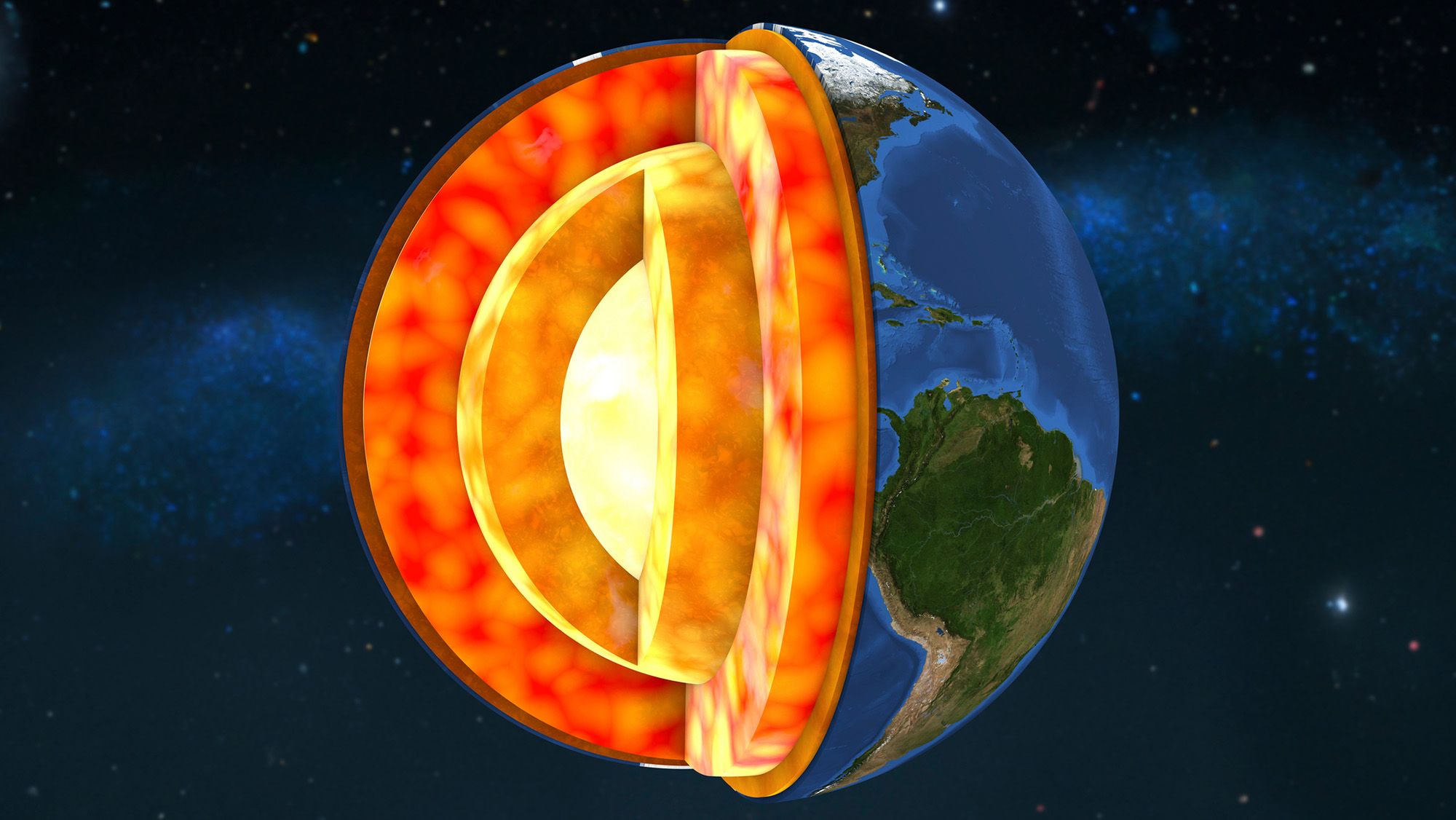
Newly discovered iron oxyhydroxide minerals stable at core-mantle boundary conditions could hold up to 15% water by weight, offering a potential primordial reservoir for Earth’s oceans and explaining ultra-low seismic velocity patches deep inside the planet, according to research published on September 8, 2026.
Deep beneath the surface, past the moving crust and the giant ocean of molten rock, scientists have identified iron minerals that might solve a long-standing planetary puzzle. Researchers discovered the iron minerals, called iron oxyhydroxides, by placing mineral samples between tiny diamond anvils and zapping them with a laser.
Extreme Pressure Stability at the Core-Mantle Boundary
These newly identified minerals remain stable under the extreme conditions found where Earth’s core meets its lower mantle. Steve Jacobsen, a mineralogist and professor of Earth science at the University of Colorado Boulder who was not involved in the study, noted that this region sits under more than a million times the pressure we feel at the surface,
as reported by the outlet.
The physical composition of these iron oxyhydroxides allows them to store significant amounts of water within their molecular structure.
- The minerals contain as much as 15% water by weight.
- A five-pound piece of this material would contain roughly a pint of liquid water.
- Just a few percent of this material spread across the base of the mantle could theoretically supply the formation of the Earth’s oceans.
“If you add up all the H and O atoms in the formula and combine them into H2O, just a five-pound piece of the stuff would contain a pint of liquid water,” Jacobsen added. “If this material existed in the early Earth, spread out across the base of the mantle, even just a few percent of it would potentially be enough to supply the formation of the oceans.”
Steve Jacobsen, mineralogist and professor of Earth science at the University of Colorado Boulder, via Livescience
Reconciling Subduction and Primordial Water Theories
Geologists have long debated how water entered the mantle, which acts as the stretchier, molten intermediary layer driving plate tectonics. Without water making this rock pliable, the material would remain too stiff to move the crust. Two primary theories dominate the field: subduction, where sinking tectonic plates drag surface water downward, and primordial water trapped near the core since planetary formation.
The newly found iron minerals fit both models. Because they are dense enough to sink to the bottom of the mantle, they align with subduction mechanics while also possessing the structural strength to endure the high-energy impacts characteristic of early planetary formation. Mantle convection could also transport these minerals upward in large plumes, where melting would release their water to fuel volcanic hotspots at the surface.
Implications for Seismic Anomalies and Exoplanet Research
Published on September 8 in Nature Geoscience, the study does not definitively prove these minerals currently transport water through the mantle, but it establishes a viable physical pathway for the first time. Beyond Earth’s internal cycle, the existence of these dense iron reserves offers a potential explanation for mysterious, ultra-low seismic velocity patches we see sitting on top of the core-mantle boundary,
according to Jacobsen. Understanding these mineral reservoirs also broadens theoretical models for water cycles on rocky exoplanets dominated by molten rock.
Keep reading
NASA Targets 2028 for Boeing Starliner Crewed Flight After Overhauls
NASA Administrator Jared Isaacman announced on Monday that Boeing's Starliner spacecraft is targeted for a crewed flight in...
Researchers Identify Two New Sea Spider Species in the Salish Sea
Researchers have identified two previously unknown species of sea spiders in the Salish Sea, marking the first such...
NASA Viking Missions Mark 50 Years Since Historic Search for Life on Mars
Fifty years ago, NASA's Viking missions conducted the only direct search for extraterrestrial life in history.
NASA Roman Telescope Powers Up 300-Megapixel Instrument in Space
NASA’s Nancy Grace Roman Space Telescope launched aboard a SpaceX Falcon Heavy rocket and has now successfully powered...