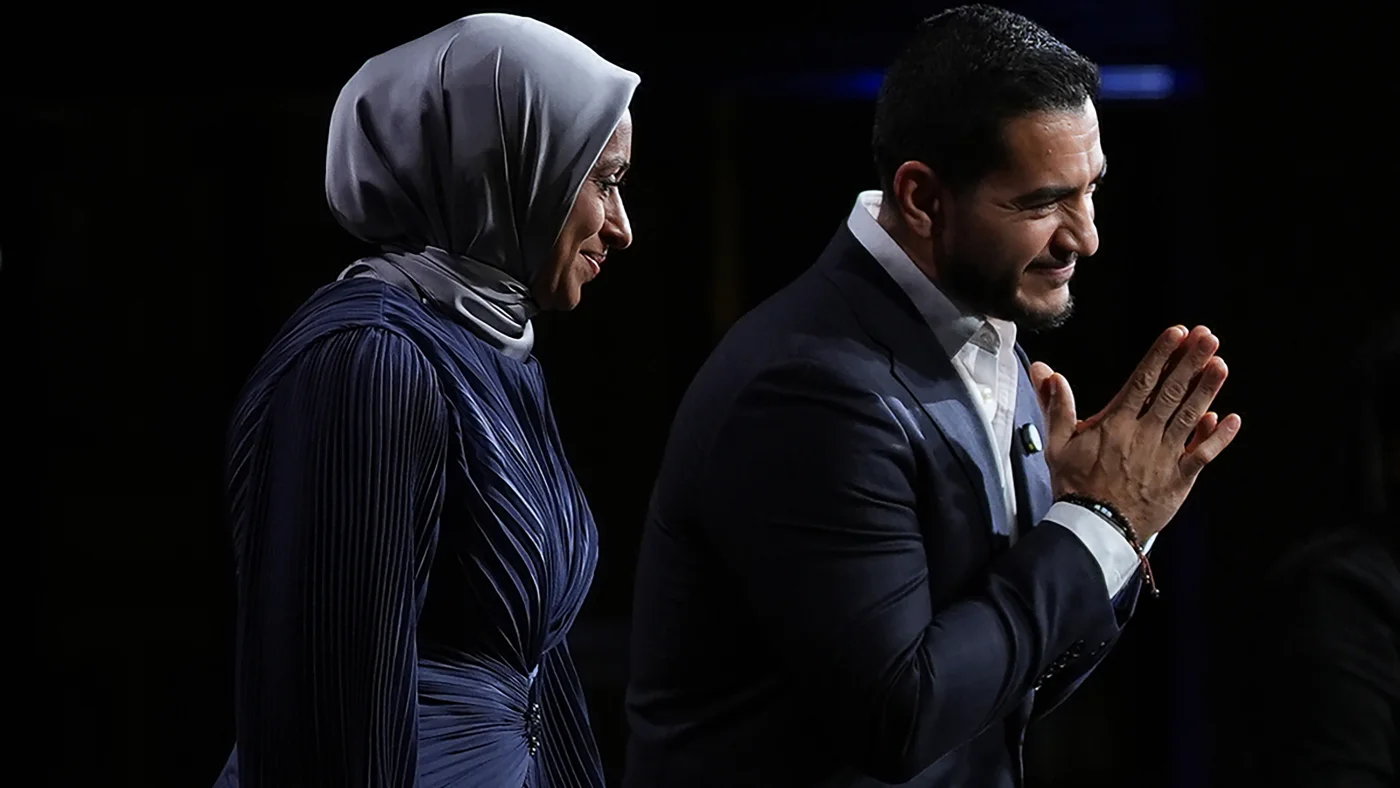
Abdul El-Sayed Welcomes Trump’s Plan to Cut $4 Billion in Israel Aid
“I think the president is actually right on this policy,” Abdul El-Sayed said. The 42-year-old Democrat, who made history Tuesday by becoming the first Muslim elected to the U.S. Senate from Michigan, was welcoming President Trump’s announcement that the United States plans to end roughly $4 billion in annual military aid to Israel by the end of the year, though the president offered no details on how the cuts would work, NPR reported.
El-Sayed defeated Republican Mike Rogers to win Michigan’s open Senate seat, a victory that helped Democrats reclaim control of Congress. The former public health official campaigned on lowering costs for working families, Medicare for All, and getting corporate money out of politics. But Israel and the war in Gaza became the defining fault line in the race, with Rogers—who was backed by President Trump—repeatedly attacking El-Sayed over his Muslim faith and his opposition to U.S. military aid to Israel.
Now the incoming senator finds himself aligned with Trump on a policy that bitterly divided his own party. Speaking to NPR’s Morning Edition after his victory, El-Sayed endorsed the aid cut and went further, calling for an end to arms sales. “I’d also like to see us stop selling weaponry that gets used to do the worst things, including genocide and apartheid, to Israel,” he said.
Trump’s Cut Would End $3.8 Billion Annual Aid Agreement
The arithmetic of Trump’s plan would upend a decades-old arrangement. Under a standing agreement that runs through 2028, the United States provides Israel with $3.8 billion in annual military aid. Trump’s proposal to end roughly $4 billion by the end of the year would effectively dismantle that framework, though the administration has not explained how the transition would work, what programs would be affected, or what would replace the funding.
El-Sayed’s critique extends well beyond Israel. He also questioned U.S. military support for Egypt, Saudi Arabia, Jordan, and Pakistan, arguing that American tax dollars should be spent at home rather than bankrolling foreign governments. For a senator-elect from a critical Midwestern swing state, the position marks a sharp departure from the bipartisan consensus that has long supported foreign military financing as a tool of American influence.
Rogers Attacked El-Sayed’s Faith in Michigan Senate Race
The Michigan contest turned particularly bitter over Israel. Rogers attacked El-Sayed’s Muslim faith throughout the campaign, while Haley Stevens—the candidate El-Sayed defeated in the Democratic primary—endorsed Rogers just days before the election amid a heated dispute over Israel policy. The primary contest revealed deep fractures in the Democratic coalition, and while visiting Michigan ahead of the election, NPR’s Michel Martin heard concerns about El-Sayed from some Jewish and Black voters who questioned his positions.
Asked if he still needed to work to win their support, El-Sayed said the election results challenged that narrative. “There’s always more work to do. There’s always more to build. There’s always more conversations to have,” he said.
Winning Michigan’s Senate seat, however, does not mean every division within his party has disappeared. The fault lines over Israel and Gaza remain sharp, and El-Sayed acknowledged that coalition-building continues even after the votes are counted.
El-Sayed Questions Military Aid to Egypt, Saudi Arabia, Jordan and Pakistan
If Trump follows through on ending the roughly $4 billion in annual aid by the end of the year, it would represent one of the most significant shifts in U.S.-Israel relations in a generation. The current $3.8 billion agreement, locked in through 2028, has served as a cornerstone of American policy in the Middle East for decades.
El-Sayed’s call to halt weaponry sales—citing genocide and apartheid—puts him at odds with most of his future Senate colleagues, including many Democrats who support conditioning but not cutting aid. Yet he enters Washington with a mandate from Michigan voters who backed his broader argument that the billions sent annually to Israel, Egypt, Saudi Arabia, Jordan, and Pakistan would be better spent addressing healthcare costs and economic struggles at home.
“There’s always more work to do,” El-Sayed said, closing the interview with a reminder that his unlikely agreement with Trump on Israel aid is only one piece of a larger debate over American military spending and moral leadership abroad.
Worth a look

Gabe Vasquez wins reelection in New Mexico’s 2nd district race
Vasquez Holds New Mexico's 2nd District as National Money Floods the Race Incumbent Democratic U.S. Rep. Gabe Vasquez...

Manchester Commons Offers Comprehensive Senior Care in Erie
Manchester Commons of Presbyterian Senior Care stands as one of Erie, Pennsylvania's large-scale senior living communities, offering residents...

Mikie Sherrill urges port operators to turn away Russian diesel
Diesel at the pump is averaging $6.29 per gallon nationwide as of Tuesday morning, down from $6.50 just...

2 Nevada Ballot Questions Pass on Abortion Rights and Voter ID
Nevada voters have rewritten their state’s foundational legal document, approving two ballot measures on Election Day that simultaneously...