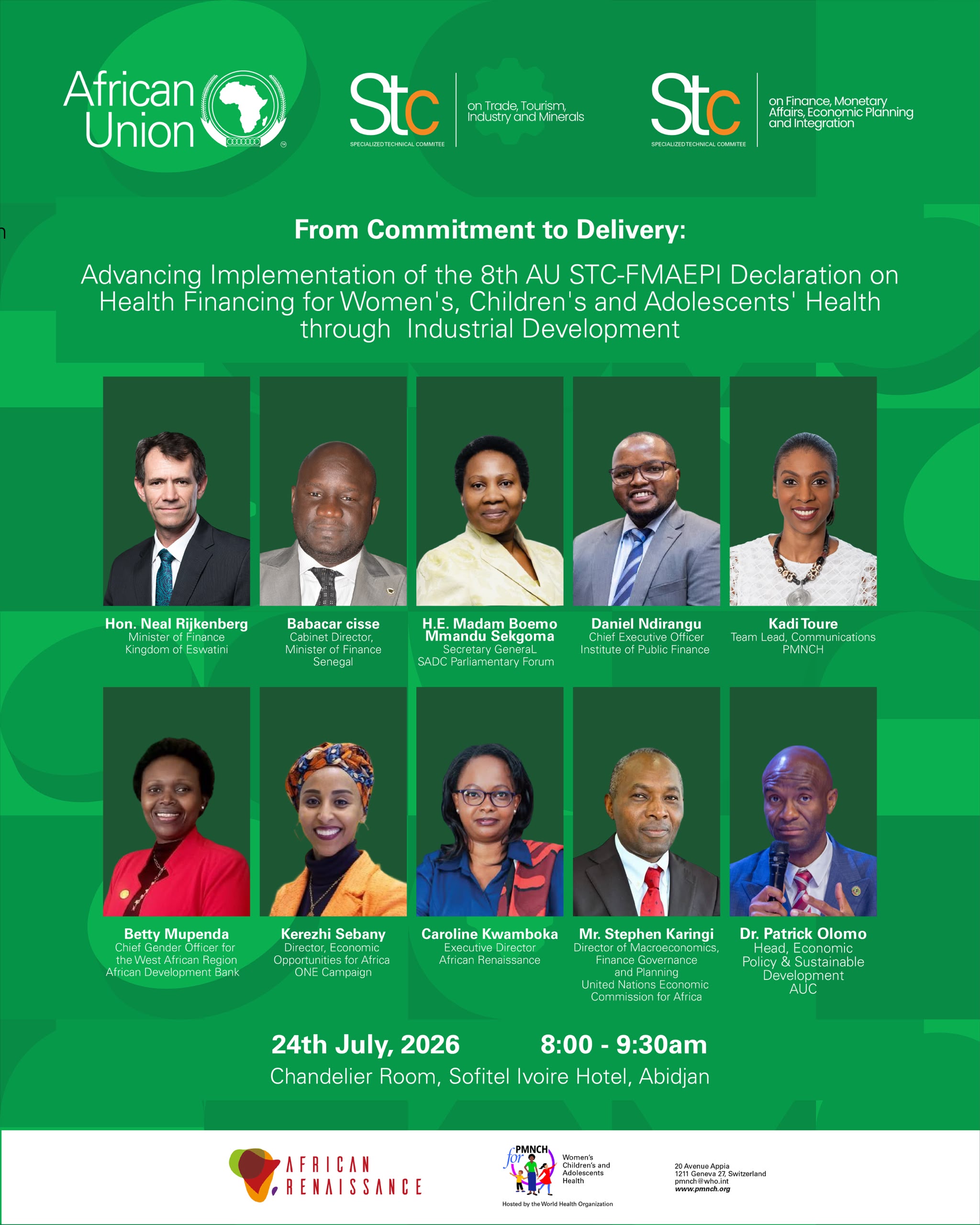
As external health aid to Africa falls sharply, ministers, financiers, and health leaders gathered in Abidjan, Côte d’Ivoire, on July 24, 2026, to confront a growing financing crisis.
Every year, 260,000 women die from causes related to pregnancy and childbirth—a toll equivalent to filling a World Cup stadium to capacity and losing every person inside it seven times over. Alongside them, nearly 5 million children die before their fifth birthday, and 1.9 million more are stillborn. These sobering figures frame what health leaders describe as the compounding toll of a health financing system losing ground across Sub-Saharan Africa.
On the margins of the African Union’s Specialized Technical Committee sessions in Abidjan, Côte d’Ivoire, regional leaders gathered to revisit a Ministerial Declaration adopted in October 2025. That declaration called for stronger domestic health financing, innovative taxes, and better public financial management. A year later, participants confronted an increasingly severe fiscal reality.
The Funding Crunch and Real-World Impact
Official development assistance fell 23 percent in 2025, marking the steepest single-year cut on record, with further declines projected. Funding for health specifically dropped 21 percent, and Sub-Saharan Africa absorbed the deepest losses of any region at 25 percent. Furthermore, in four out of every ten countries, governments now spend more servicing debt than they spend on health or education combined.
A survey conducted by the Partnership for Maternal, Newborn & Child Health (PMNCH) revealed that nearly 90 percent of member organizations had been directly affected by the funding cuts. Over 60 percent of those organizations reported being forced to downsize programs, disproportionately hitting community health and sexual and reproductive health services—the very areas that reach women and adolescents first.
Progress that had previously cut maternal and child deaths by roughly 40 percent since the early 2000s has slowed sharply since 2016. Only three countries on the continent currently meet the Abuja target of allocating 15 percent of government spending to health.
At the 7th Collaborative Advocacy Action Plan Peer Learning Exchange, advocates from ten countries—including Kenya, Senegal, Tanzania, Malawi, Nigeria, Ethiopia, Sierra Leone, and South Africa—shared lessons on navigating these fiscal pressures. Country representatives discussed practical solutions, such as Ethiopia’s matching-fund compact model, which transforms political commitments into available funding, and Malawi’s unified civil society coalition strengthening engagement with government stakeholders.
Innovative Domestic Financing and Local Manufacturing Solutions
Despite the grim numbers, participants emphasized delivery and domestic resource mobilization rather than resignation. African Union Commission’s Dr. Patrick Ndzana Olomo framed the work ahead as an essential shared climb.
Ministers brought concrete examples of how delivery can look in practice. Eswatini’s Minister of Finance, Hon. Neal Rijkenberg, described a debt swap arrangement with the African Development Bank, supported by the Gates Foundation, that channels every dollar of savings directly into health. He also advocated for a right-of-supply model enabling African manufacturers to compete in producing essential health commodities.
The manufacturing challenge remains stark, as Africa imports 80 percent of its health commodities, including 60 percent of the tranexamic acid used to control postpartum hemorrhage, the leading cause of maternal death. To close this gap, Senegal highlighted the Institut Pasteur de Dakar’s Project MADIBA, a public-private partnership blending commercial and concessional finance from the IFC and the African Development Bank with support from the Mastercard Foundation to build domestic vaccine production.
Malaria, Disease Burdens, and Regional Roadmaps
The broader financing crisis intersects directly with persistent disease threats. A perfect storm of drug and insecticide resistance, climate change, population growth, and funding shortages has stalled fundamental progress against malaria, leaving Africa off track to meet elimination targets.

External health aid to Africa fell by 70 percent between 2021 and 2025, while recent Global Fund and Gavi replenishments fell short of their targets. To bridge the gap, countries are turning to targeted instruments such as National End Malaria Councils and Funds. Active in 12 countries, these councils have raised over $228 million by uniting governments, the private sector, traditional leaders, youth, and civil society behind national goals.
As leaders prepare for continental summits, the focus centers squarely on implementing the African Union Roadmap to 2030 and Beyond, ensuring that high-level declarations translate into functioning clinics, reliable medicine supplies, and preserved lives across every community.
Worth a look

Venus and Crescent Moon to Align in September 2026 Sky
Stargazers caught a striking view on the evening of September 13, 2026, when Venus shone brightly beside a...

Worker Dies After Being Struck by Compressed Air Hose at Jurong Port Road
A 35-year-old worker died at a Jurong Port Road construction site on September 11, 2026, after being struck...

Singapore Police Investigate Three Traffic Officers Over Unsafe Riding Footage
The clip, which surfaced online, shows the outriders cutting across lanes and forcing sudden braking near the Traffic...

Justice Department Deports Legal Resident to Afghanistan in First ATRC Case
The Justice Department deported a 47-year-old legal U.S.