
Researchers have documented a previously unknown orca feeding and socialization strategy in the Mexican Pacific and Gulf of California, where killer whales were filmed coordinating to ram dead sharp-tail sunfish with such explosive force that the heavy carcasses shattered into thousands of tiny fragments.
Cooperative Ramming Caught on Video in Mexican Waters
The rare hunting and food-processing behavior was captured during two separate encounters spaced more than a year apart. On July 29, 2024, marine scientist Kathryn Ayres filmed the first event while working as an ocean safari tour guide near San José del Cabo in Baja California Sur. Observing the pod from the water, she recorded an adult female gripping a massive sharptail sunfish by its large tail fin—known as the clavus—while an adult male accelerated from a distance and barreled straight into the carcass.
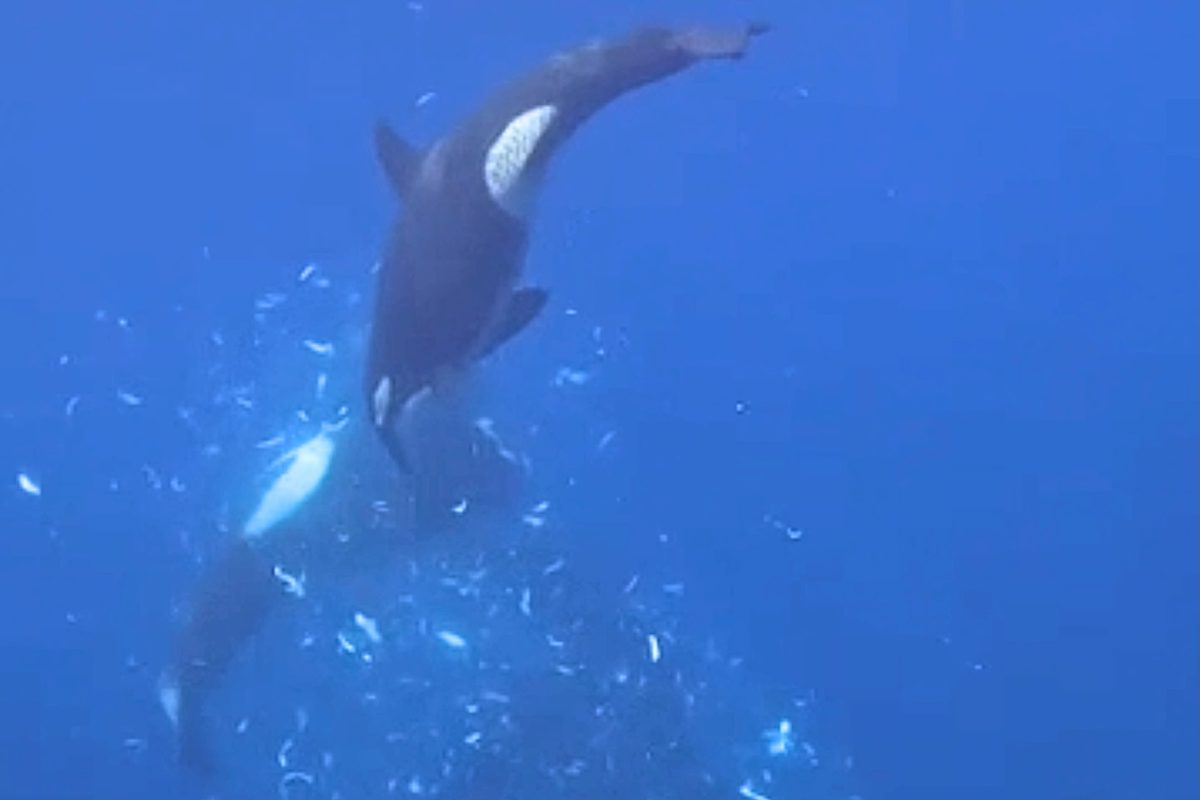
The impact completely fragmented the prey. A second identical incident followed in September 2025 in the Gulf of California, filmed by ecotourism digital creator Héctor Franz. Both events demonstrated precise teamwork between the marine mammals. One orca held the heavy prey steady to act as a target, letting go at the final fraction of a second before its podmate struck.
Kathryn Ayres, a research scientist for Beneath The Waves, said she couldn’t believe what she was witnessing when she filmed the first event several years ago. She noted that the outcome was unique, as seeing the sunfish fragment into countless pieces was unlike anything she had encountered before.
Targeting Heavy Prey With Specialized Biology
Because these giant molas possess incredibly dense, rubbery, and collagenous skin several inches thick alongside a gelatinous outer capsule, consuming them presents distinct mechanical challenges for marine predators.

Researchers analyzing the footage suggest that the impacts served to process the prey rather than kill it, as both sunfish were already dead when the ramming occurred. Examining the interaction in the journal Frontiers of Ethology, the study authors noted that adult orcas consumed the main body of the carcass while calves and juveniles largely fed on the floating fragments.
“Orcas do not possess hands or tools to tear apart their prey… so ramming sunfish to bite-size pieces is incredibly practical.”
Erick Higuera, executive director of Orcas México and study co-author
Marine ecologist Robert Pitman of Oregon State University, who was not involved with the research, noted that the high-speed shattering technique likely prevents older or younger orcas from wearing down their teeth against the thick, abrasive skin of the heavy fish.
Weighing Practical Feeding Against Playful Social Behavior
While breaking down heavy carcasses into bite-sized pieces offers a clear nutritional advantage for developing young, researchers emphasize that the explosive stunt may also serve a recreational purpose.
Furthermore, Ayres noted that internal organs—the most nutrient-dense portions of the sunfish—had already been consumed before the high-speed ramming took place, leaving open the possibility that the final destruction was driven by entertainment rather than immediate hunger. Whether this localized technique represents a broader cultural tradition shared across other killer whale populations remains an open question for marine biologists tracking regional pod behaviors.

SpaceX Launches Final Three O3b mPOWER Satellites for SES
SpaceX successfully launched the final three O3b mPOWER satellites for SES on September 13, 2026, from Cape Canaveral...

Japan Launches Kaguya Spacecraft to Map Moon in 2007
On September 13, 2007, Japan launched its advanced Kaguya spacecraft from the Tanegashima Space Centre aboard an H-IIA...

Astronomers Identify Eos, a Massive Molecular-Hydrogen Cloud Near the Sun
Astronomers have identified Eos, a massive molecular-hydrogen cloud located roughly 300 light-years away and spanning 40 full-Moon widths...
Researchers Find Diamond Melting Point Is Lower Than Previously Measured
Researchers zapping synthetic diamond plates with a powerful ultraviolet laser discovered the mineral's melting point is more than...