
Alabama school spending declines in real terms as inflation outpaces budget increases
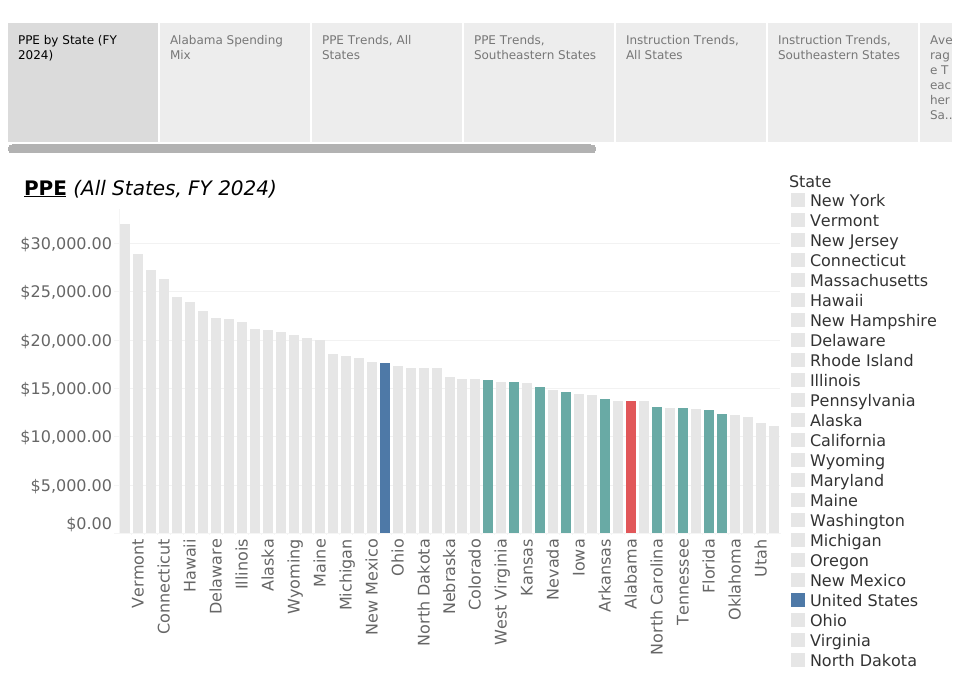
Alabama public schools spent more money per student last year in nominal dollars, but rising costs effectively wiped out those gains, according to newly released state spending records. While the average expenditure per K-12 student rose to $13,629 during the 2024-25 school year, the actual purchasing power of that money dropped by approximately $102 per student once inflation was factored in, The Alabama Baptist reported.
The data, which comes from fiscal year 2025 school spending reports released Oct. 20 by the Alabama State Department of Education, reveals a complex shift in how education is being funded across the state. While the statewide average suggests a slight decline, the reality on the ground varies significantly depending on the district. Nearly 44% of the 1,334 schools with comparable data for both years saw their inflation-adjusted spending per student drop by more than 1%, with some declines approaching 40%.
The end of the pandemic relief era
A primary driver of this shift is a massive reduction in federal support. Federal expenditures among 1,342 schools with available financial data fell by about $602 million, a 32% decrease from the 2023-24 school year. This downturn aligns with the conclusion of the multi-billion-dollar federal pandemic relief programs; the deadline for schools to commit the final round of those funds was Sept. 30, 2024.
State and local governments attempted to bridge this gap, but they couldn’t quite close the hole left by the vanishing federal dollars. State-funded expenditures rose by roughly $527 million, and local funding saw an increase of $199 million. Despite these injections of cash, the total amount of “real” money available to classrooms fell short of the previous year’s capacity.
For context, spending in the 2023-24 school year had reached the equivalent of $13,731 per student. The slip to $13,629 represents a cooling period following the height of the pandemic-era funding surge.
A tale of two different spending models
The financial landscape for Alabama schools is far from uniform. While the statewide average shows a slight dip, 47% of schools actually gained more than 1% in purchasing power. This divergence highlights how different school structures and local tax bases create vastly different classroom realities.
Small schools often face higher per-student costs because they must maintain the same basic operating infrastructure as larger schools but have fewer students to distribute those costs across. Similarly, schools serving students with significant disabilities or specialized program needs naturally command higher expenditures. Par Alabama notes that Alabama’s spending priorities also show unique national standing. For example, the state devotes 8.1% of its Personnel Expenditures (PPE) to student support services—covering counseling, nursing, and social work—ranking 16th nationally in that category.
However, other areas show a lean approach. Alabama spends only 4.7% of its PPE on instructional staff support services, such as curriculum development and technology, which ranks 38th nationally. In contrast, the state spends $413 per pupil on general administration, a figure that exceeds the national average of $351. Par Alabama points out that much of this administrative spike was driven by a single reporting anomaly in Mobile County, which recorded a non-administrative expense under that category. Without that anomaly, the state’s administrative share would sit closer to 2.7%.
The following table compares the high-level spending shifts noted in the state reports:
| Funding Source/Metric | Change/Value (2024-25) |
|---|---|
| Average Spending per K-12 Student | $13,629 |
| Inflation-Adjusted Change per Student | -$102 |
| Total Federal Expenditure Change | -$602 million (32% drop) |
| Total State Expenditure Change | +$527 million |
| Total Local Expenditure Change | +$199 million |
Long-term growth remains intact
Despite the recent dip in purchasing power, the long-term trajectory for Alabama education funding remains upward. When compared to the 2018-19 school year, when schools spent an average of $9,887 per student, the current spending level represents a significant increase. Even after adjusting for inflation, the 2024-25 spending is approximately 9% higher than it was six years ago.
This growth was largely fueled by the influx of federal relief money and rising state education funding in the years immediately following the pandemic. As those temporary federal lifelines disappear, the state faces the challenge of maintaining that momentum through sustainable local and state revenue. The current data suggests that while the “emergency” era of funding has ended, the baseline for Alabama’s educational investment is higher than it was in the pre-pandemic years.
The ability of the state to provide a high return on investment will likely depend on how effectively these resources are directed toward targeted, evidence-based interventions as the federal cushion continues to thin.
Related reading

Three men indicted in Hartford drug trafficking ring, feds say
Federal prosecutors indict three men in Hartford drug trafficking investigation Three men face federal charges for allegedly operating...

DOJ Targets Democratic Election Lawyers in Alaska Ballot Probe
Department of Justice targets Democratic operatives in Alaska ballot probe Federal investigators have issued target letters to a...

Simpson Manufacturing (SSD) Q3 2026 Earnings: $1 Billion Buyback and Rising Steel Costs
Steel Inflation Forces Simpson Manufacturing to Pivot on Pricing Simpson Manufacturing (NYSE: SSD) is facing a significant margin...

Cheyenne Considers $1 Million Expansion for Reed Avenue Corridor Project
The cost of reimagining Cheyenne’s West Edge is climbing toward a new milestone. The Cheyenne Finance Committee is...