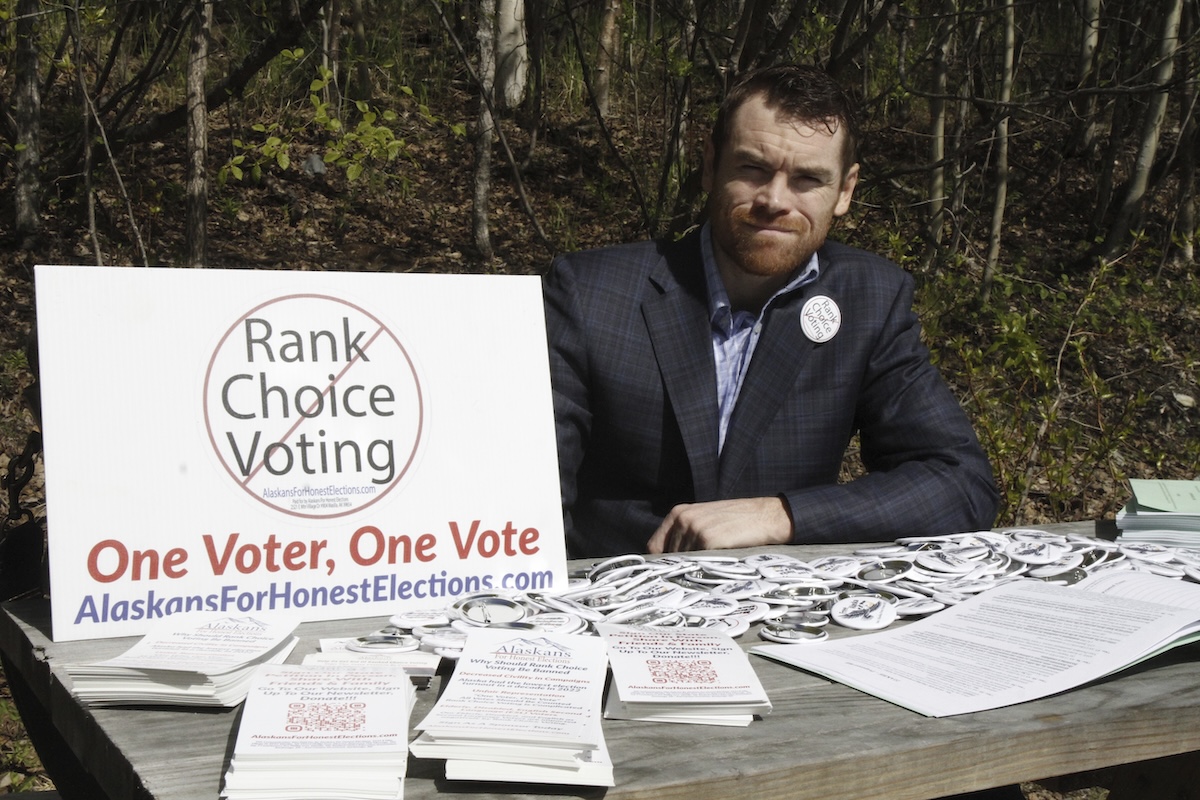
Alaska voters rejected a measure to repeal the state’s ranked-choice voting system in the Nov. 3 election.
The defeat of Alaska Ballot Measure 2, which would have replaced the current top-four primaries and ranked-choice general elections with traditional party primaries and single-choice voting, came with a 54% to 46% margin. Decision Desk HQ called the race on Nov. 12.
While voters originally adopted the ranked-choice voting and top-four primary system in 2020 with a 50.6% to 49.5% vote, the 2024 attempt to repeal it was decided by a narrow margin, with voters rejecting it 50.1% to 49.9%.
Under the existing Alaska framework, candidates participate in a single primary election regardless of party affiliation. The four candidates who receive the highest vote totals advance to the general election, where voters rank their preferences among those four candidates.
A candidate must secure a simple majority of 50% plus one vote to win. If no one reaches that threshold, the candidate with the fewest votes is eliminated, and those votes are redistributed to the voters’ second choices. This process continues until a winner emerges.
Voters in Irvine, California, and Longmont, Colorado, approved measures to adopt ranked-choice voting for their respective municipal elections.
Irvine voters passed Measure D with a 53% to 47% margin, a decision that will implement the system for all mayoral and city council elections starting after Jan. 1, 2028. This makes Irvine the eighth locality in California to either use or plan for the use of the voting method.
In Colorado, Longmont voters approved Question 3C by a 56% to 44% margin. This measure requires the use of ranked-choice voting for mayor and city council elections beginning in November 2029, marking the sixth such locality in the state.
| Locality | Measure Result | Implementation Date |
|---|---|---|
| Irvine, CA | 53% to 47% | After Jan. 1, 2028 |
| Longmont, CO | 56% to 44% | November 2029 |
| Honolulu, HI | Rejected (55% to 45%) | N/A |
The momentum for these local changes stands in contrast to recent trends in Hawaii, where voters in Honolulu rejected a ballot measure to adopt the system for mayoral, city council, and prosecuting attorney elections by a 55% to 45% margin.
Nationally, 42 localities across 14 states and Washington, D.C., now use or are scheduled to use the system. However, the total number of local ballot measures regarding ranked-choice voting has seen a recent decline. In 2022, nine local measures appeared on ballots, the highest number since 1966, but that figure dropped to three in the most recent cycle.
Alaska and Maine remain the only two states currently utilizing the system for regular statewide or federal elections. Hawaii also employs the method for special federal elections and county council vacancies.
Mayor Mamdani Announces 16 Judicial Appointments to NYC Criminal and Family Courts
Mayor Zohran Kwame Mamdani announced 16 judicial appointments and reappointments to New York City’s Criminal and Family Courts...

Vermont Minimum Wage to Increase by 49 Cents in January
Vermont’s minimum wage floor is set to shift upward on January 1, moving from $14.42 to $14.91 per...

Student Writer Shares Experience with Imposter Syndrome
In a recent column for the Her Campus at Northeastern chapter, a student writer recounts her personal transition...

Pastor Phil Explains the Ministry of Reconciliation in 2 Corinthians 5
On November 16, 2026, Pastor Phil of Providence Church in Raleigh, North Carolina, addressed his congregation with a...