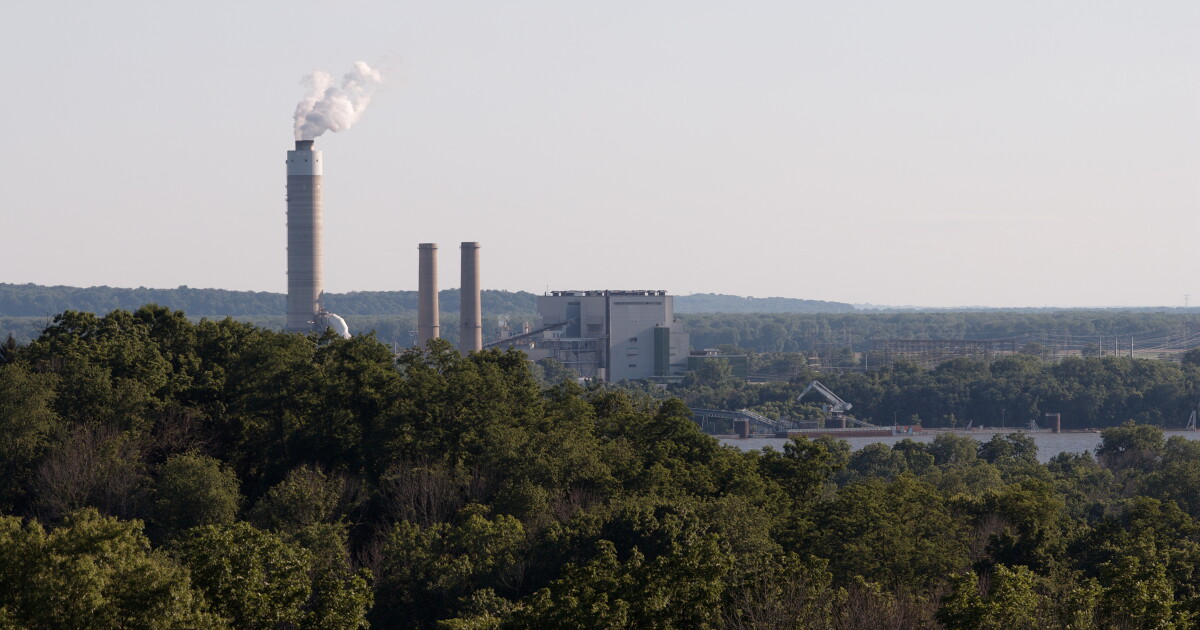
The Missouri Public Service Commission held a public hearing last week on Ameren Missouri’s proposal to build a 2,100-megawatt natural gas plant in West Alton, a facility intended to replace the aging Sioux coal plant and help meet surging demand from large-load customers such as data centers.
Ameren Missouri projects that energy demand from large-load customers will increase by 20% over the next 20 years, reaching 5 gigawatts by 2035 — equivalent to the consumption of nearly 4 million households and roughly half of the utility’s current 10-gigawatt supply, according to STLPR. Residential and other non-large-load demand is projected to grow just 1.2%.
Rob Dixon, an Ameren Missouri representative, said rising demand is one factor behind the proposal but not the only one. “At the end of the day, people want the lights to work when they flip that switch, and that’s really what our most important priority is here,” Dixon said. He added the plant would provide 24/7 generation as older facilities retire and create 1,000 construction jobs and 45 permanent positions.
The Missouri Office of Public Counsel, which represents utility customers, challenged that framing. “Our belief is that, based on the evidence available, the primary driver behind this is the increase in large load customers – primarily data centers – coming to the state,” said Senior Counsel John Clizer.
Ameren Missouri’s own project website states that new large-load customers like data centers “will pay the costs associated with serving them” and that state law and the company’s Powering Missouri Growth Plan ensure existing customers will not pay costs created by data centers.
The utility also says building next to the existing Sioux Energy Center reduces construction and connection costs, and that paying some construction costs upfront lowers long-term financing expenses.
Retired Boeing engineer Tom Golab testified that locking in a decades-long project lacks flexibility. “A technology project with this long time horizon benefits greatly from flexibility, which this project doesn’t have a lot of,” Golab said.
“Flexibility includes responsiveness to both risks and opportunities.” He cited potential shifts in how AI is powered, the emergence of regional hubs, and advances in energy infrastructure that could render the plant unnecessary or uneconomical.
Dixon responded that Ameren’s projections consider macroeconomic conditions and multiple demand scenarios, aiming for a middle ground. “We plan for a range of possible scenarios so we can adjust as real commitments develop,” he said. The utility aims to break ground next year and have the plant in service by 2031, pending regulatory approval.
Cost protections and financing plan detailed
The utility also says paying some construction costs upfront reduces the amount that must be borrowed and lowers financing expenses over the life of the project.

The website adds that building the West Alton Energy Center next to the existing Sioux Energy Center allows Ameren to use infrastructure already in place, which helps reduce construction and connection costs.
Resident raises notice and fairness concerns
Retired Boeing engineer Tom Golab testified that locking in a decades-long project lacks flexibility, saying a technology project with this time horizon benefits greatly from flexibility, which this project does not have much of.
A resident identified as Reineck said he did not receive a notice of the public hearing but attended after seeing it on Facebook, adding, “These people are deciding our future for us.” He also said data centers are getting approved anyway.
Ameren emphasizes reliability and timeline
HeatPress reported $260 billion in canceled data center projects this year alone, while the Center for Public Enterprise warned that uncertain revenue and financing underpin the boom and a bust could be economically devastating. Tech Policy Press noted data centers are following a historical pattern of bubbles seen in railroads and internet communications.
Worth a look

Michigan Boy Thrives After Boston Surgeons Remove ‘Inoperable’ Brain Tumor
Conor, a 7-year-old from Michigan, is riding his bike and negotiating for Legos after Boston surgeons removed recurring...

Svi Mykhailiuk Scores 39 as Jazz Rally Falls Short to Mavericks
Svi Mykhailiuk scored a season-high 39 points, including 23 in the fourth quarter, to rally the Utah Jazz...

Patricia “Patti” Chittenden, Former Omaha Village Clerk, Dies at 63
Patricia C. “Patti” Chittenden, who served as the village clerk in Omaha for more than 20 years, died...

URI Professor Theresa Deeney Uses National Family Literacy Month to Prepare Teachers for Book Challenges
URI literacy professor Theresa Deeney is using National Family Literacy Month this November to prepare future teachers for...