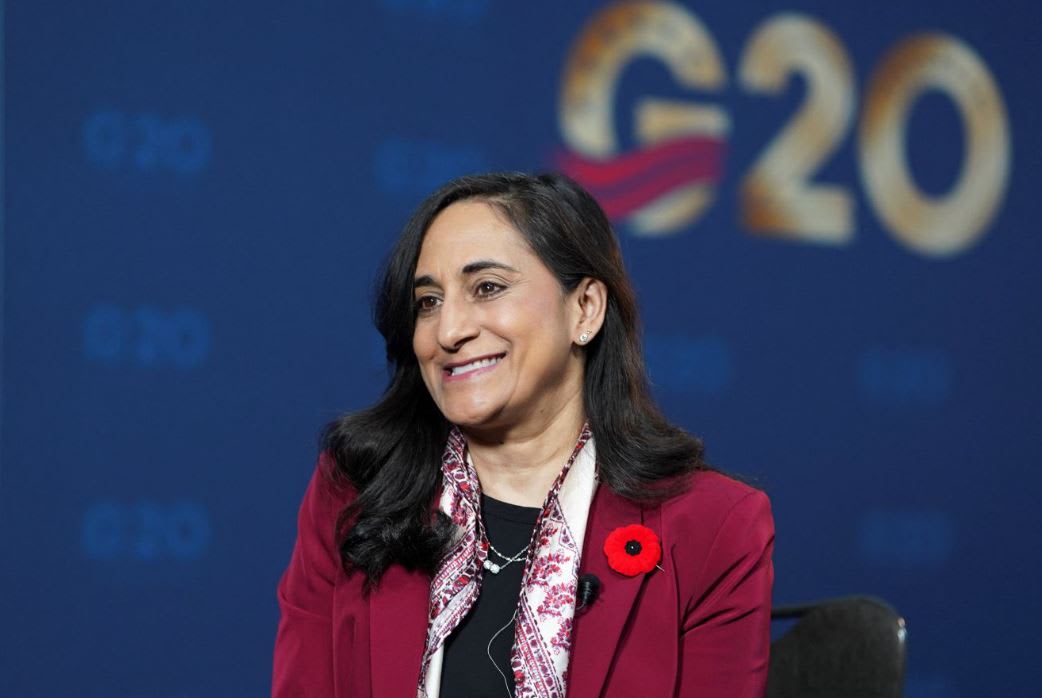
Canada aims to double trade outside the United States within ten years, Foreign Minister Anita Anand declared Saturday from the sidelines of a fractious G20 meeting in Atlanta.
The pledge, delivered to Reuters by Anand, marks the sharpest articulation yet of Prime Minister Mark Carney’s strategy to rewire an economy that sends roughly 75 percent of its exports south. It comes after talks to ease tariff pressure from the Trump administration collapsed, leaving Ottawa with no diplomatic off-ramp.
“This is our middle power diplomacy,” Anand told the wire service, framing the pivot as a deliberate leverage of regulatory standards and soft power rather than raw economic weight. The phrase signals a doctrine: build rule-setting coalitions where Canada can write the code, not just follow it.
The Atlanta gathering laid bare why Ottawa feels the clock ticking. Russian Foreign Minister Sergei Lavrov’s presence turned the G20 into a theater of rupture; Anand, a vocal critic of his attendance, said the session illustrated the “transformed and ruptured nature of the international order.” Finance Yahoo, U.S. News and WHTC all carried the same Reuters pool report, confirming the ministers barely masked their divisions.

Twenty Deals, 1.5 Billion Consumers, One ASEAN Target
Since the Washington track stalled, Canada has inked 20 new security and trade agreements spanning 51 countries and a consumer base of 1.5 billion, according to figures Anand cited to Reuters. The network stretches from the Indo-Pacific to the Middle East, with clean technology, agriculture and services flagged as priority exports.
Canada already holds free-trade pacts with every other G7 member — a unique position Anand called a foundation for the next prize: a comprehensive deal with the Association of Southeast Asian Nations before year-end. ASEAN’s combined GDP tops a significant amount, and its middle class is expanding faster than any other region’s.
Canada Coordinates Arctic Military Scientific Efforts
The strategy clusters around three theaters where Canada claims niche authority.
In the High North, Ottawa is deepening military and scientific coordination with Nordic states to counter what Anand described as growing Russian threats. The Arctic is no longer a scientific preserve; it is a contested supply route and a mineral frontier.
Canada will seek to ease trade frictions with the US after tariff-weary voters rebuked Trump in midterm elections, Foreign Affairs Minister Anita Anand said https://t.co/xMnHXhUS2r
On digital governance, Canada is partnering with India and Australia on privacy and ethical AI frameworks. The trio represents a middle-power bridge between Western regulatory models and the Global South’s data-sovereignty demands.
In Europe, a newly released national security strategy ties critical minerals, energy independence and food security to EU integration. The European Commission has signaled reciprocal interest, especially on battery-grade nickel and cobalt from Canadian deposits.
Redirecting Imports Affects US Manufacturers
For American businesses, the math is blunt. Canada is the top export destination for 35 U.S. states. If Ottawa redirects even a tenth of its annual import bill toward Asian and European suppliers, Midwestern manufacturers and Gulf Coast energy exporters feel the pinch first.

Conversely, U.S. importers of Canadian aluminum, lumber and critical minerals face a new risk: if Canada locks preferential access into ASEAN or EU deals, American buyers could face higher tariffs than competitors in Hanoi or Berlin. The Carney government has not threatened retaliation; it has simply built alternatives.
Devil’s Advocate: The Gravity Model Still Pulls South
Trade economists caution that geography is stubborn. The U.S. market remains 10 times larger than the next Canadian partner, integrated by just-in-time supply chains, shared infrastructure and a common language. Doubling non-U.S. trade in a decade implies a compound annual growth rate near 7 percent — double the historical average — while U.S. trade merely flatlines. No middle power has achieved that velocity without a regional bloc anchor.
Anand acknowledged the ambition: “Canada is coming to the table to ensure that … there are, if necessary, new bodies, new groupings, new alliances and partnerships in order to address the crises of the day.” The next test arrives in November, when ASEAN leaders meet in Kuala Lumpur and Ottawa expects to close the deal.
Related reading

EU Envoy Says ‘No Compromise Yet’ on COP31 Deal in Antalya
European Union climate envoy Wopke Hoekstra declared Saturday that no compromise has been reached on the central dispute...
China Bars Bloomberg Reporter From Shenzhen Summit After Nvidia Question
"It is commendable that the White House is defending press access," Jacqui Heinrich, president of the White House...

Zelensky Rejects Putin’s Claim on Crimean Bridge as Streeting Meets in Kyiv
Ukraine brought down the Kerch Bridge's road span in a multi-day operation this week while Donald Trump held...
Italy Adopts Antisemitism Law Using IHRA Definition on Tuesday
Italy adopted the International Holocaust Remembrance Alliance working definition of antisemitism into national law on Tuesday, passing the...