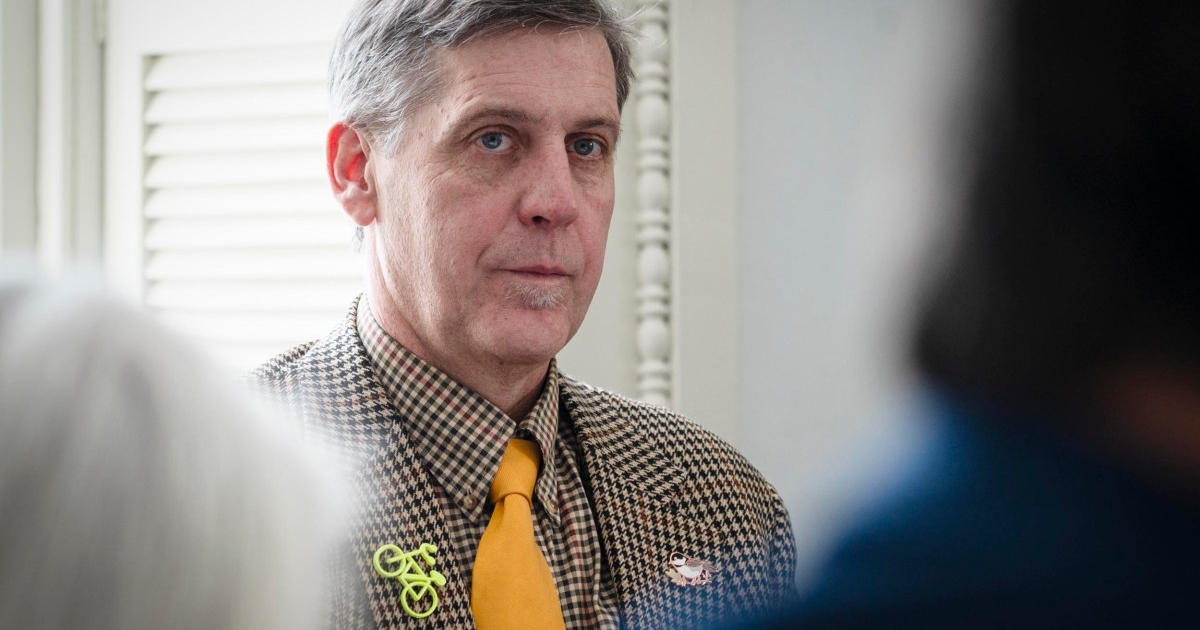
Andrew Perchlik was chosen by the Vermont Senate’s incoming Democratic caucus as its nominee for president pro tempore on Monday.
The 58-year-old senator, who represents Washington County, secured the unanimous backing of his caucus to lead the chamber. Because Democrats hold a supermajority in the Senate, Perchlik is almost certain to win the position when the full Senate votes at the start of the legislative session in January.
Perchlik will succeed Sen. Phil Baruth, a Democrat/Progressive from Chittenden Central, who did not seek reelection. As president pro tempore, Perchlik will wield substantial influence over the daily operations of the Senate and determine which bills reach the floor for debate.
“Future generations are questioning whether they can afford to build their lives here,” Perchlik said during a speech to his fellow caucus members.
He emphasized that the incoming majority must address the rising costs of housing, energy, and healthcare while supporting the economic health of rural communities. Perchlik, who currently chairs the Senate Appropriations Committee and has served in the chamber since 2018, said that a 21-member caucus provides the strength necessary to enact these priorities.

A dominant Democratic mandate
Democrats won a supermajority of seats in the Vermont Senate and House. The caucus consists of 20 Democrats and one senator who identifies primarily with the Progressive Party but caucuses with Democrats. With eight Republicans and one independent also slated for the chamber, the Democratic supermajority grants them the power to override potential vetoes from Republican Governor Phil Scott.
Governor Scott was recently reelected to a sixth term, but the legislative math favors the Democratic caucus. This dominance extends to the House of Representatives, where Democrats also hold a supermajority. The House is scheduled to choose its nominee for speaker on Dec. 5, according to Conor Kennedy, chief of staff to outgoing Speaker Jill Krowinski.
New faces in Senate leadership
Beyond the top leadership post, the Democratic caucus finalized several other key roles on Monday.
| Role | Appointee | District/Affiliation |
|---|---|---|
| Senate Majority Leader | Becca White | D-Windsor |
| Assistant Majority Leader | Rob Plunkett | D-Bennington |
| Third Member | Ginny Lyons | D-Chittenden Southeast |
Becca White succeeds Kesha Ram Hinsdale as majority leader, while Rob Plunkett takes on the role of assistant majority leader, often referred to as the whip. Both were chosen unanimously by the caucus.
The election for the “third member”—a position on the powerful Committee on Committees that handles Senate assignments—was more contested. Sen. Ginny Lyons retained the seat after winning 12 votes to nine in a secret ballot against Sen. Ruth Hardy. Hardy, who is more than two decades younger than Lyons, argued that the leadership needed fresh perspectives and more representation from outside Chittenden County.
In response to the challenge, Lyons cited her 25 years of Senate service as essential experience and pledged to make the committee’s work more transparent to the public.
Perchlik supports universal primary care through income tax changes
Perchlik indicated he would support legislation to advance components of a universal primary care plan, a central platform for Democrat Amanda Janoo during her recent campaign against Governor Scott. Although Scott won that race by his narrowest margin, Perchlik suggested that exploring changes to the state’s income tax structure to fund such a system is something “Vermonters would want to see.”
This Democratic supermajority faces a potential roadblock in the Republican executive branch. While the Democrats hold the numbers to override vetoes, Republican leadership is still organizing its response. Sen. Scott Beck, the Republican Senate minority leader, said that it remains an “open question” whether his caucus will nominate its own candidate for the president pro tempore position.
The tension between the expanding Democratic mandate and the Republican executive branch sets the stage for a legislative session that could include vetoes and overrides regarding the state’s budget and other priorities.
“We have before us a tower of tasks to take on,” Perchlik said.

Update Your Contact Information and Location Preferences
Mutiny Presents is bringing Sammy Virji to Salt Lake City on March 6, according to listings on Edmtrain....

Mayor Mamdani Announces 16 Judicial Appointments to NYC Criminal and Family Courts
Mayor Zohran Kwame Mamdani announced 16 judicial appointments and reappointments to New York City’s Criminal and Family Courts...

Vermont Minimum Wage to Increase by 49 Cents in January
Vermont’s minimum wage floor is set to shift upward on January 1, moving from $14.42 to $14.91 per...

Student Writer Shares Experience with Imposter Syndrome
In a recent column for the Her Campus at Northeastern chapter, a student writer recounts her personal transition...