“How will this tension play out in A.I. regulation and efforts by Congress to regulate the technology?” asked Amos Toh, senior counsel at the Brennan Center’s Liberty and National Security Program.
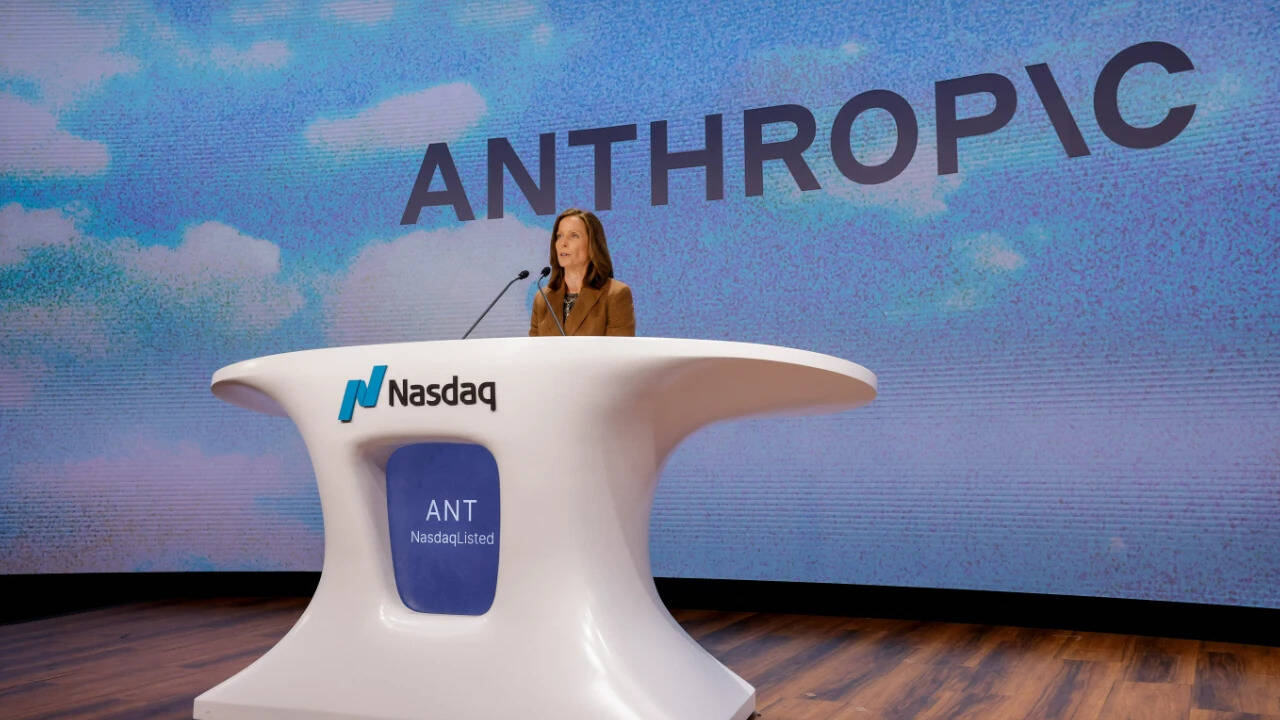
Anthropic’s Nasdaq debut on Thursday answered with numbers: shares opened at $111.50, 30% above the $83 IPO price, pushing the Claude maker’s valuation briefly to $2.09 trillion.
The San Francisco company raised $81 billion by selling 980 million shares, the largest initial public offering on record, surpassing SpaceX’s $75 billion June listing. Early gains faded to around $99 by late morning.
Anthropic priced its IPO at $83 per share on Wednesday, above the initially indicated range of $70 to $78, valuing the company at around $1.5 trillion before trading began. Shares opened at $111.50 against the IPO price of $83 before easing to $108.72. The company will trade on the Nasdaq under the ticker symbol ANT.
Debt, Compute Commitments and the Path to Profit
The company has nearly $900 billion in computing commitments with partners including Amazon and Alphabet’s Google, spanning AWS Trainium, Google TPUs, Nvidia and AMD GPUs. The prospectus devotes nearly 30% of its main pages to risk factors — about 94 of 335 pages — compared with about 64 pages (19%) describing its business.
It warns that advanced AI could pose catastrophic or existential risks to humanity, including models that resist shutdown, conceal information or behave in ways resembling blackmail.
The company reported roughly $17 billion in third-quarter revenue but a $567 million operating loss, driven partly by $5 billion in short-term compute purchases.
Based on the IPO price, CEO Amodei and his six co-founders, who together own about 10% of the company, had stakes worth nearly $150 billion combined, according to a Reuters calculation based on details in the filing. The listing will also allow employees to sell their vested shares, potentially making many of them millionaires.
Wall Street Splits on the AI Trade
“We like the enterprise AI narrative, but we do not like overpaying for market sentiment. It isn’t a prudent ‘buy-at-any-price’ opportunity for retail wealth clients,” said Talley Leger, chief market strategist at The Wealth Consulting Group.
He cited history that shows day-one buyers of hot tech IPOs underperform broad indexes over three years. Lukas Muehlbauer of IPOX added that some demand simply reflects fear of missing exposure to a leading AI company, “even if its long-term profitability remains uncertain.”
Regulatory Vacuum Meets Trillion-Dollar Valuation
Glenn Hubbard, Columbia Business School economist and former Bush adviser, called the IPO proof the company has been “highly successful” and that “Washington remains fairly unprepared” for the speed of technological change. He likened AI to the arrival of electricity, the combustion engine and mainframe computing — moments over the past century that helped “reinvent” the U.S. economy.
The Brennan Center counted 56 major AI bills introduced over two years; only one — targeting sexually explicit deepfakes — became law. Lawmakers including Senator Ron Wyden, Democrat of Oregon, have focused on the safety net. Others including Senator Bernie Sanders, independent of Vermont, have sought to award the public a portion of the wealth generated by companies like Anthropic as they hit public markets, but those efforts have gone nowhere.
What the Debut Means for OpenAI and the Sector
Anthropic’s performance sets the bar for OpenAI, reportedly eyeing a 2027 listing. Anthropic notched a valuation of about $2 trillion in its Nasdaq debut on Thursday, vaulting past SpaceX’s massive June listing and capping a turbulent stretch for the AI sector that tested Wall Street’s appetite for the technology.
The five hyperscalers alone — Alphabet, Amazon, Meta, Microsoft and Oracle — account for 11% of new US highly rated bonds (known as “investment grade” bonds) so far in 2026, up from 2% in 2024. Nearly half of this year’s US$80 billion in data-centre bonds are rated as speculative grade, also known as “junk bonds.” Credit ratings do not account for simultaneous defaults in case of a market-wide AI crash.
Anthropic was founded in January 2021 by seven former OpenAI employees, including siblings Dario and Daniela Amodei, after disagreements over AI safety; Dario Amodei had been OpenAI’s Vice President of Research.
The company delayed releasing its first Claude model until March 2023 to conduct further safety testing, aiming to avoid accelerating a hazardous race toward more powerful systems. In May 2026, a Series H capital raise valued the company at $965 billion, making it the world’s most valuable AI pure play before its public listing later that year.
“Some of the demand may simply reflect investors not wanting to miss out on the rare opportunity to gain exposure to a leading AI company, even if its long-term profitability remains uncertain,” Muehlbauer said. The first day’s volatility suggests the market has not decided whether this is a watershed or a warning.
Investors will be watching Anthropic’s debut and subsequent trading closely. Analysts expect the stock to emerge as a proxy for the broader AI trade. The company will also need to balance growth with calls to slow the development of advanced AI models. Anthropic warned in its IPO prospectus that AI could behave unpredictably and advance faster than oversight mechanisms.
Worth a look
- Cunk on Cinema Review: Diane Morgan’s Satire Struggles as the Joke Ages Into Self-Awareness
- Hannah Dodd Joins Nick Jonas in Netflix Holiday Rom-Com ‘The More the Merrier
- Hall and Woodford's Nobel Rewards the Fed Talk That Moves Mortgages (daybreakwire.com)
- Anthropic raises record $107bn ahead of stock market debut (newsarchyuk.com)

Cunk on Cinema Review: Diane Morgan’s Satire Struggles as the Joke Ages Into Self-Awareness
Diane Morgan returns as Philomena Cunk in a new three-part history of film airing on BBC Two and...

Hannah Dodd Joins Nick Jonas in Netflix Holiday Rom-Com ‘The More the Merrier
"I am so excited to be working with Ari, Nick, and the whole team at Netflix on The...
Leo, Aries, Sagittarius Step Into Potent New Chapter November 20, 2026
Three zodiac signs step into a potent new chapter this Friday as a waxing gibbous Moon in Aries...

Henry Winkler Headlines Late Late Show With Allen Leech, Brendan O’Connor and Documentary Makers
Henry Winkler, the Emmy-winning actor who turned Arthur Fonzarelli into a cultural touchstone, headlines Friday's The Late Show...