
A Broken Supermajority Changes Arkansas’s Legislative Math
Last Tuesday’s election in Arkansas broke something that had become a political fixture: the Republican supermajority in the state House. The Arkansas Advocate reported that Democrats flipped 11 legislative seats—10 in the House and one in the Senate—creating a new dynamic for the upcoming session. With this shift, the Republican majority in the House will be 70-30, a powerful number but just shy of the supermajority threshold.
The stakes are immediate. Republican Gov. Sarah Huckabee Sanders, who won reelection on the same day, will present her proposed balanced budget to lawmakers this Friday morning. The new legislative math means that for most funding bills, Republican support alone may no longer be enough. As the Arkansas Advocate noted, Appropriations bills, which authorize spending for state agencies, require a three-fourths vote in both the House and the Senate. The only exception is the public schools appropriation, which needs only a simple majority. In a 70-30 House, that three-fourths threshold is now 78 votes—a number Republicans cannot reach without Democratic votes. The practical consequence is that Democratic support will be essential to pass the state’s budget and keep government operations funded.
Democrats Claim a Seat at the Table, but Will They Use It?
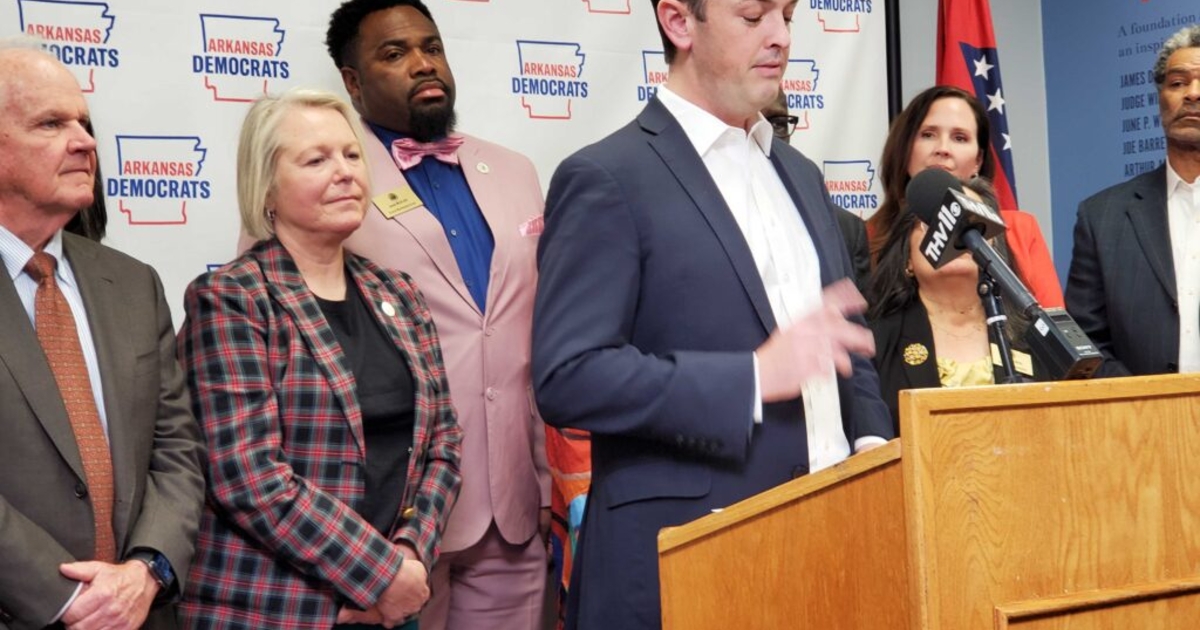
On a virtual call with reporters Thursday, House Minority Leader Andrew Collins laid out his party’s approach. He was clear that having influence doesn't automatically mean a partisan standoff. “Just because we have more leverage doesn’t mean the party’s going to hold up appropriations bills,” Collins said. Democrats, he explained, will continue to challenge policies they disagree with and look for common ground with Republicans. But he also drew a line, using language that reflected the friction of the last few legislative sessions. “But if we continue to see some of the extreme legislation and bad policies come down that we have seen in the last sessions, we’re not going to shy away from being vocal about that,” Collins stated. “If that means contentious, that means contentious, but we have to stand up for the people we represent.”
During Sanders’s first term, controversial legislation passed with only Republican support included a bill creating the state’s school voucher program and another prohibiting K-12 students from using bathrooms that do not match their gender assigned at birth.
In an election full of historic victories, we are proud to have flipped four state house seats and four justice of the peace seats. Every Democratic candidate who ran in Benton County demonstrated strength and a clear vision for the kind of Arkansas they hope to help create.
Democratic Party of Benton County, in an emailed statement
The New Faces Changing the Conversation
Among them is Northwest Arkansas Democrat Rey Hernandez, who became one of the House’s newest members after defeating Republican Rep. Rebecca Burkes on his third try for the House District 11 seat. Hernandez is a Latino, a veteran, a senior citizen, and a cattle rancher—a profile that shows the changing demographic makeup of the districts flipping to blue. He told reporters he is looking forward to providing “representation for the minority populations that are hardworking Arkansans that need a voice in government.”
House District 11 includes portions of Benton and Washington counties, which saw a significant surge in Democratic support. In fact, five of the 10 new Democratic House candidates will represent these counties. The Democratic Party of Benton County, in an emailed statement, said voters sent a clear message that “the status quo will no longer be accepted.” The party highlighted its historic victories in the area, flipping four state house seats and four justice of the peace seats. These localized wins suggest a shift in Arkansas politics that is less a national “blue wave” and more a series of “blue ripples,” as the Arkansas Advocate’s newsletter put it—changes that may fly under the national radar but have significant implications for the state.
A Republican Governor’s Response: Emphasize Conservative Priorities
While Democrats celebrate their gains, Arkansas remains a deeply conservative state. Republican Gov. Sarah Huckabee Sanders’s spokesperson, Sam Dubke, made that clear in a statement Wednesday. Dubke emphasized that large Republican majorities still exist in the Legislature and that the governor’s focus will remain on core conservative issues: education, public safety, and tax cuts. However, Dubke also left the door open for bipartisan cooperation, pointing to past successes where Sanders worked with both parties. “Governor Sanders will continue her focus on education, public safety, and tax cuts, but also looks forward to working with members of both parties when priorities align, like she has on free school breakfast, phone-free schools, and other bipartisan issues,” Dubke said.

The prospect of a funding deadlock is real, and it could give Democrats influence to push for policy changes in exchange for their votes. But Sanders will likely try to frame the debate around her priorities and position any cooperation as a win for Arkansans, not a concession to the opposition. The success of this strategy will depend on how aggressively the new House minority chooses to challenge her agenda.
What’s Still Unknown: The Path Forward
One of the biggest questions hanging over this new legislative dynamic is the future of Medicaid expansion and prison reform. The Arkansas Advocate’s newsletter noted that the Democratic gains could make it more difficult for Republicans to pass certain policies, including those related to Medicaid expansion and prison reform, along strictly party lines.
The school voucher program and the bathroom bill, both passed on party-line votes, are potential targets. Democrats could push for amendments or seek to attach riders to budget bills that would alter the implementation of these laws. The coming legislative session will test the limits of the new political reality in Arkansas.
Keep reading

Northbound Highway 99 reopens after multi-vehicle crash, CHP says
Northbound Highway 99 in Sacramento County has reopened after a multi-vehicle crash involving a semi truck that claimed...

Denver Broncos May Target Tony Pollard Over Jonathan Taylor
The Denver Broncos find themselves staring down a Tuesday deadline at 2:00 p.m. Mountain Time, facing a choice...

Arkansas AG Tim Griffin Seeks to End Majority-Black Judicial Districts
Arkansas Attorney General Tim Griffin asked a federal judge Thursday to end a 35-year-old order that established multiple...

Kipnuk, Alaska recovers a year after Typhoon Halong destruction
A Year After Typhoon, Remote Alaska Village Fights to Reclaim Its Home It sounds like magic: in the...