
“The plume will be dispersed enough that it won’t be an impact for Wisconsin residents,” Brad Pierce told WPR.
The U.S. Army plans to detonate 68 drums of degraded lead azide around noon Friday at the Iowa Army Ammunition Plant near Middletown, roughly 100 miles south of the Wisconsin border.
The material, about 9,700 pounds in total, recrystallized in storage and became too unstable to move safely, the Army concluded in its environmental review. An EPA emergency permit authorized the controlled detonation as the only way to eliminate the risk of an accidental explosion.
Current modeling shows the lead dust plume extending 30 to 50 miles north and northeast — reaching just south of Wapello, Iowa, about 34 miles from the plant. Milwaukee sits nearly 300 miles away.
The Wisconsin Department of Natural Resources told WPR on Thursday that no impact outside Iowa is anticipated, and Pierce, who directs the Space Science and Engineering Center at UW–Madison, agreed the plume will dissipate long before it crosses the state line.
But environmental advocates aren’t dismissing the risk. “Airborne contaminants like lead particles can travel long distances, depending on things like wind speed, wind direction,” Peg Sheaffer, spokesperson for Midwest Environmental Advocates, told WPR. She noted the models could shift before Friday’s blast. The Army will refresh its projections 48 hours out, again six hours out, then hourly until the operation, with a final estimate afterward.
Lead is a potent neurotoxin; the EPA says no safe blood lead level exists for children. The Army identifies two exposure routes: breathing airborne particles during the blast and touching contaminated dust after it settles. For areas in the projected path, the advisory recommends staying indoors, closing windows, setting HVAC to recirculate, and cleaning surfaces children touch — play sets, porch rails — with wet cloths once the all-clear sounds.
Residents in Middletown’s City Park neighborhood are being asked to voluntarily evacuate between 8 a.m. and 2 p.m. Friday. The Army warns of a loud noise, ground vibrations, and a visible dust plume that could linger up to an hour depending on wind.
Uday Kumar, a University of Iowa mechanical engineering professor who studies shocks and detonations, said the shockwave dissipates with distance but can shatter windows nearby and deliver “definitely uncomfortable pressure and sound.”
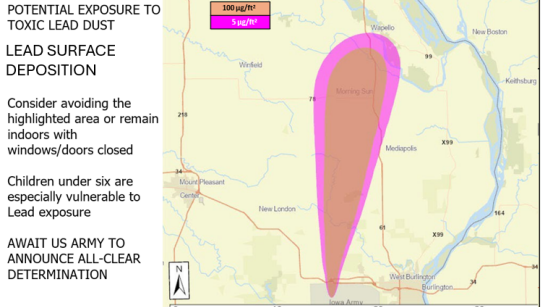
The Army will monitor air around the plant during the detonation and collect environmental samples afterward. The EPA’s emergency permit requires monitoring before, during, and after the blast, plus cleanup of contaminated areas and reports to the agency. Illinois officials are also watching; the Illinois EPA says current modeling shows portions of western Illinois could be affected and has requested more detail on the Army’s monitoring plans.
Search interest in the detonation has spiked across Wisconsin in recent days, Google Trends shows. Updated maps and advisories are available through the Iowa Army Ammunition Plant’s public information channels.
‼️The Army will set off two controlled detonations at the Iowa Army Ammunition Plant near Middletown on Friday, Nov. 20, to dispose of an old cache of lead azide. The Army found 68 barrels of the explosive that had been stored at the plant for more than 20 years. Lead azide… pic.twitter.com/BMWV9huBQ0
More on Wisconsin
Heads up over eastern Iowa Friday! The U. S. Army is preparing for two controlled explosions around noon Friday, November 20, at the Iowa Army Ammunition Plant near Middletown, Iowa. The detonations will destroy a highly unstable explosive known as lead azide. This will lead to… pic.twitter.com/t1jdZibYca

Brake Rotor Tears From Tractor-Trailer, Kills Driver on I-84 in Tolland
"Brakes, tires, things strapped down in the back, those are the things we are looking for," said Matt...

UNL Student Arrested on Sexual Assault Warrant Seven Months After Campus Dorm Rape Report
University of Nebraska–Lincoln police arrested a student Tuesday on a first-degree sexual assault warrant, seven months after a...

Oregon Students Gather at Capitol as Visa Hurdles Drive International Enrollment Decline
About 65 college students from across Oregon gathered at the Capitol in Salem on Wednesday to tell lawmakers...

Juventus Stepping up Pursuit of Höjbjerg Amid FFP Constraints, Goal/Livescore Report
Juventus are stepping up their pursuit of Olympique Marseille midfielder Pierre-Emile Höjbjerg but face strict financial constraints that...