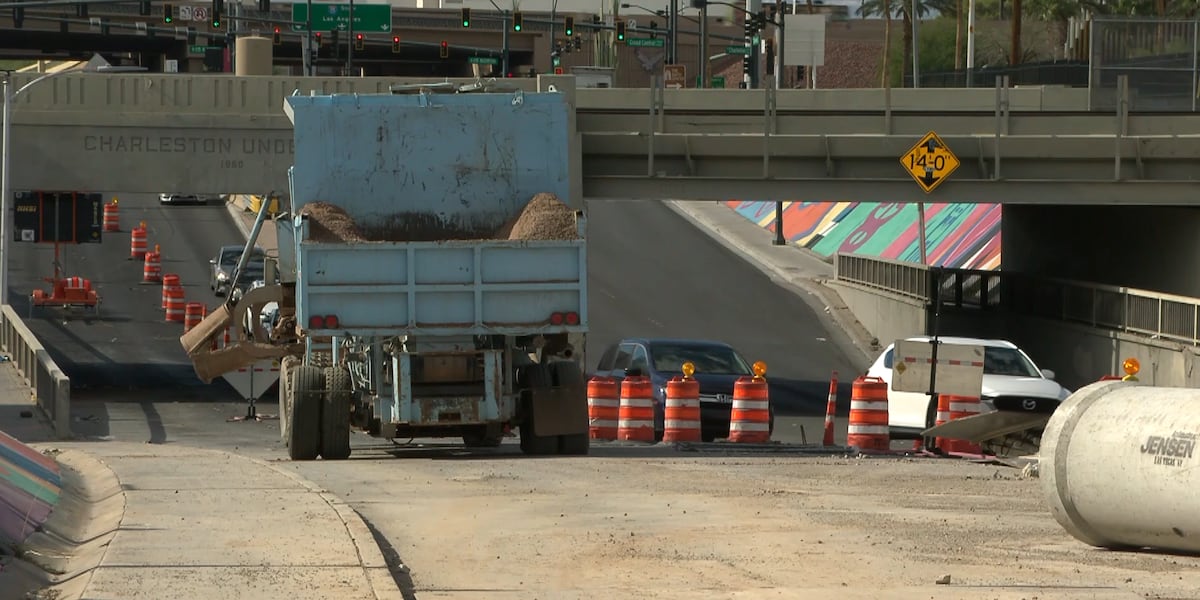
“Oh, the sales are way down. I would say we’re at least down 30%.” That’s the stark reality for Tina Spreull, owner of Artistic Ironworks, a 50-year-old Las Vegas institution, as she grapples with the chaos unfolding outside her shop. Her story is not unique. FOX5 reported that a multi-year storm drain construction project on Charleston Boulevard has brought the vibrant Arts District to a grinding halt, forcing businesses to fight for survival against a tide of dirt, detours, and dwindling customers.
Earlier this spring, the struggle became too much for one local business. Dig It! Coffee Shop closed its doors for good, unable to weather the storm of construction. Now, its neighbors worry they could be next. The project, a massive flood control initiative, began in 2021 near Maryland Parkway and Charleston Boulevard and has been steadily rolling westward ever since. Its current phase has turned Charleston into a maze of roadblocks, heavy machinery, and confusing signage, creating what business owners describe as a commercial dead zone.
Detours and Dollars: The Human Cost on Charleston
The problem, Spreull told FOX5, is visceral. “They have actually closed off my driveway from time to time with the trucks, the equipment,” she said. Even when access is technically open, the psychological barrier of moving through the construction is enough to drive customers away. “I get several phone calls – not an exaggeration – ‘Are you guys open through the construction? How do I get to you?’ This happens daily.”
With more than 50 employees relying on Artistic Ironworks, the 30% drop in sales isn’t just a bad month; it’s an existential threat. “So you either chalk it up and spend the money and continue, or you just shut down,” Spreull said, laying out the brutal calculus facing many of her neighbors.
The Conrad West Gallery has seen a visitor plunge from 1,500 people a month to just 150. For owner Claire Conrad, the silence in her gallery is deafening. “It’s pain. It’s pain when you have staff here and not very many people walking in. And I still have to pay the rent every month and the utilities – I mean, I don’t get a break on that,” she said.
Tony Martinez, who owns multiple restaurants in the district, pointed to a feeling of relentless disruption. He described back-to-back construction projects that have made it nearly impossible for anyone approaching from Charleston to reach his establishments. “With commerce being cut off, we have no access for anyone coming from Charleston. So they just have to forcibly just roll right by,” Martinez said. “We don’t know what a Charleston looks like without having some sort of construction.”
The City’s Long Road Ahead
Facing mounting pressure, business owners floated a potential solution: a 24-hour work schedule to speed up the project. But Mayor Shelley Berkley quickly shot down the idea, citing the immutable laws of physics. “Concrete needs time to cure. So you can’t be working on the site until the concrete hardens,” Berkley explained. “I wish it could be faster, but we’re going as fast as we can.”

The city’s plan, detailed in its official Charleston storm drain fact sheet, is a massive undertaking. It’s a flood control project along Charleston Boulevard from Commerce Street to Maryland Parkway, and along Maryland Parkway from Franklin Avenue to Charleston. While the current phase is on track to be completed by the end of November, the city warns that this is just the beginning. Paving and final phases will not be completed until the end of 2027—a timeline that feels like a lifetime to the businesses fighting to stay open.
It’s good for the city. It’s not good for any of the merchants down here.
— Claire Conrad, owner of The Conrad West Gallery
The project, which includes new sewer and water infrastructure, pavement updates, and traffic signal modifications, is undeniably necessary for the long-term health and safety of the city. But for the small businesses that give the Arts District its soul, the long-term vision offers little comfort for the immediate crisis. They are left in a state of suspended animation, their futures tied to a construction schedule that stretches years into the future.
Related reading

New Britain Police Investigate Shooting Deaths of Husband and Wife
New Britain Police Respond to Roxbury Road Emergency New Britain police are investigating the shooting deaths of a...

Colorado Voters Approve Transgender Sports Restriction Measure
Colorado Approves Sports Restriction Measure Two days after the polls closed, Colorado voters approved a measure restricting which...
Dodgers reportedly expected to pursue Padres reliever Adrián Morejón
Dodgers Eyeing Bulked-Up Bullpen The Los Angeles Dodgers are reportedly expected to pursue left-handed reliever Adrián Morejón this...

Harding Volleyball Beats Arkansas Tech 3-2 to Secure No. 2 GAC Seed
Lady Bisons Outlast Arkansas Tech in Five-Set Thriller to Lock Up No. 2 Seed The Harding volleyball team...