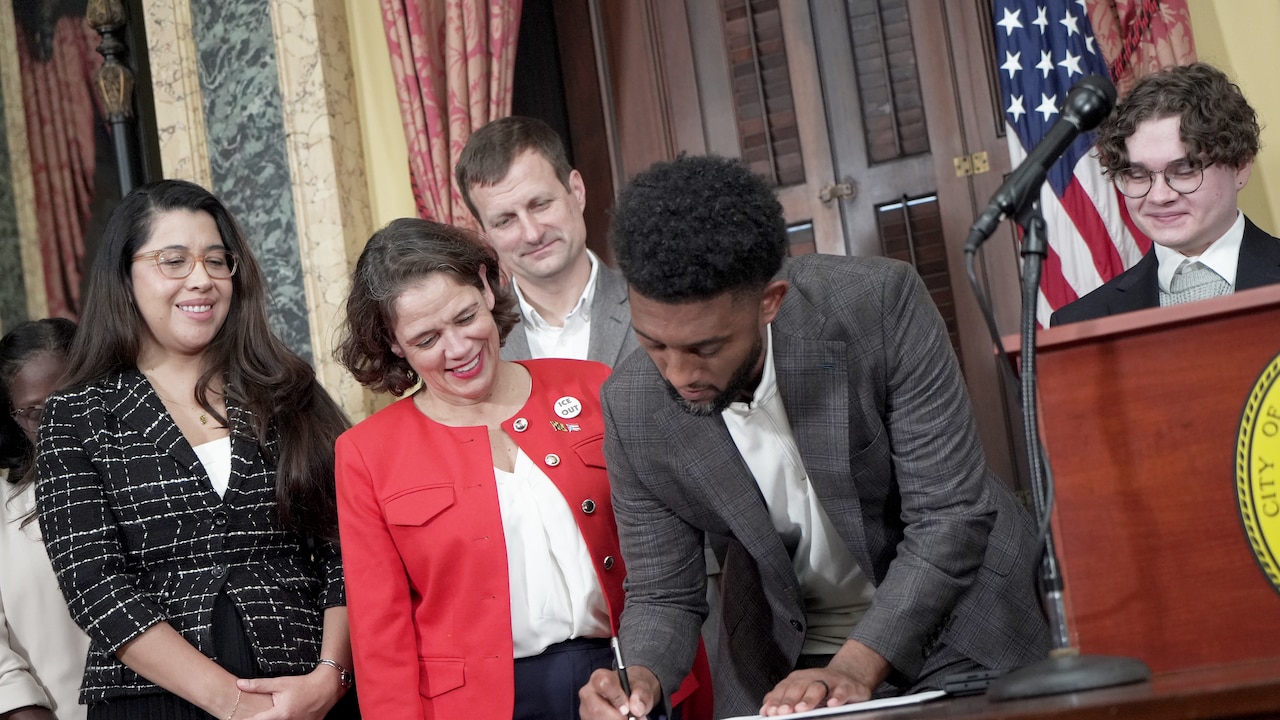
Baltimore residents will finally be able to carry a city-issued photo ID starting early next year, roughly a decade after the City Council first authorized the program.
Mayor Brandon Scott announced Thursday that the “410 Card” — named for the city’s area code — will roll out in early 2027 at no cost to residents. Scott signed a new bill Thursday broadening the list of documents accepted to prove identity and residency, including school and social services records, while adding privacy protections for the data applicants submit.
“There are countless situations where Baltimoreans are asked to show government ID in order to access important services,” Scott said. “That’s not a straightforward ask for so many of our residents.”
A decade of delays
The program’s authorization dates back roughly a decade, but implementation stalled through multiple administrations. Scott attributed the long gap to “turmoil” in the years following the program’s creation, including the onset of the COVID-19 pandemic in 2020, and said the city needed time to build the infrastructure “in the most responsible way.”

City Council member Odette Ramos, who championed the effort starting in 2022, framed the card as a universal civic symbol rather than a targeted benefit. “Are we proud to be in Baltimore City? Absolutely,” Ramos said.
“We should show it by having that municipal ID. And that way it’s for everybody, so we’re not stigmatizing groups of people, we’re just saying, ‘We believe in Baltimore, we’re here, and this is our ID.'”
Who stands to benefit
The card is designed to help residents who struggle to obtain traditional government identification — people experiencing homelessness, immigrants without access to passports, and others who face barriers to the documents required for a state driver’s license. All city agencies, including law enforcement, will accept the 410 Card as valid identification for services ranging from library cards and health department vaccinations to rental assistance applications.
The program also allows residents to designate their gender on the card, a provision advocates say is critical for transgender and nonbinary residents whose documents may not reflect their identity.
Immigrants regardless of legal status can already obtain a Maryland driver’s license or ID through the Motor Vehicle Administration, but that process requires proof of Maryland residency and at least two years of state tax filings — a higher bar than the municipal ID will set.
“Beyond access to local services, the municipal ID program is also about people feeling a sense of belonging in the city where they live and raise their families,” said Crisaly De Los Santos, director of operations for Baltimore and Central Maryland at We Are CASA.
Following a national model
Baltimore joins a wave of cities that have launched local ID programs. New York City’s IDNYC launched in 2015. Washington, D.C., operated the DC One Card for years before transitioning to a new system. Locally, We Are CASA issues its own identification cards for members, and they’re accepted for some local services. The Archdiocese of Baltimore began a similar parish ID program in 2018.
Baltimore, designated an independent city by the Maryland Constitution in 1851, is the state’s most populous city with 585,708 residents at the 2020 census. Its Inner Harbor was the second-leading port of entry for immigrants to the United States after Ellis Island, and the Baltimore and Ohio Railroad, the nation’s oldest, opened in 1830 to cement its role as a transportation hub.
During the War of 1812, the Battle of Baltimore at Fort McHenry inspired Francis Scott Key to write “The Star-Spangled Banner,” designated the national anthem in 1931.
The first cards are expected to be issued in early 2027.
Keep reading

Portland Drains Washington Park Reflecting Pool to Investigate Leak Losing 68,000 Gallons Daily
The reflecting pool at Washington Park is empty, drained this week so crews can hunt a leak losing...

9-1-1: Nashville Fall Finale Reveals Pharaoh as AJ Buckley
Viewers expected a cliffhanger; they got a face. The fall finale of "9-1-1: Nashville" finally pulled back the...

Undefeated Gophers debut in Charleston Classic vs. Oklahoma State
The undefeated Minnesota Golden Gophers will make their first appearance in the Shriners Children's Charleston Classic on Friday...

Former RI Priest James Silva, 86, Avoids Prison With Probation in Child Molestation Plea
Former Rhode Island priest James M. Silva, 86, pleaded no contest Thursday to molesting a boy in the...