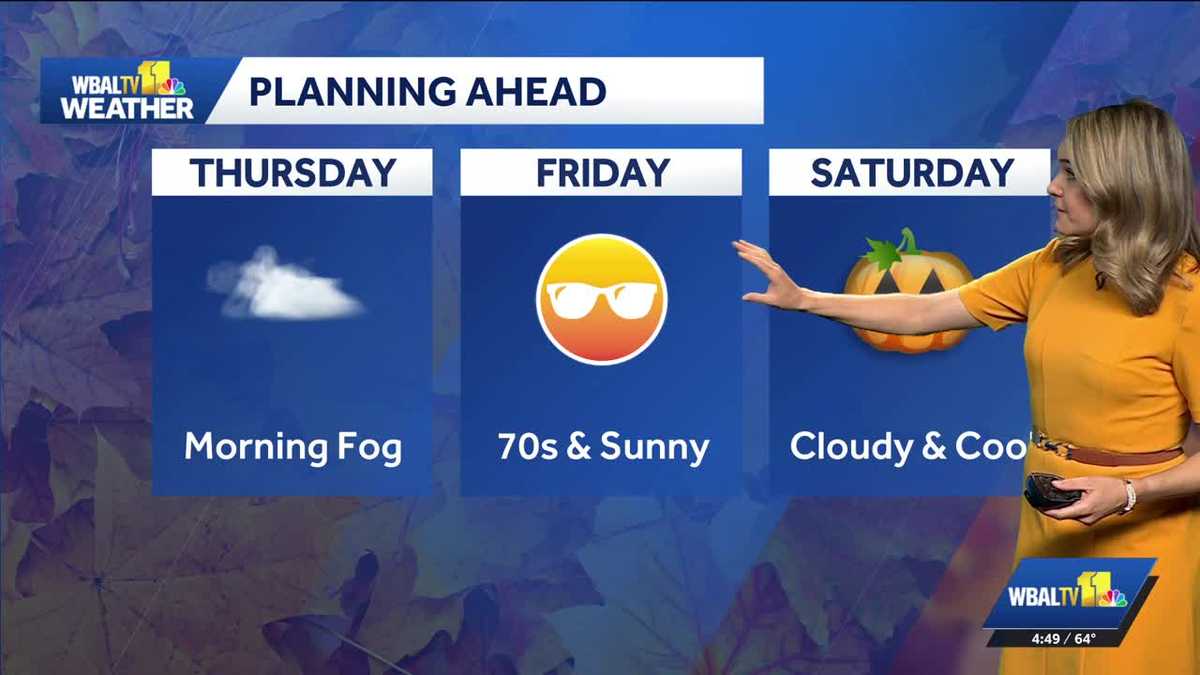
Widespread fog will impact the morning commute across central Maryland on Thursday, potentially slowing travel before clearing between 8 a.m. and 11 a.m. According to WBAL-TV, the fog is the result of increasing humidity overnight, which is expected to slow traffic throughout the region until the skies clear between 8 a.m. and 11 a.m.
This weather event falls under the WBAL-TV 11 Weather Team’s classification of an “Impact Day,” meaning the conditions are significant enough to disrupt normal schedules and daily routines. While not categorized as a life-threatening "Alert Day," the density of the fog poses a tangible risk to motorists driving through the Baltimore metro area and surrounding corridors during the peak morning rush.
Fog reduces visibility for Baltimore commuters
The primary concern for Thursday morning is the reduction in visibility. When humidity spikes in the overnight hours, moisture condenses into low-lying clouds, effectively blinding drivers to road hazards, signage, and braking vehicles ahead. For the thousands of commuters funneling into Baltimore, this typically translates to a ripple effect of delays across major arteries.
The timing is particularly tight. With the fog slated to persist until as late as 11 a.m., the entire window of the morning commute is affected. Once the sun breaks through, temperatures are expected to climb to a comfortable high near 70 degrees, but the early hours will require heightened caution.
“Impact Day: The weather could disrupt your normal schedule or routine.”
For those relying on tight schedules, the “so what” is simple: the commute will take longer. A few minutes of slowed traffic on a major highway can lead to miles of congestion, turning a standard drive into a significant delay.
Wildfire smoke turns the moon orange
While the fog dominates the immediate forecast, Marylanders recently witnessed a distinct atmospheric phenomenon on Tuesday evening. The moon appeared strikingly orange—an effect often referred to as a “Pumpkin Moon”—which was not caused by the moon’s orbit, but by the quality of the air.

WBAL-TV reported that wildfire smoke had moved into the atmosphere above Maryland. This smoke acted as a natural filter; the particles in the air scattered the shorter, bluish wavelengths of light while allowing the longer, reddish wavelengths to pass through to the observer’s eye. Even when the skies appear clear, particulate matter from distant fires can influence local atmospheric conditions and visibility.
Forecast outlook for Central Maryland
The transition from Wednesday's pleasant weather into Thursday's foggy start shows that humidity levels have increased. Following the morning haze, the region can expect a return to sunshine. The broader seven-day outlook suggests a period of relatively mild temperatures, though the volatility of autumn humidity continues to create these localized “Impact Days.”
The contrast between Tuesday’s smoke-filtered moon and Thursday’s humidity-driven fog highlights the different ways air quality and moisture levels dictate the visual and practical experience of living in the Mid-Atlantic. One is a distant environmental byproduct; the other is a local meteorological hurdle.

AAA Urges Mississippi Lawmakers to Implement Hands-Free Driving Law
AAA is calling for a "Hands Free" law in Mississippi, where drivers averaged 31.3 phone interactions per 100...

Minnesota Senate Candidate Austin Peterson Injured in Rollover Crash
"I am grateful to be alive," said Austin Peterson, a Republican candidate for the Minnesota Senate, following a...

Electra to Invest $850 Million in New Aircraft Production Facility in Springfield, Ohio
Mike DeWine and local leaders gathered in Springfield on Wednesday, Oct. 28, 2026, to celebrate the establishment of...
Using ABLE Accounts to Save for Disabled Children in Idaho
For Idaho parents of children with disabilities, the desire to provide a financial safety net often crashes directly...