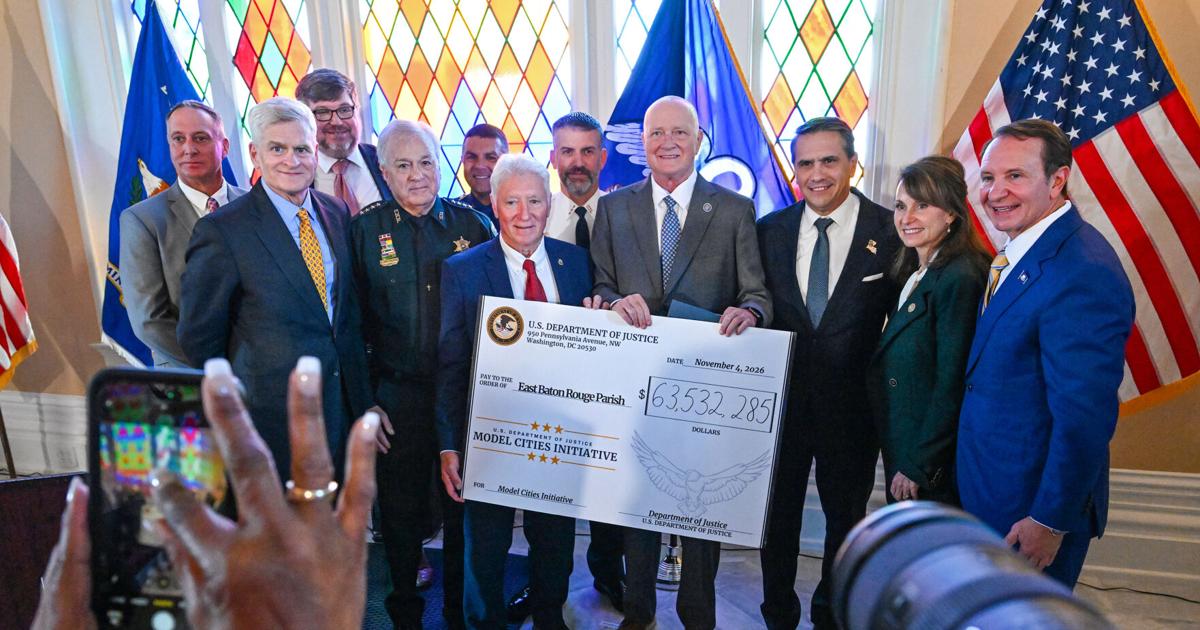
Baton Rouge will receive $63.5 million in federal funds over the next three years to expand officer patrols, hire more prosecutors and modernize police technology, U.S. Attorney General Todd Blanche announced Wednesday during a visit to the city-parish, The Advocate reported. The award, part of the Department of Justice’s $300 million Model Cities Initiative, positions Baton Rouge alongside Jackson, Mississippi; Jacksonville, Florida; and St. Louis as one of four metro areas selected from a pool of 47 applicants to receive the funding.
The money arrives at a critical moment for a parish that has struggled with gun violence. Between 2021 and 2025, Baton Rouge police responded to more than 1,300 nonfatal shootings, 12,000 shots-fired calls and 1,200 armed robberies, according to data cited by Blanche. The parish’s average homicide rate has run roughly three times that of large U.S. cities over the past two decades, Gov. Jeff Landry said. Last week’s fatal shooting of 13-year-old Madison Harris on East Mason Avenue highlighted the urgency of the crisis, as she was one of several children killed in parish violence over the past two years.
The Model Cities Initiative, announced in June following reported crime reductions in Memphis and Washington, drew applications from 47 municipalities, The Epoch Times reported. Twenty-one became semifinalists and 11 were interviewed by the DOJ before the final four were selected. Baton Rouge stood out, Blanche said, because the city-parish came with a concrete plan to work with the Department of Justice to address its higher-than-average violent crime rates.
Targeting the 10 Hot Spots Where 46% of Violent Crime Occurs
Officials plan to concentrate resources where the violence is densest. Blanche said the funds will help target 10 specific hot spots where 46% of violent and drug-related crime occurs. Mayor-Sid Edwards said the plan targets repeat offenders through increases in law enforcement personnel, technology and prosecution, and that the parish will spend the next two months finalizing exactly how the $63.5 million will be divided before implementation begins at the start of 2027.
“In other words, more law enforcement officers will be on the beat in Baton Rouge, and they’ll be working with better equipment, better tech and better info,” Blanche said.

The grant represents roughly half of the $125 million Baton Rouge originally requested in its application packet, but Blanche said the city-parish will receive about the same amount as the other three winning cities. “What we expected was for cities to come with a wish list for everything,” Blanche said. “We wanted to make sure that we were spending money fairly, not just in Baton Rouge, but to the other winning cities and the cities that didn’t win.”
Why New Orleans Walked Away
The award carries conditions that kept some cities out. Cities receiving the grant are required to provide certified guarantees that they will adhere to a federal law prohibiting state and local governments from barring local agencies from sharing details about a person’s citizenship or immigration status with federal immigration officials. New Orleans and Houston backed out of applying for the grant because of that requirement.
Landry seized on the contrast during Wednesday’s news conference. “New Orleans made an intentional decision not to apply,” Landry said. “They chose play politics with safety. The leaders here in Baton Rouge, that was not the choice they made. They decided to put the citizens first.”
Blanche said the requirement does not change Baton Rouge’s local policies, despite the city’s involvement. “Does that mean that there are people here illegally that may get arrested? Yes,” Blanche said. “If there were no Model Cities program, though, there are still people in Baton Rouge that are here illegally that were gonna get arrested. This isn’t a shift or policy or procedure change in Baton Rouge.”
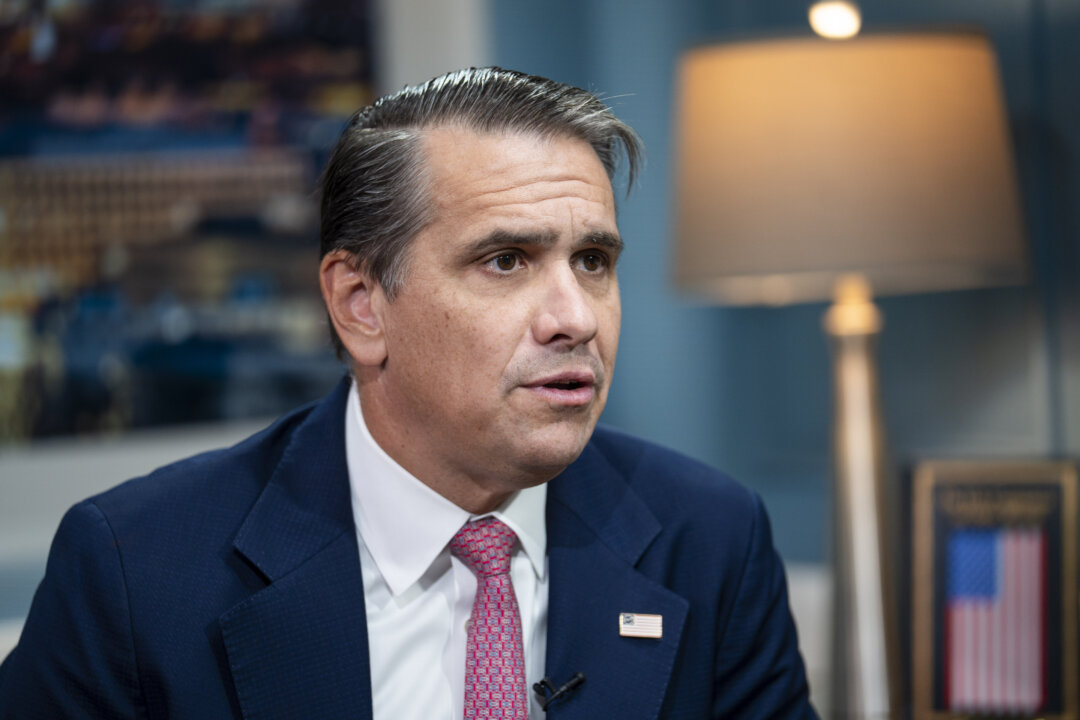
Although the application materials indicated that grant-winning cities might be obligated to repay the federal government should federal agents be summoned to help during a spike in violent crime or civil unrest, Blanche explained that these funds are not required to be paid back. “This is money that the Department of Justice gets from Congress, and we’re spending it in a way authorized by Congress,” Blanche said. “This isn’t a loan; this isn’t a program that has to get paid back. These are grants.”
An Investment, Not a Giveaway
Local leaders framed the funding as a long-term investment rather than a temporary infusion, pointing to recent gains in public safety. Edwards said overall crime in the parish is down 20% this year. The Metro Council sanctioned record salary increases for Baton Rouge police officers in April, rendering them the top earners in the state. Still, the Baton Rouge Police Department remains down about 170 officers, though inquiries from people interested in joining rose by about 300% from 2025 to 2026. Police Chief T.J. Morse said he is “cautiously optimistic” about adding up to 75 officers by the end of 2027.
Louisiana Attorney General Liz Murrill connected the funding to the human toll of violence on children, referencing Harris’s death and other young victims. “In the last two years, we’ve lost two 8-year-olds, a 12-year-old and two 3-year-olds,” Murrill said. “We’re losing children in our community to gang violence they aren’t even a part of.”
Landry additionally pointed to Operation Redstick, a joint enforcement effort spanning local, state and federal agencies that led to 185 felony arrests, the capture of 100 fugitives and the confiscation of 45 firearms, 11 of which were reported stolen, as reported by ktbs.com. Authorities also recovered 12 stolen vehicles. Over roughly the past decade, more than 1,100 people have been killed in shootings in East Baton Rouge Parish, Landry said, with about 90% of the victims Black.
Edwards predicted the three-year grant would produce decades of change for the parish. “We plan a tenfold return on investment,” he said, according to ktbs.com. “This three-year grant will yield 30 years of transformational change for Baton Rouge.” He described the award as “one of the most historic and significant public safety investments in Baton Rouge’s history.”
Specific spending plans remain unfinished, but the timeline is set: two months of planning by local officials, then rollout in early 2027.
Keep reading

East Lansing Police Release Suspect Descriptions After Two Unrelated Shootings, Seven Firearms Recovered
Halloween night in East Lansing was supposed to be about costumes and candy, not gunfire. Instead, by the...

Christin L. Stewart is a Norton Healthcare nurse practitioner in Louisville
Christin L. Stewart, an advanced practice registered nurse, is serving patients as a nurse practitioner with Norton Cancer...
A Charming Fall Getaway to Cape May, NJ: A Travel Guide
For travelers within driving distance of the Chesapeake Bay who crave autumn’s crisp air and storybook charm, Cape...

East Baton Rouge awarded $63,532,285 federal crime-fighting grant
East Baton Rouge Parish walked away with $63,532,285 in federal crime-fighting money on Wednesday, a sum that sounds...