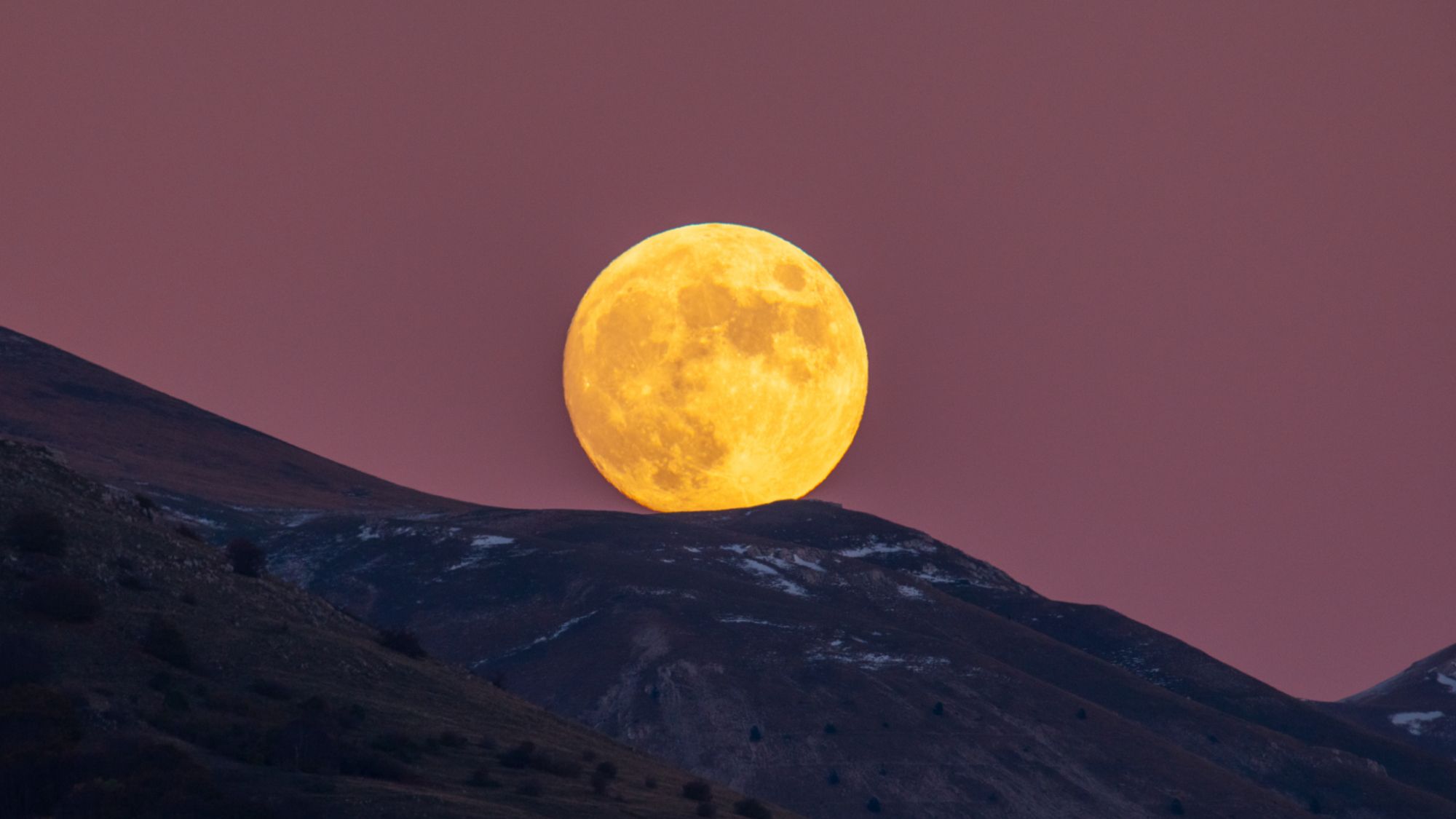
November’s Beaver Moon reaches peak illumination at 9:53 a.m.
The full moon occurs during daylight across North America, so the best viewing comes after sunset on Tuesday when the lunar disk rises low in the eastern sky. At that moment it sits about 224,170 miles (360,768 kilometers) from Earth — within 90 percent of perigee, the closest point in its elliptical orbit — meeting the commonly used threshold for a supermoon according to NASA.
“The moon's orbit is a little bit elliptical; it's not a perfect circle. So sometimes the moon is slightly closer to the Earth, and when that happens, it'll appear larger in the sky as a result,” said Kevin Lewis, vice chair and professor of Earth and planetary sciences at Johns Hopkins University.
Why this supermoon stands out
The sequence continues with the Cold Moon on Christmas Eve, the Wolf Moon on January 22, 2027, and the Snow Moon on February 20, 2027. December’s full moon will be the closest, largest and brightest of the series — and the nearest full moon since 2018 — at roughly 221,668 miles from Earth per Forbes.
The “Beaver Moon” name traces to the time of year when beavers shore up their lodges and store food for winter, a tradition drawn from Native American and colonial-era almanacs. Some astronomers using a stricter definition do not count February’s moon as a supermoon, but the more generous 90-percent standard has become the prevailing one Smithsonian Magazine reports.

What you’ll actually see
“Folks who pay regular attention to full moons will notice the difference,” said Kevin Lewis. The moon may also take on an orange-yellow hue as its light passes through more atmosphere at low altitude, scattering shorter blue wavelengths.
Supermoon amplifies king tides near flood stage
The supermoon’s stronger gravitational pull amplifies high tides. In Boston Harbor, king tides — also called “wicked high tides” regionally — are forecast to reach about 12 feet this week, just half a foot below flood stage. A storm system arriving Thanksgiving could push water levels into minor or moderate coastal flooding at high tide The Boston Globe reports.
How to watch
No equipment is needed. Find an unobstructed eastern horizon around sunset Tuesday. In New York City, moonrise is 4:16 p.m. EST; in Los Angeles, 4:43 p.m. PST. The Virtual Telescope Project is streaming live views from robotic telescopes in Manciano, Italy, starting at 10:30 a.m. EST Space.com notes. Binoculars or a small telescope reveal craters and the dark plains of ancient lava flows known as lunar seas.
Scientists Explain the Supermoon Mechanics
Devon Salasin, head astronomer and site manager at Stargazing Moab, told National Geographic that perigee marks the moon’s closest approach to Earth while apogee marks its farthest point.
She said a supermoon occurs when perigee roughly coincides with a full moon, which she described as a fancy way to say the sun, Earth and moon all line up. NASA notes the term typically applies when the full moon comes within at least 90 percent of perigee.
Salasin added that although the moon appears slightly bigger and brighter during a supermoon, the difference is nearly indistinguishable to the naked eye.
Kevin Lewis, vice chair and professor of Earth and planetary sciences at Johns Hopkins University, explained the moon’s orbit is elliptical rather than a perfect circle, so the satellite sometimes passes closer to Earth and looks larger as a result. The average Earth-moon distance is 238,855 miles, according to the Detroit Free Press.
Why Consecutive Supermoons Happen
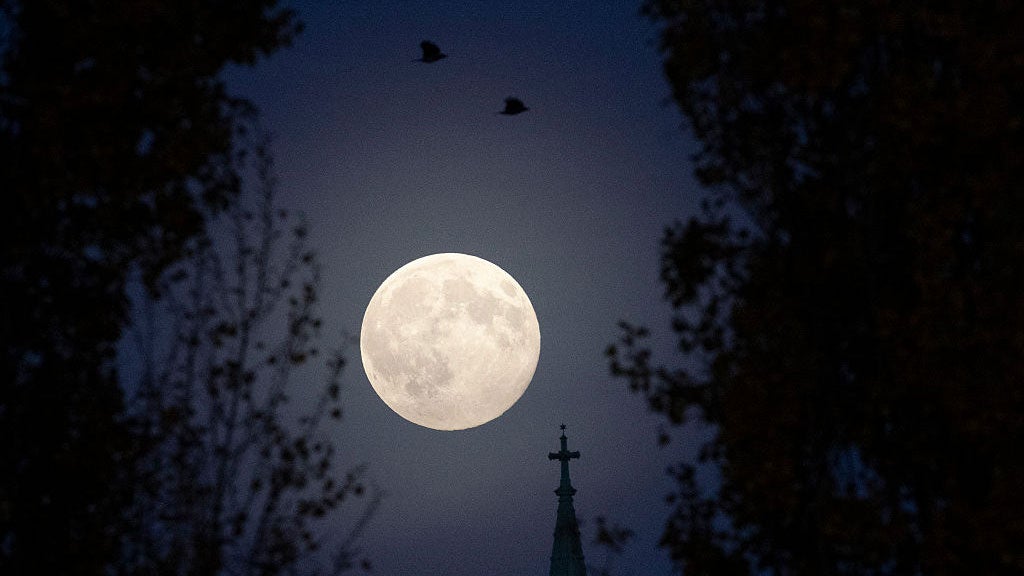
The moon takes about 27.5 days to return to its closest point to Earth and about 29.5 days to complete a full cycle of phases, according to reporting by EarthSky. These similar time frames allow the full moon to coincide with its closest approach several months in a row, Lewis said. The Weather Channel reported this pattern is typical, producing three to four supermoons a year that always arrive back to back.
Forbes listed the distances for the current series: November’s Beaver Moon sits 224,171 miles away, December’s Cold Moon 221,668 miles, January’s Wolf Moon 222,230 miles and February’s Snow Moon 225,748 miles.
Beaver Moon name reflects winter beaver habits
The Old Farmer’s Almanac says the Beaver Moon name comes from beavers setting up their lodges for winter during this season and from the history of trapping beavers for the North American fur trade. The Boston Globe noted beavers do not hibernate but store food to survive the winter.
The moon’s gravitational pull influences ocean tides, and full moons contribute to larger high tides, Lewis said. Supermoons amplify this effect. In Boston Harbor, king tides are forecast to reach about 12 feet this week, roughly a foot above average high tide and just half a foot below the 12.5-foot flood stage, The Boston Globe reported.

A rare Christmas Eve coincidence
Under the stricter supermoon definition, a Christmas Eve full moon at perigee hasn’t occurred since 1787. With the broader definition now standard, the alignment also happened in 2007 and 1912 Smithsonian Magazine notes. The December 24 Cold Moon will be the standout of this winter’s celestial parade.
Kevin Lewis, vice chair and professor of Earth and planetary sciences at Johns Hopkins University, explains that the Moon’s elliptical orbit brings it closer to Earth at perigee, making the disk appear larger and brighter during a supermoon.
Lewis previously highlighted that the Moon’s stronger gravitational pull at perigee amplifies high tides and suggested the spectacle offers a moment to reflect on upcoming missions.
“We're still exploring our closest neighbor in the universe, and so it's now especially exciting to look up at the moon,” Lewis said.
Worth a look

Teenager Accused of Stabbing Two Pupils in Neck at London School While Shouting ‘Allahu Akbar’ in Alleged Terror Attack
A 13-year-old boy entered Kingsbury High School in Brent, north-west London, on February 10 armed with a knife...

Large CT Study Finds No Link Between Overall Abdominal Muscle Size and Low Back Pain; Muscle-to-Fat Ratio Lower in Pain Group
Stanford University researchers found no meaningful difference in overall abdominal muscle size between people diagnosed with low back...

Major Streaming Services Launch Black Friday Discounts
Major streaming services have launched Black Friday discounts that run through Cyber Monday on November 30, with HBO...

Rep. Raskin Expands 1789 Capital Probe, Demands Records From Four Firms
Rep. Jamie Raskin, the ranking member of the House Judiciary Committee, sent letters on Monday to four companies...