
Bell Textron announced Tuesday it has finished the first fuselage for the MV-75 Cheyenne, the tiltrotor the U.S. Army selected for its Future Long Range Assault Aircraft program, and shipped the structure from its new Wichita Assembly Center to Amarillo, Texas, for wing mating and full-scale structural testing.
The milestone arrives two years after Bell picked Wichita for the fuselage line and marks the first time the company has moved a complete airframe section — nose to tail, including the forward, mid and aft assemblies and the fuselage mate — out of the Kansas facility since it opened the plant in April, according to a company press release dated November 16.
“This achievement is a testament to the dedication and agility of Bell and the entire MV-75 team, who rapidly established infrastructure and moved with purpose to design and assemble the first fuselage.”
Adam Blackford, general manager of the Wichita Assembly Center, said in the release.
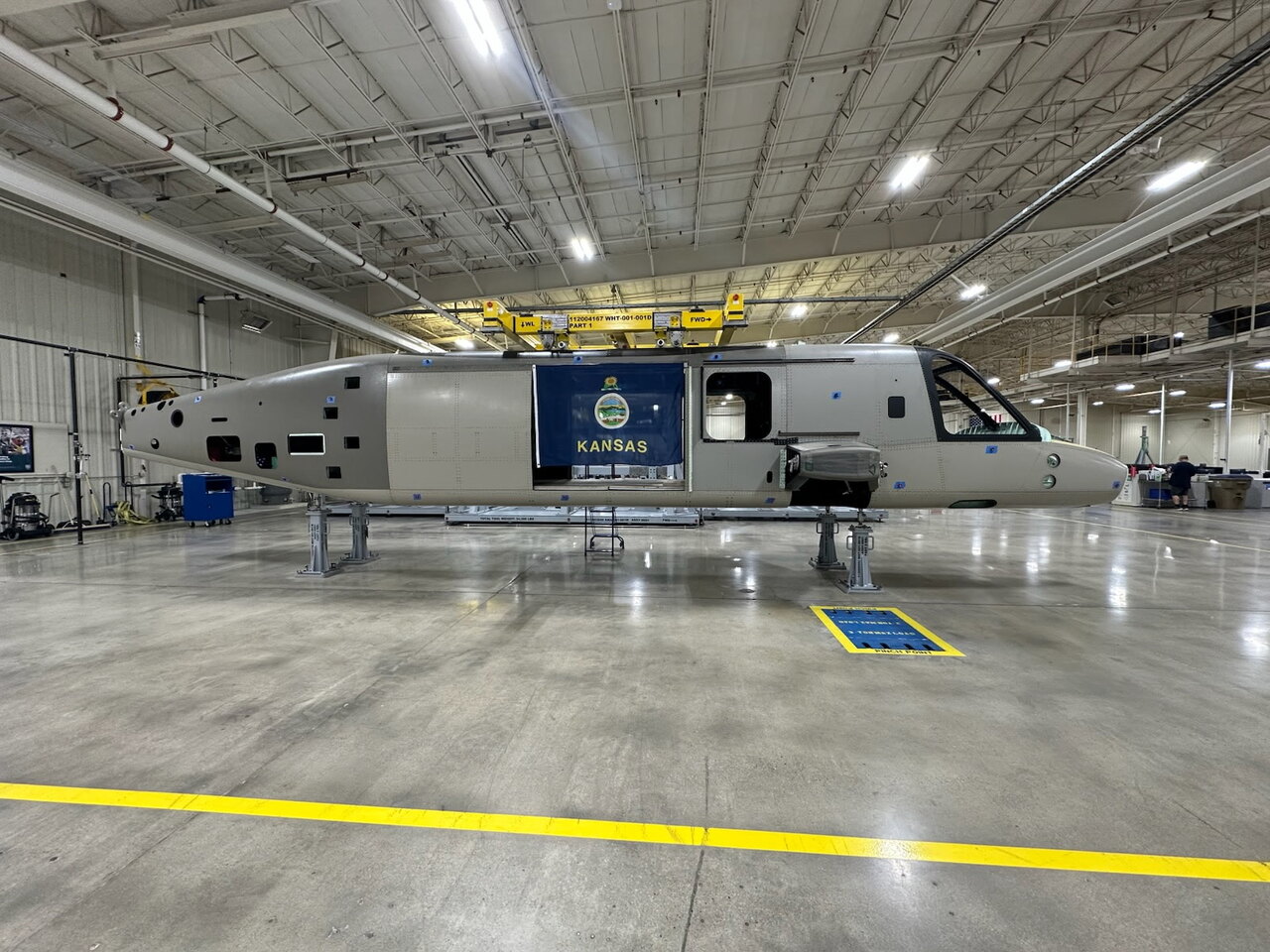
The fuselage will be joined with the completed wing structure and nacelle at the Amarillo Assembly Center, then loaded into a purpose-built test fixture to calibrate strain-gauge instrumentation and proof-load the airframe — the first major structural test of the MV-75’s capability, Bell said.
Wing structures were finished earlier this year; the first wing, completed in February, required 90 percent fewer labor hours than the initial V-22 wing build, and the second achieved an additional 40 percent reduction, Culley Shafer, director of operations in Amarillo, said in the release.
From Wichita to Amarillo: the production chain
All MV-75 fuselage work takes place at the Wichita Assembly Center on North Greenwich Road, a facility Bell describes as its latest manufacturing investment for the program. The company has said the plant has capacity to produce up to 48 fuselages per year. At that time, MV-75 program director Ryan Ehinger cited Wichita’s aerospace workforce and experience with complex defense systems as the primary reasons for the site selection.
Wing and nacelle assembly runs through Amarillo, where Bell has decades of V-22 production history. Nacelle structures were completed in October and mated with the wing ahead of the fuselage arrival.
Meanwhile, the first gearboxes for the test aircraft began testing in the new MV-75 Drive System Test Lab in Grand Prairie, Texas — a facility that broke ground in 2023 — and flight-control computers, general-purpose computers, actuator drive units, electrical components and large-area displays are being validated in the Weapon System Integration Lab in Arlington, Texas.
Bell has completed the first fuselage for the #MV75Cheyenne at the Wichita Assembly Center, just two years after selecting Wichita for MV-75 fuselage manufacturing in support of the @USArmy #FLRAA program.https://t.co/9jVZ4ycNZH
Program schedule and the open question of first flight
When the Army approved Milestone B in August 2024, the service planned the first FLRAA flight for 2026. Bell’s November 16 release did not provide a date for first flight, and the company said only that the completion of the fuselage, wing and nacelles moves the first test aircraft “one step closer to completing the build and beginning flight test.” Structural proof testing in Amarillo is the next gating event.
The MV-75 Cheyenne is the tiltrotor the U.S. Army selected in December 2022 over a Sikorsky-Boeing compound helicopter for the FLRAA program. The service has said the new aircraft must fly twice as fast and twice as far as the UH-60 Black Hawk it will replace.
Bell claims the design meets those thresholds, though the structural test campaign now underway will be the first physical validation of those performance targets at the airframe level.

Workforce and industrial base implications
The Wichita facility represents Bell’s first major manufacturing footprint in Kansas, diversifying a production base long centered on the Fort Worth and Amarillo corridors. Bell has not disclosed current headcount at the Wichita Assembly Center.
The first fuselage has left the building. The test fixture in Amarillo is waiting. The Army’s 2026 flight target remains on the calendar, but the schedule now lives in the strain-gauge data.
Worth a look

Louisiana Tech Hosts Arkansas-Pine Bluff Wednesday in Coaching Reunion Game
Louisiana Tech women's basketball hosts Arkansas-Pine Bluff Wednesday at 6:30 p.m. CT inside the Thomas Assembly Center. The...

Judge Grants Injunction Requiring Eligibility Certification for Godfrey
"RJ is such a good individual, and he's deserving of this opportunity," Arizona coach Tommy Lloyd said Tuesday...

Peltola 146 Votes Shy on Official Count; Live Results Show Majority
Mary Peltola is 146 votes away from an outright majority in Alaska's U.S. Senate race as the state's...

Commerce Issues Rule Targeting Chinese Access to Advanced Chips After Nvidia Scandal
President Donald Trump ordered the Commerce Department on Monday to close a loophole that let Chinese firms lease...