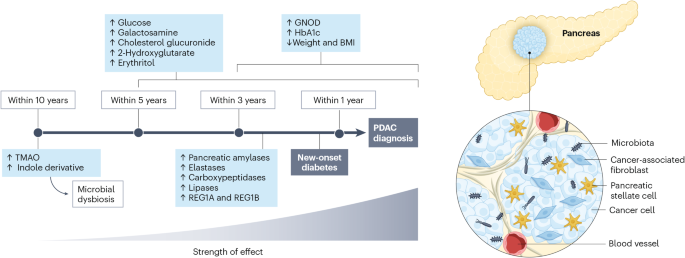
A comprehensive review published in Nature Reviews Clinical Oncology examines the opportunities and challenges of biomarker assays for risk assessment and early detection of pancreatic cancer, a disease projected to become the second leading cause of cancer-related death in the United States by 2040.
The review synthesizes current evidence on risk stratification, surveillance strategies for high-risk individuals, and the emerging role of metabolic signatures—particularly new-onset diabetes—as a window for earlier diagnosis. It notes that the U.S. Preventive Services Task Force reaffirmed its recommendation against screening the general population in 2019, citing a lack of evidence that screening reduces mortality and the potential for harm from invasive follow-up procedures.
For individuals with inherited genetic syndromes or strong family history, however, surveillance is recommended by the International Cancer of the Pancreas Screening (CAPS) Consortium.
The consortium’s updated guidelines, published in Gut in 2020, advise annual magnetic resonance imaging (MRI) or endoscopic ultrasound (EUS) for carriers of pathogenic variants in genes such as CDKN2A, BRCA1/2, PALB2, and ATM, as well as for those with Peutz-Jeghers syndrome or Lynch syndrome with a family history of pancreatic cancer. Surveillance typically begins at age 50, or 10 years before the earliest diagnosis in the family.
Data from the CAPS5 study, published in Gastroenterology in 2018, showed that among 354 high-risk individuals under long-term surveillance, 10 pancreatic ductal adenocarcinomas were detected, nine of which were resectable. The five-year survival rate for screen-detected cancers was 73%, compared with 25% for those diagnosed outside surveillance. A 2023 cost-effectiveness analysis of the CDKN2A-p16-Leiden cohort in the United European Gastroenterology Journal supported the economic value of such programs.
The review highlights new-onset diabetes as a critical clinical clue. Approximately 0.85% of people over 50 with new-onset diabetes develop pancreatic cancer within three years, a risk roughly 50 to 100 times higher than the general population.
A 2025 study in JAMA Network Open by Stefanova and colleagues modeled the cost-effectiveness of biomarker-assisted early detection in this group, finding that a strategy combining a blood-based biomarker test with imaging could be cost-effective at a willingness-to-pay threshold of $100,000 per quality-adjusted life year.
The U.S. Preventive Services Task Force reaffirmed its D recommendation against screening asymptomatic adults in 2019 using a reaffirmation deliberation process, concluding no new evidence warranted a grade change because potential benefits still did not outweigh harms.
The task force found adequate indirect evidence that harms of detection and early treatment are at least moderate, driven by false-positive results and invasive follow-up procedures, while no accurate, validated biomarkers for early detection existed.
The USPSTF would need a very high level of evidence to alter its grade, such as direct evidence that screening reduces pancreatic cancer mortality in asymptomatic adults and that harms—including surgical morbidity from false positives—are smaller than previously bounded. Until such evidence emerges, the 2019 reaffirmation stands.
Despite these advances, the review points out persistent challenges: the low prevalence of pancreatic cancer limits the positive predictive value of any single biomarker; heterogeneity in tumor biology complicates assay development; and there is no validated blood test approved for population screening. The authors call for large, prospective, longitudinal cohorts with serial biospecimen collection to validate multi-analyte panels that integrate genetic, epigenetic, proteomic, and metabolomic features alongside clinical risk calculators.
Worth a look

Indonesia Fires Burn 2.8M Hectares; Orangutans Displaced, Skeletons Found
More than 2.8 million hectares burned across Indonesia from July through October. Particulate pollution at the Tuanan research...

RTÉ: Horse Sport Ireland Faces Liquidation Thursday, 40 Jobs at Risk
Horse Sport Ireland faces liquidation at a High Court hearing on Thursday, threatening around 40 jobs and risking...
Cardiologist Names 7 Festive Foods That Can Lower Cholesterol, Including Walnuts, Oats and Brussels Sprouts
Cardiologist Francesco Lo Monaco has identified seven festive foods that can help lower cholesterol levels during the Christmas...

Optometrist Colette Donellon on Role and Treatments at Optilase Galway
Colette Donellon manages the Optilase clinic in Galway city centre, where she guides patients through every stage of...