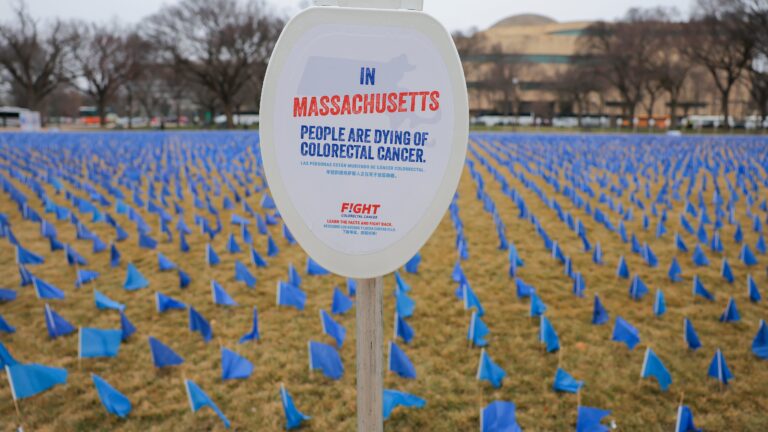
Blue Flags and a Biological Breakthrough in the Fight Against Young-Onset Colon Cancer
It was a sea of blue flags—27,000 of them—blanketing the National Mall in March, each representing a life that could be saved with more research into colorectal cancer. That stark, visual reminder of the stakes in this fight was just the backdrop for the complex, biological mystery that has been unfolding inside patients. Now, researchers in Boston say they have found a new clue. The Boston Globe reported that a team from Dana-Farber Cancer Institute, Mass General Brigham, and the Broad Institute published a study Thursday, offering a detailed look at why colorectal cancer is striking younger people.
The study advances understanding of a trend that has defied easy explanation. For a decade, the number of colorectal cancer cases in Americans under 50 has climbed by nearly 3% annually. Tragically, the disease is now the leading cause of cancer death for that age group. This isn’t a statistical blip; it’s a public health crisis unfolding in real time, forcing doctors and researchers to ask a fundamental question: What is different about this cancer when it appears in a 28-year-old versus a 68-year-old?
The Black Box Opens
Until now, that question has been a “bit of a black box,” said Ana Anderson, a senior author and core faculty member of the Gene Lay Institute of Immunology and Inflammation at Brigham and Women’s Hospital. The factors contributing to the rise—like diet, ultra-processed foods, and other lifestyle elements—have been part of the conversation. But what happens inside the tumor itself has remained largely unknown. The new research, published in the peer-reviewed journal Nature Medicine, drills down into that black box, examining not just the tumor but the ecosystem of cells around it.
The team didn’t just look at a handful of tumors; they analyzed 189 tumors from patients ranging from their 20s to their 90s. This included 54 young-onset cases. They didn’t just look at the tissue; they broke it down, analyzing more than 850,000 cells, a level of detail that paints a much clearer picture of the disease. What they found suggests that the tumors in younger patients are not just smaller versions of the ones in older adults. They appear to be fundamentally different beasts.
A Different Kind of Tumor
Dr. Kimmie Ng, a senior author and director of the Young-Onset Colorectal Cancer Center at Dana-Farber, pointed to one of the most significant discoveries: the difference in stromal cells. These are the connective and supporting cells that act as a sort of scaffolding for a tumor. The study found that tumors in younger patients have a much higher proportion of these stromal cells. While that might sound like a minor detail, it carries enormous weight. Studies of other types of solid cancers have linked stromal cells directly to chemotherapy resistance. In essence, this “scaffolding” can shield the cancer from the very treatments meant to destroy it.
That finding alone could help explain why cases in younger people are often more advanced and more difficult to treat by the time they’re discovered. It’s a biological barrier that has been hindering progress. “We know that this connective tissue or scaffolding around tumors can actually shield tumors from the effects of chemotherapy or immunotherapy,” Ng said. The study also found distinct differences in how genes are expressed within these young-onset tumors, revealing potential new targets for future therapies.
It’s been a bit of a black box. Now we have a research direction. We have a path to follow and hopefully find something that’s really specific to this disease and that will be the basis for developing tailored therapies specifically for young-onset colon cancer.
This is where the human stakes become painfully clear. Consider the story of Chris Causey, a Norwood, Massachusetts, father who was suddenly facing Stage 4 metastatic colorectal cancer at 42. With no family history, his journey began with symptoms his first doctor dismissed as stress. “He’s like, ‘You’re just stressed. You’re carrying a lot,'” Causey recalled. By the time he got his real diagnosis, the cancer had spread. For patients like him, this research isn’t an abstract scientific advancement; it’s a lifeline. “As a patient, you’re always trying to find out ‘What’s the next step? How do we fight this thing that’s so mysteriously beating us?’ So I saw hope in that article,” Causey said.
The Path Forward
The study is being hailed as a critical resource, “the largest of its kind” for colorectal cancer, as the Globe noted. It provides a massive, public dataset that scientists around the world can now use to build upon these findings. Dr. John Paul Shen, an associate professor in the department of gastrointestinal medical oncology at the University of Texas MD Anderson Cancer Center, who was not involved in the study, called the data “hugely valuable” because it points to “some very clear experiments that we might do in our lab or other people would do in their labs around the world.”
Yet, the experts are careful to frame this as a beginning, not an end. The dataset, while expansive in its cellular analysis, is drawn from a limited number of people. Christina Annunziata, senior vice president of extramural discovery science at the American Cancer Society, noted that future research will need to analyze other groups of patients to confirm these findings. Having this dataset, Annunziata said, is “an essential first step.” The research, she added, is “necessary for us to understand why people are getting cancers early and what we can do about it.”
The 27,000 blue flags from the National Mall represented potential lives saved. This new study from Boston represents a detailed map of the biological battlefield where that fight is taking place.
Keep reading

Lucas defeats Daniels in race for North Salem supervisor
Lucas secures re-election as North Salem supervisor The final, unofficial numbers are in, and the race for North...

South Carolina Women’s Soccer Earns Multiple SEC Honors and Player of the Year Awards
Two Gamecocks Earn SEC Player of the Year Honors For the University of South Carolina Gamecocks, the latest...

Philly Officials Condemn Boycott of Jewish Restaurants
Philadelphia Mayor Cherelle Parker and Pennsylvania Attorney General Dave Sunday are condemning a planned boycott of Jewish-owned restaurants...

Sioux Falls Boxing Classic Moves to Convention Center for 2027
The Sioux Falls Boxing Classic is moving to the Sioux Falls Convention Center for its fifth annual installment...