Spanning the South Fork of the Yuba River in Nevada County, California, the Bridgeport Covered Bridge reaches an impressive length of 229 feet according to See California, while the Historic American Engineering Record notes the structure at 233 feet long (loc.gov) and other records note a 230-foot span.
Built in 1862 by David Isaac John Wood utilizing lumber from his mill in Sierra County, the landmark served as part of the Virginia Turnpike Company toll road to transport freight wagons to the Comstock Lode in Virginia City, Nevada. The crossing is recognized as California Registered Historical Landmark No. 390 and holds entry #71000168 in the National Register of Historic Places, featuring three commemorative plaques dedicated in 1948, 1964, and 1973 (See California reports).
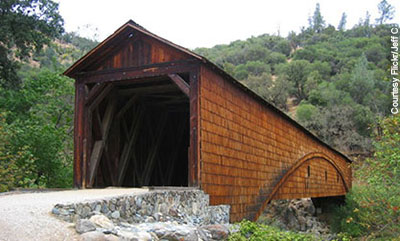
The structure combines truss and arch construction using heavy timber trusses reinforced with vertical iron rods, and it follows William Howe’s 1846 patent with an auxiliary arch supporting the standard Howe Truss. Sheathed in over 27,000 sugar-pine shingles, the bridge originally supported up to 15 tons and formed part of a 14-mile toll road authorized by the California state legislature. As S. Griswold Morley noted in The Covered Bridges of California, 1938:
“Dropping to the South Fork of the Yuba River on the old route from the mines of French Corral and San Juan Ridge to Marysville, the traveler comes unexpectedly upon one of the most remarkable of covered bridges…” —S. Griswold Morley”
According to structural details reported by the American Society of Civil Engineers, the laminated arches of the crossing are constructed from Douglas fir cut by the Virginia City Turnpike Company and are anchored by massive granite blocks. These arches remain visible from both inside and outside the structure.
The American Society of Civil Engineers also documented that toll prices in 1862 for using the roadway and bridge were set at $0.25 for foot travelers, $0.50 for horsemen, and reached a maximum of $6 for a team of eight animals.
The California Department of Parks and Recreation acquired the landmark in 1986 to anchor South Yuba River State Park, where visitors can explore the bridge and swim in the river below. Complementing the bridge is a classic Dutch-style historic barn built concurrently for animal stalls, hay storage, equipment upkeep, and wagon repairs, which the South Yuba River Park Association began transforming into an interpretive transportation exhibit in 2006.
The preservation group is also restoring a 1927 Shell Gas Station featuring a Shell pump, lubsters, and store products originally operated as a resort and store by Andrew Kneebone. Documentation and historic recording projects for the site have been coordinated by the National Covered Bridges Recording Project, the Historic American Engineering Record, and supporting committees.
South Yuba River State Park hosted a three-day celebration taking place April 27-29, 2012, to celebrate the Sesquicentennial Birthday and the 150-year anniversary of the historic covered bridge and barn.
Worth a look

Milwaukee Organizations Provide Free Gun Lock Boxes at Fire Station 13 November 21, 2026
Milwaukee gun lock boxes distributed November 21, 2026 As reported by yahoo.com, three Milwaukee community groups assembled at...

UBS Predicts Economics Will Outweigh Geopolitics in 2027 Investing Outlook
Economic fundamentals like growth, corporate earnings, and interest rates will remain the primary drivers of financial markets in...
Rhode Island Holiday Light Show at Confreda Farms Returns for Seventh Year
The Rhode Island Holiday Light Show at Confreda Farms in Hope returns for its seventh year, with event...

Media and Community React to Michigan Upset of No. 4 UCLA in OT
Michigan football secured bowl eligibility on Saturday by upsetting No. 4 UCLA 18-16 in a triple-overtime victory at...