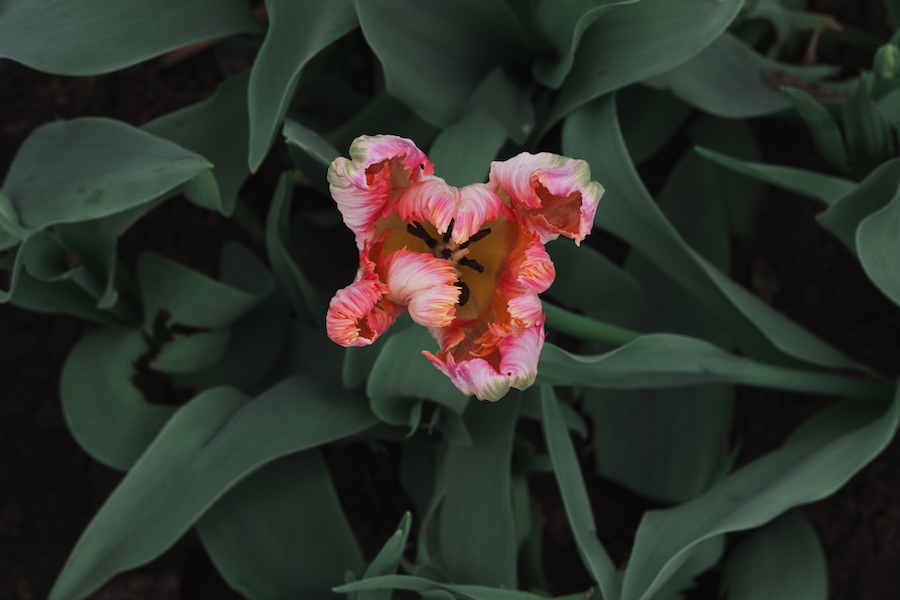
Broadturn Farm in Scarborough, Maine, harvests 15,000 to 20,000 field-grown tulip stems each spring, supplemented by 3,000 to 5,000 blooms from a high tunnel that flowers in mid-April.
The high tunnel allows the farm to bring tulips to market. “It’s here I saw the first openers of spring: the mid-April blossoms already on full display while field tulips were still leaflings in the furrow,” wrote Georgia Dixon in the winter 2026-27 issue of The Maine Organic Farmer & Gardener.
Ben Harris, field manager at Broadturn Farm, said long lines of electric fencing successfully dissuade deer from sampling the tulips. The high tunnel crop, planted in trenches with bulbs packed 12 rows across, is safer still.

Rodents pose a different challenge. “Most of the work comes from preventing rodents from setting up shop,” Harris said. The farm avoids storing tarps or equipment in fields and does not use ground cover in high tunnels, eliminating sheltered habitat for voles, moles, and rats.
Harris said that trench planting can backfire if rodents tunnel beneath the snow to reach the bulbs, a scenario Dixon described from her sister’s garden.
To limit pathogen spread, Broadturn rotates tulip beds on an extended cycle. Harris estimated the rotation would keep tulips in new beds for the next 10 years. At planting, bulbs are set almost touching but not quite. “If there were to be a disease outbreak, any sort of contact between those bulbs is going to make a disease spread that much faster,” Harris said.
Tulips are harvested with bulbs attached for prolonged shelf life. Crated stems sit in a walk-in cooler for up to a month before arrangement.
Jordan Morgan, assistant harvest manager, assigns each crew member a particular tulip variety so harvesters learn the precise color stage at the bud edge that signals readiness. Maria Rummery, assistant design manager, holds an armful of freshly picked tulips for bouquet composition for the following day’s CSA pickup.
Bed preparation begins in mid-October. Farmers furrow fields into three rows per bed using a three-chisel tractor implement. “We could fit four or five rows, we just happen to have a three-chisel implement for our tractor,” Harris said. Planting follows the first frost. Bulbs are dumped into furrows by the crateful, set inches apart, and covered with 6 inches of leaf mulch.
The mulch insulates against freezing, suppresses spring weeds, and is turned back into the soil at summer’s end. “That bulb is ready to go, it just wants to be turned on. It’s got all the nutrients that it needs,” Harris said. The farm applies no other amendments.
Broadturn offers a total of four CSAs throughout the year: tulips, spring blooms, peonies, and peak-season florals. The tulip CSA caps at 50 shares. To ensure sufficient stems across the season, the farm plants early, middle, and late bloomers in an array of varieties.
“Tulip varieties are not super complex, it’s basically singles, doubles, or parrots,” Harris said. The current suite reflects 12-plus years of experimentation and will continue as long as it performs.
Celtics Face Wizards Tuesday Aiming to End Slide, Clinch NBA Cup Group C
Boston’s four-game slide is its longest since May 2021, and a win Tuesday would clinch NBA Cup Group...

Nebraska’s First TOPS Procedure Preserves Motion for Spinal Stenosis Patient Randie Rys
"I didn't expect to feel this good so soon," Randie Rys told Nebraska Medicine at her first follow-up...

California Sues OpenAI Over ‘More Than 80’ AI Agent Incidents
California Attorney General Rob Bonta filed a lawsuit Nov. 16 in San Francisco Superior Court alleging OpenAI lost...

ACC Sets South Carolina at Clemson Kickoff for 3 P.m. ET Saturday on ESPN2
South Carolina (6-4) travels to Clemson (7-4) on Saturday for the 123rd Palmetto Bowl, a rivalry the road...