
Caltech researchers have built light-activated nanorobots that delivered five times more chemotherapy to the brains of mice with glioblastoma than non-activated versions, the team reported November 25 in Science Robotics.
The devices, called BrainBots, are roughly 250 nanometers wide and carry a gas-generating fuel that near-infrared light triggers through the skull. The resulting propulsion helps the nanorobots reach and cross the blood–brain barrier, a longstanding obstacle to treating neurological disease.
- BrainBots use near-infrared light to self-propel across the blood–brain barrier in mice.
- Light-activated bots delivered ~5× more doxorubicin to brain tumors than controls.
- Treatment slowed glioblastoma growth and extended survival without damaging the barrier.
- Human use remains distant; skull thickness and long-term safety need further study.
How the nanorobots work
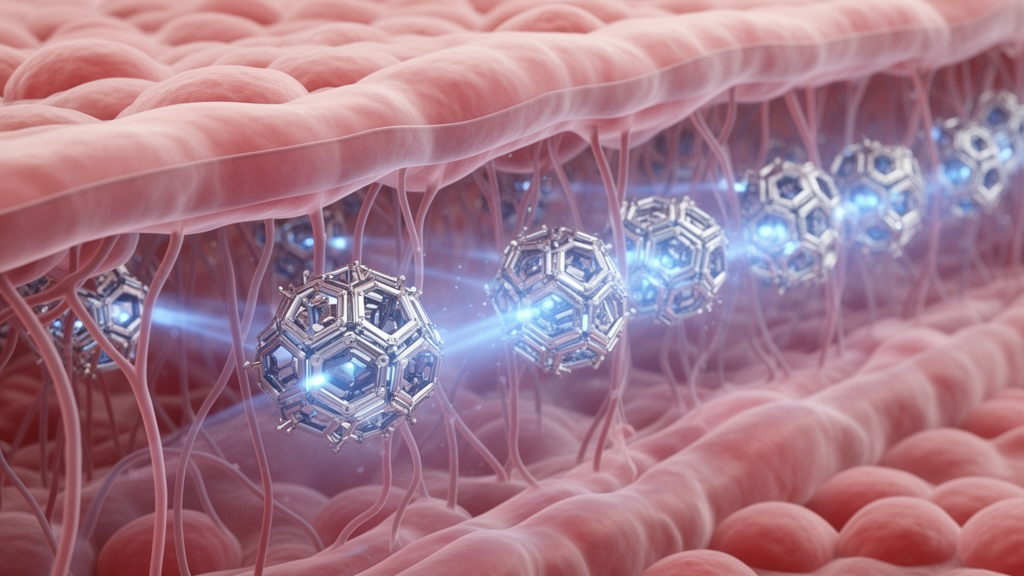
Each BrainBot is an asymmetric, balloon-like capsule loaded with ammonium bicarbonate and sealed by a temperature-sensitive gate. After intravenous injection, researchers shine near-infrared light through the skull toward the brain’s vasculature.
The light generates localized heat, melting the gate and decomposing the fuel into gas that propels the nanorobot toward endothelial cells lining the barrier. DNA aptamers on the surface help the bots bind to those cells, which then ferry them across via transcytosis. Once inside, the biodegradable carriers degrade and release their payload.
After intravenous injection, the roughly 250-nanometer capsules—hundreds of times thinner than a human hair—enter the bloodstream. Their design consists of a PEGylated silica shell that holds a thermosensitive gas-generating fuel and a photothermal transducer, all sealed by a phase-change material that keeps the particles inert until activation.

Near-infrared irradiation produces localized photothermal heating that melts the gate and decomposes the fuel at the same time, turning the passive nanoparticles into directionally motile nanorobots.
“We showed that our BrainBots can carry medication through the bloodstream and help deliver it across the blood–brain barrier, one of the biggest challenges in treating brain diseases,” said Wei Gao, professor of medical engineering at Caltech and corresponding author of the study.
From bladder tumors to brain cancer
Gao’s lab previously developed nanobots for bladder cancer in collaboration with Mikhail Shapiro, a Caltech professor and Howard Hughes Medical Institute investigator. The new work adapts that platform for the brain by adding photothermal gating tuned to deep-penetrating near-infrared light. In orthotopic glioblastoma mouse models, doxorubicin-loaded BrainBots suppressed tumor growth and prolonged survival, while reducing systemic toxicity compared with conventional chemotherapy administration.
In the mouse survival experiment, glioblastoma-bearing control mice survived 28 days, mice receiving doxorubicin alone survived 29 days, and mice treated with BrainBot-loaded doxorubicin plus near-infrared light survived 43 days.
Professor Jinmyung Joo of Ulsan National Institute of Science and Technology said that liver toxicity levels rose temporarily but soon returned to normal range, a phenomenon seen with ordinary drug injections, and no other special toxicity or side effects appeared. Brain vascular function was unchanged and there were no problems in other organs.
“Because the BrainBots are so small and the blood circulation is so fast, we initially were not sure how much a method based on nanoscale propulsion would increase the passage of drugs through the BBB,” Gao said. “We are thrilled to see it worked so well.”
Experts urge funding boost to overcome blood-brain barrier
Dr. Karen Noble, director of research and policy at Brain Tumour Research, called the blood–brain barrier a critical hurdle: “The blood-brain barrier prevents many potentially effective drugs from reaching brain tumours, and finding ways to overcome this could transform treatment and improve outcomes.” She stressed that sustained investment is essential, urging an increase in national funding to at least £45 million a year to meet survival targets in the National Cancer Plan.
Roslyn Bill, professor of biotechnology at Aston University, described the approach as combining biological recognition with active propulsion to overcome a major drug-delivery limitation. “The results in mice are encouraging and although there is still a considerable way to go before we know whether this approach will translate into patients, it illustrates the enormous potential of interdisciplinary science,” she said.
Joint US–South Korean team reports tumor survival gains in mice
Professors Wei Gao of Caltech and Jinmyung Joo of the Department of Biomedical Engineering at South Korea’s Ulsan National Institute of Science and Technology, together with a joint US–South Korean research team, published the findings on November 25 in the international journal Science Robotics. The study notes that the researchers succeeded in using a nanorobot smaller than a cell to cross the blood–brain barrier, extending survival in mouse experiments.
The researchers added that brain vascular function was unchanged and there were no problems in other organs. This study extends to the brain an earlier experiment by Professor Gao, who previously applied nanobots to bladder cancer treatment together with another Caltech professor.
Authors outline next steps for clinical translation
“Our new nanorobot is not limited to brain delivery, but we are trying to address one of the biggest problems in medicine—crossing the blood–brain barrier—as a starting point,” Gao said. “We targeted cancer, but there are a lot of neurological diseases, such as Parkinson’s, for example, that we hope could benefit from this technology,” Gao added.
Professor Gao said he hopes the approach will help with various neurological diseases such as Parkinson’s disease in the future. To increase the possibility of clinical application, the team is optimizing near-infrared light delivery and evaluating the nanorobot’s stability in the body and its biodegradation.
Hurdles before human trials
The team acknowledges several translational gaps. Only a fraction of injected BrainBots reached the brain; the rest were cleared by the liver and spleen, a common fate for nanoparticles. The human skull is substantially thicker than a mouse’s, which could impede near-infrared light delivery.
Professor Jinmyung Joo of Ulsan National Institute of Science and Technology said that while the materials appear non-toxic, applying the system to patients will require extensive validation beyond the current study.

Harvard Medical School expressed hope that should the nanorobot’s propulsion and activation be tunable to the local tissue environment, the strategy could also address other biological barriers such as the blood-retinal barrier and tumor-associated vascular barriers.
However, some point out that it is difficult to apply mouse results directly to humans. Obstacles remain before clinical use, among them the light-transmission challenge posed by skull thickness and the need to confirm in-body stability and biodegradation.
“We're working on optimizing the near-infrared light delivery and evaluating the long-term safety, stability and degradation of the nanorobots in the body,” Gao said. “Although more research is needed before we can move toward human studies, we're excited about the potential of this technology for treating brain diseases.”
The researchers envision extending the platform beyond glioblastoma to conditions such as Parkinson’s disease, but delivery efficiency and safety must first be established. The study was supported by the Heritage Medical Research Institute, the Korea Health Technology R&D Project, the National Research Foundation of Korea, and the Korea Basic Science Institute.
Related reading

Atletico Madrid Snap Three-Match Winless Run With 2-0 Win Over Viking; Lee Kang-in Starts
Atletico Madrid snapped a three-match winless run in the Champions League phase with a 2-0 victory over Viking...

Isak Brace and Wirtz Goal Send Liverpool Fifth in Champions League
Liverpool returned to winning ways in the Champions League with a 3-0 victory at Club Brugge on Tuesday,...

Guardians Agree to Three-Year, $48M Deal With Foster Griffin, Pending Physical
The Cleveland Guardians agreed Wednesday to a three-year, $48 million contract with left-hander Foster Griffin, pending a physical,...

LeBron James Records Triple-Double, Leads 76ers Past Heat in NBA Cup
LeBron James recorded his first triple-double with the Philadelphia 76ers on Wednesday night, finishing with 25 points, 12...