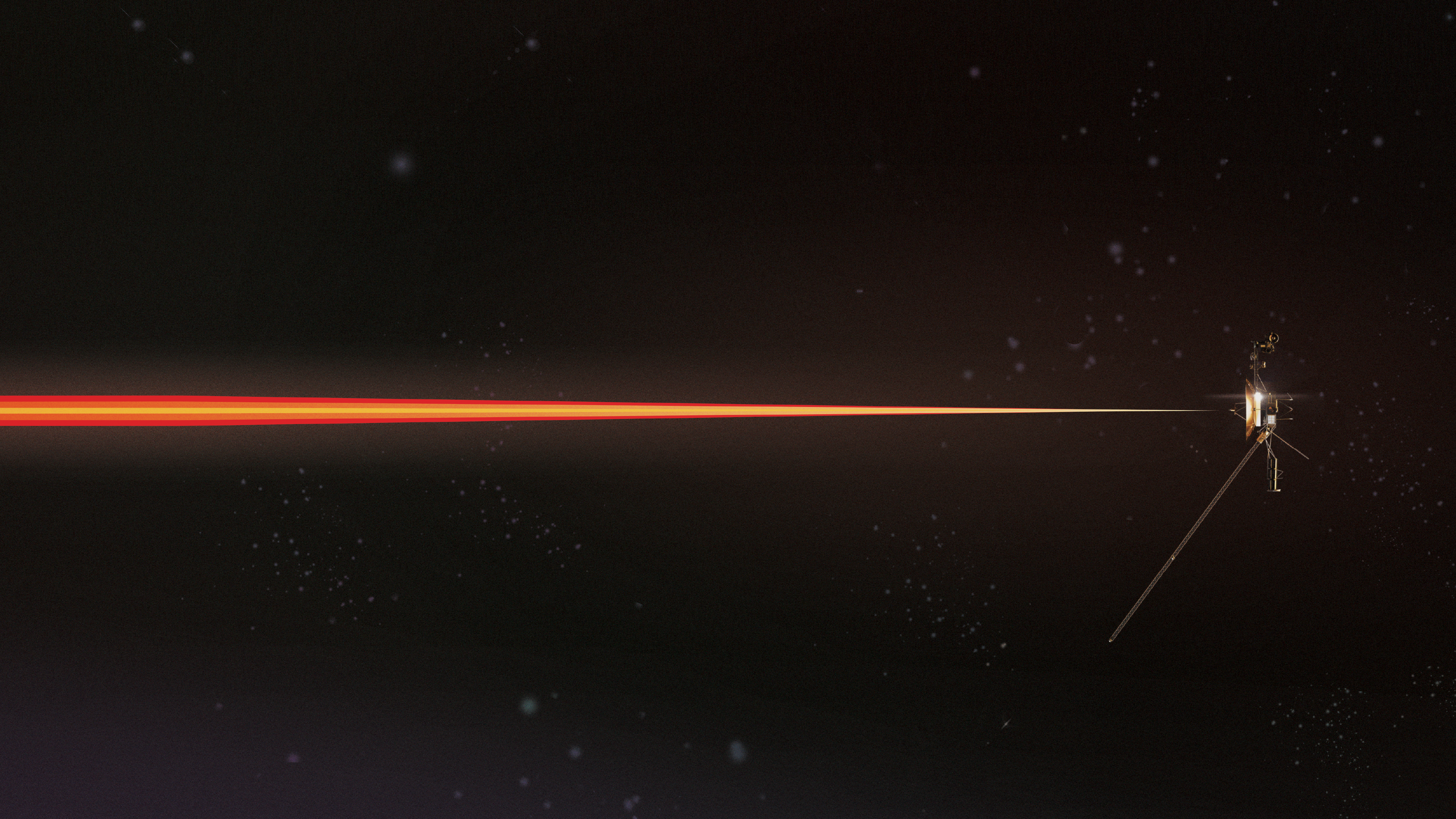
NASA’s Voyager 1 crossed one light-day from Earth on Wednesday, becoming the first human-made object to reach a distance where a radio command takes 24 hours to arrive and another day to return.
The milestone arrived at 5:16 a.m. EST on November 18, 2026, after more than 49 years of flight. At that moment the probe sat roughly 16.1 billion miles (25.9 billion kilometers) from Earth.
Mission controllers at the Jet Propulsion Laboratory received the confirming carrier signal 24 hours later, on Thursday, the time required for light to traverse the gap.
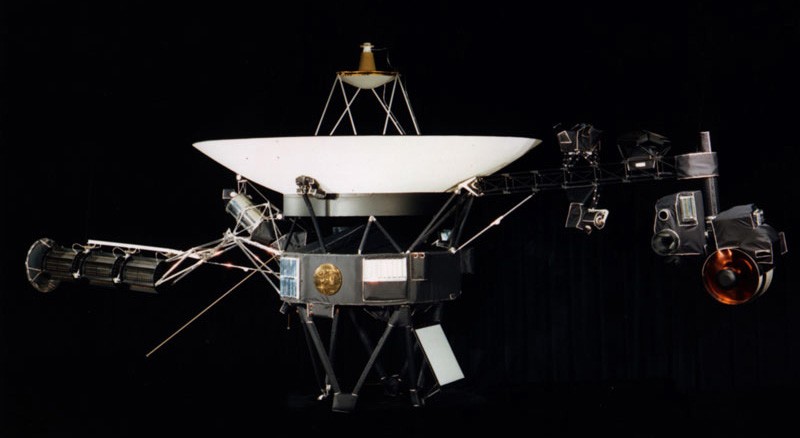
Voyager 1 is not merely a distant beacon. It remains an active science platform, measuring magnetic fields and plasma in interstellar space — the only direct observations humanity has from beyond the heliosphere.
But the celebration is tempered by a fresh communications problem: since November 14 the spacecraft has stopped sending science and engineering data, transmitting only a carrier tone that confirms its antenna still points toward Earth.
A data gap with a familiar pattern
Engineers detected the issue after a Deep Space Network antenna in Canberra locked onto the carrier signal but received no formatted data. The fault likely lies in the onboard computer that packages measurements from the remaining instruments for transmission. The spacecraft’s attitude control and radio hardware appear healthy, since the carrier tone remains steady.
This echoes a 2023 episode when Voyager 1 sent a carrier signal without data. That problem originated in one of the onboard computers, and the mission’s engineering team is drawing on their experience fixing that earlier fault to guide the current response.
Complicating the diagnosis, a 48-hour communications blackout occurred in October; the probe resumed normal operations until the November 14 interruption. With a 48-hour round-trip light time, each troubleshooting cycle consumes days, and engineers expect the investigation to take weeks.
Power dwindles as instruments shut down
Voyager 1’s radioisotope thermoelectric generators, fueled by decaying plutonium, lose power over time. Mission managers have already shut down instruments to stretch the supply; in April 2026 another science subsystem was powered off.
The probe now runs on a shrinking subset of its instruments, with magnetic field and plasma detectors still receiving power.
Projections suggest Voyager 1 could lose the ability to communicate with Earth around 2029, followed by Voyager 2 roughly two years later. Until then, the twins remain the sole sources of in-situ measurements from the interstellar medium, capturing the Sun’s influence far beyond the heliopause — a boundary Voyager 1 crossed in 2012 and Voyager 2 in 2018.
Early this morning (Nov. 18, 5:16 a.m. ET), the Voyager 1 spacecraft officially traveled one light-day from Earth! Learn what Voyager is revealing about our corner of the universe and how NASA keeps a nearly 50-year-old mission running >> https://t.co/tJaepd1aGO pic.twitter.com/TJMkcl4HA2
Science that keeps rewriting the textbook
“One big surprise is the extent to which our Sun continues to affect interstellar space, all the way out to Voyager 1. Where does the Sun’s influence end and pristine interstellar space begin?” said Linda Spilker, Voyager project scientist at JPL.
Jason Rhodes, chief scientist for astrophysics at JPL, put the distance in perspective: “To put this in some perspective, the sun is about eight light-minutes away from the Earth,” he told PBS NewsHour. “It’s a real testament to the engineering on the Voyager side that a spacecraft launched almost 50 years ago continues to operate. And not just operate, it’s making breakthrough scientific discoveries.”
After nearly 50 years, Voyager 1 has traveled more than one light-day from Earth. Hear about what the Voyager mission has taught us about our solar system—and beyond—in the newest episode of our Curious Universe podcast: https://t.co/myZespHoPz pic.twitter.com/bRi1iaSWCs
Those discoveries include the first detection of volcanic activity beyond Earth — on Jupiter’s moon Io — and the revelation that the Sun’s magnetic field shapes the interstellar environment. “Voyager is not anywhere near the end of telling us about the universe,” Rhodes added.
A generational handoff at mission control
The mission’s human side is also crossing a threshold. Merav Opher, a Boston University professor who joined the Voyager team, traveled to New York on Tuesday to light the Empire State Building yellow — a nod to the Golden Records included in Voyager probes.
Video: @NASAWatch editor @KeithCowing spoke with @DeutscheWelle about the #OneLightDay milestone that #interstellar starship Voyager 1 has achieved. https://t.co/FFF4HmuhbG
Opher described the moment as a baton pass from the original engineers to a new, more diverse generation. Edward Stone, who oversaw the Voyager program from 1972 until his retirement in 2022, died two years ago.
The immediate priority is restoring telemetry. Engineers will continue sending commands — each a day-long shout into the dark — and waiting 48 hours for a reply.
Meanwhile, the spacecraft coasts onward at roughly 38,000 mph. Reaching the inner part of the cloud will take about 300 years, and perhaps 30,000 years to exit it entirely.
In around 40,000 years the probe will pass at about 1.7 light-years from the star Gliese 445.
Founded by Caltech researchers in 1936, the Jet Propulsion Laboratory traces its origins to rocket tests in the Arroyo Seco by a group known as the “Suicide Squad.” The laboratory built and operates NASA’s Deep Space Network, the global antenna array that maintains the 48-hour round-trip link with Voyager 1.
JPL was transferred to the newly formed NASA in December 1958, becoming the agency’s primary center for planetary spacecraft and launching the first U.S. satellite, Explorer 1, just months earlier.
Shining bright across the solar system! On Nov. 18, the Voyager 1 spacecraft will pass an extraordinary milestone, a distance reached by no other human-made object: one light-day away from Earth. And we're celebrating with a special message for the spacecraft! pic.twitter.com/CHgYMKrbhL
For now, the carrier tone persists — a heartbeat from the farthest outpost humanity has ever built. “It has taken decades of exceptional engineering to get Voyager 1 to the one light-day milestone, and hopefully much further before the mission ends,” said Suzanne Dodd, Voyager project manager.
“One of the reasons that one light-day is so special is that it has never happened before that we were in contact with a spacecraft at this distance, and it may never happen again.”
If you'd like to know where Voyager 1 is right now in the sky: pic.twitter.com/wdnksvkLCp
Related reading

Indonesia Apologized for the Haze on Saturday
Indonesia apologized for the haze on Saturday; by Thursday a former Malaysian finance minister was demanding $3.16 billion...

Meta Removes Children’s Health Defense Posts After Guardian Investigation
Meta let an anti-vaccine group back onto Facebook and Instagram this year, then started pulling its posts down...

Eurogamer: 34 Fired Rockstar Staff in GTA 6 Credits; Six Listed as Current Employees
All 34 Rockstar employees dismissed last October now appear in the Grand Theft Auto VI credits, while a...

Fire Spreads From Apartment to Cafe Calactus, Closes Streets, Cuts Power
"By the time our crews arrived on scene, the fire was running up the side of the building...