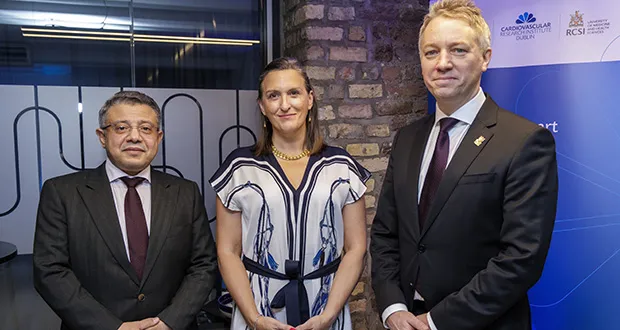
Ireland’s only dedicated cardiovascular research centre has opened a new Dublin 2 office to expand operations, bringing clinical trials, AI-enabled imaging, and patient outcome data under one roof.
The Cardiovascular Research Institute aims to meet an unmet need for cardiovascular research in the country. The institute comprises a team of 30 researchers working alongside more than 45 consultant cardiologists across Dublin and Cork.
“When Mater Private established CVRI Dublin in 2019 with RCSI, our aim was to integrate advanced clinical research into the everyday treatment of patients with cardiovascular disease,” said Prof Robert Byrne, CVRI director and consultant cardiologist.
“Patients put their trust in us, and we repay it through safer care, access to new therapies in our clinical trials, and research that improves treatment in Ireland and worldwide. This new building is a launch pad for our next phase, and for a coordinated network for cardiovascular research across Ireland and further afield,” Byrne said.
Part of the institute’s mission involves partnering with Irish medical technology innovators to develop devices aimed at improving cardiovascular health outcomes. One such partner is CroíValve, which has developed a device designed to repair the heart’s tricuspid valve without the need for open-heart surgery.
Around 40 patients have been treated so far, with ongoing studies in the US. By collaborating with the institute’s PRECISE Core Lab for image-based patient evaluation, CroíValve is transitioning toward artificial intelligence-driven assessments to ensure every individual receives the most appropriate device.
The PRECISE Core Lab, led by Prof Osama Soliman, combines imaging analysts and AI engineers to provide regulator-ready analysis for international clinical trials. Having published their findings in the New England Journal of Medicine this year, the group is now working on an AI-driven cardiovascular ‘digital twin’, which serves as a virtual replica of a person’s heart.
Aside from creating new devices, the institute leads clinical investigations like CYCLOPES, an RCSI-backed trial spanning 25 European locations focused on optimal management for severely calcified coronary arteries. During the COVID-19 pandemic, the SETANTA project enlisted general practitioners to offer cardiac MRIs to all individuals who had tested positive, rapidly disproving fears that the virus led to extensive, permanent cardiac scarring.
“While other people were still formulating the question, we were already moving on to the answer,” said Prof Byrne.

Indonesia Vice President Gibran Rakabuming Raka Resigns
Indonesian Vice President Gibran Rakabuming Raka announced his resignation on Thursday, ending a political crisis. If Gibran had...

Adobe and Google Expand Partnership to Link AI and Creative Tools
Adobe and Google announced an expanded strategic partnership at Adobe MAX in Miami on Tuesday linking major document...
Wheat and Rye Bran Hydrogels Enable Targeted Colon Drug Delivery
Wheat and rye bran fibers could soon help transport targeted colon disease treatments through the human gut, according...

Dublin Travel Disruptions: Road Closures and Security for EPC Summit
Fifty political leaders are descending on Dublin today for the European Political Community (EPC) summit, triggering the largest...